Coordinating With GMs to Preserve Foreshadowed Arcs in Editing
The Foreshadowing Problem in Actual Play Production
Foreshadowing in improvised actual play is different from foreshadowing in scripted media. A TV showrunner plants a hint in episode two knowing exactly when and how it pays off. A GM in an actual play session plants a hint that might pay off — or might not, depending on what the players do, how the story develops, and whether the hint even registers with the table.
The problem for producers is that they can't tell the difference between intentional foreshadowing and interesting improvisation that isn't going anywhere. Both can look identical in the recording. The GM knows which is which. The editor doesn't. GM plot coordination and producer-GM collaboration are what close that gap — and editing foreshadowing correctly is impossible without the structured handoff those workflows create.
Foreshadowing planted in early sessions only pays off if it survives editing. When the editor cuts a scene because it seems like flavor rather than plot, and that scene contained the only hint that Lord Thadderon's true identity was telegraphed in episode eight, the GM's carefully laid plan collapses. The audience arrives at the reveal and feels nothing because the setup isn't there.
Actual play production emerged from informal frameworks, and lack of formal GM-editor coordination is endemic to the medium. The shows that avoid this problem don't have better instincts — they have better systems.
The cost of the foreshadowing gap is also asymmetric. An editor who protects a moment that didn't need protecting costs a few extra seconds of runtime. An editor who cuts the only planted hint for a major arc payoff costs the audience the emotional impact of a reveal that should have been earned. The asymmetry strongly favors over-protection — but over-protection without a system produces bloated episodes. The coordination protocol is what allows precise protection rather than blanket over-caution.
The GM-Producer Coordination Protocol
StoryTransit treats foreshadowed arcs as routes with future terminals. The GM knows the destination; the producer's job is to make sure every stop along the way survives the editing process. The coordination protocol creates a shared document of intent between the GM and the production team.
The protocol operates at three points in the production cycle.
Pre-session arc intent briefing. Before recording, the GM flags any moments they intend to plant as foreshadowing. This doesn't need to be detailed — a one-line note per planted hint is enough. "I'm going to have the compass react oddly to Lord Thadderon's name tonight — this matters later." The producer logs this in StoryTransit as a foreshadowed arc with no current payoff timeline.
TV showrunners lay groundwork for future arcs in pilots with explicit future-payoff documentation. TV writers' rooms assign arc beats with explicit future-payoff documentation to preserve intent. The GM-producer briefing is the actual play equivalent of that writers' room process — a structured moment where narrative intent is transferred from the GM's head to a shared document. The briefing doesn't need to reveal the full arc plan — just enough for the producer to know which moments are load-bearing.
Post-session foreshadowing capture. After recording, the GM and producer run a targeted debrief: did any unplanned moments emerge that now feel foreshadowing-worthy? GMs often improvise hints that are only recognized as meaningful in retrospect. Capturing these immediately after the session — while the GM can still identify them — prevents them from getting lost before the edit. This post-session capture is often where the most valuable foreshadowing gets documented, because the best moments in actual play are rarely the ones that were planned.
Pre-edit foreshadowing brief. The editor receives a specific document listing every live foreshadowing plant: what moment it is, where it appears in the recording (with timestamp), and what future arc it supports. This is separate from the general pre-edit brief — it's a protected-scenes list specifically for narrative intent. Any flagged moment requires producer sign-off before it can be cut. The timestamp anchor is critical — an editor who can jump directly to the flagged moment spends thirty seconds assessing it instead of thirty minutes hunting.
Maintaining Foreshadowing Across a Long Season
The coordination protocol above handles individual sessions. For shows running 40+ episodes, foreshadowing preservation requires additional practices.
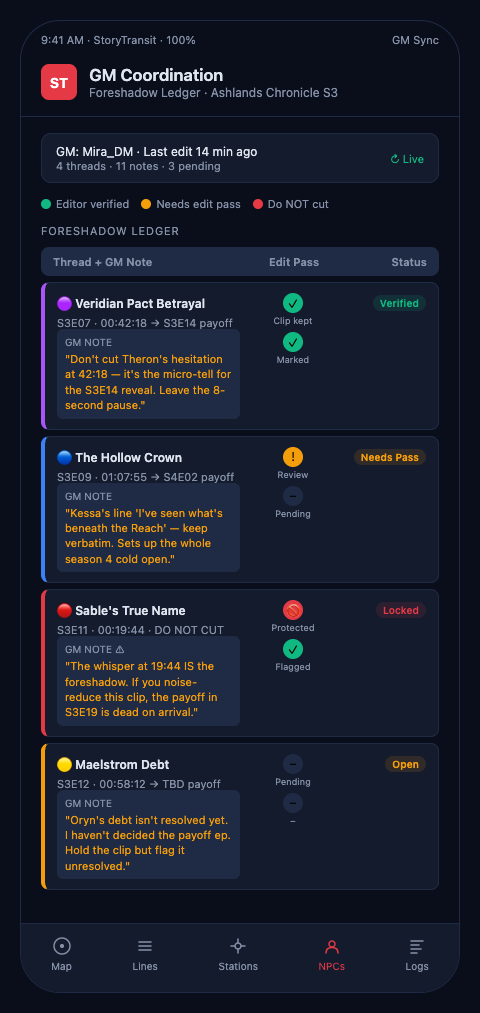
The foreshadowing ledger. Maintain a running log of all active foreshadowing plants: episode of origin, the moment planted (with timestamp), the arc it belongs to, and payoff status (open, approached, resolved). This is not the same as the arc status dashboard — it's specifically a hint-level document. Some arcs have five separate planted hints; the ledger tracks each one. Writers' rooms maintain shared story documentation that serves exactly this purpose. For an actual play show past episode 25, the ledger is also the quickest way to answer the question "have we set this up enough?" before a major revelation airs.
GM check-in at season midpoint. At the halfway point of a season, the GM reviews the foreshadowing ledger and confirms which plants are still live, which have been superseded by story developments, and whether any payoffs are approaching. This mid-season check-in catches plants that have been forgotten by the GM as well as the production team. A foreshadowing plant that the GM has mentally abandoned but hasn't communicated to the producer is a continuity trap — the producer is still protecting scenes that no longer matter while potentially missing plants that do.
Foreshadowing density review. Periodically, the producer reviews the ledger and checks whether specific arcs are underprepared. If a major reveal is five episodes away and only one hint has been planted, the GM needs to know. The ledger makes this visible. Screenplay foreshadowing requires enough planted hints to make the payoff feel earned — one hint is fragile, three hints is structural.
Foreshadowing decay protocol. Some planted hints naturally expire — the story went a different direction, the player whose character was supposed to encounter the payoff left the table, or the GM decided the arc wasn't working. These plants need to be formally retired rather than just quietly dropped. The production team should know when a foreshadowed arc is being abandoned so they can remove its protected-scene flag and stop treating those scenes as load-bearing.
A practical note on the foreshadowing ledger format: the simplest version is a table with five columns — episode number, timestamp, the planted hint (one line), the arc it belongs to, and status. This can live in a shared doc alongside the arc status dashboard. The key distinction from the arc dashboard is granularity: the arc dashboard tracks arcs at the thread level, while the foreshadowing ledger tracks at the hint level. An arc with three planted hints has three rows in the ledger and one row in the arc dashboard.
The coordination skills here connect directly to how you track broader character development over time. Character arcs mapping covers the full arc tracking process across a long season, which provides the scaffolding that foreshadowed arc coordination operates within. For shows with returning special guests, guest character arcs addresses the specific coordination challenges that arise when foreshadowing needs to be preserved across production gaps. Producers coordinating around long-form plot structures in other formats will find parallels in 48-hour plot beats, where similar pre-event coordination preserves intended story beats during a live format.
Why This Coordination Is Non-Negotiable
The GM-producer relationship in an actual play podcast is the closest analog to the showrunner-writer room relationship in TV production. Shared story-breaking software preserves foreshadowing through post-production phases. The actual play production team needs the same protection mechanism.
The podcast production software market reached $1.8 billion in 2024, with narrative coordination features driving growth in the serialized segment. The market is catching up to what actual play producers have needed for years.
The shows that handle foreshadowing well don't have GMs with better narrative instincts — they have GMs who know their production team will protect the setups they plant. That trust loop is created by the coordination protocol. When the GM knows that the moment they flag will be protected through post-production, they invest more care in crafting the hint. When the producer knows what to protect, they can give the editor precise guidance rather than vague instructions to be careful. The coordination system is what makes the creative trust possible.
There's also a listener-facing dimension that producers sometimes underestimate. Audiences at the high-engagement end of an actual play community are actively tracking foreshadowing. They post theories, they catalog planted hints, they celebrate when a payoff lands that they called three episodes ago. When a planted hint gets cut and the payoff lands without its setup, those listeners notice — and the conversation that follows ("wasn't this set up earlier?") can undermine the reveal for the broader audience. The coordination protocol protects not just the story but the community engagement built around anticipating it.
For actual play podcast producers managing the arc preservation workflow across a long season, the pre-session briefing, post-session capture, foreshadowing ledger, and mid-season check-in create a continuous loop that keeps narrative intent current from one episode to the next. StoryTransit's GM-producer coordination tools are built around this protocol. Actual play podcast producers who want to protect the story their GM is building can join the waitlist. Join the Waitlist for Actual Play Producers and start coordinating with your GM at the level the story deserves.