Scheduling Plot Beats Across a 48-Hour Live-Action Event
The 48-Hour Scheduling Problem
Most LARP scheduling advice is written for events with a clear beginning and end — a run-of-show document, a final scene, done. A 48-hour event does not have that shape. Players sleep in shifts, runners rotate, and the story continues without a pause. A plot beat scheduled for 2 a.m. Saturday needs costumed volunteers who are awake, runners who are coherent, and players who are still engaged enough to make it matter.
The sleep deprivation problem is real and specific. Twenty-four hours without sleep impairs cognitive function to a degree equivalent to a blood alcohol level of 0.10%. The consequences of sleep deprivation on cognitive performance – PMC Runners making live plot decisions after hour twenty are not operating at the same standard as runners at hour two. Partial sleep deprivation across five consecutive nights compounds further, reducing data-gathering quality before decisions. Effects of Total and Partial Sleep Deprivation on Reflection Impulsivity – PMC For 48-hour LARP scheduling, this means your overnight beat block needs to be the lowest-complexity narrative window — not the climax.
Multi-day festival scheduling must manage attendee energy, narrative arc, and moving parts simultaneously. 7 Essential Tips for Multi-Day Festival Scheduling A run-of-show is a minute-by-minute roadmap — but on a 48-hour event, the narrative arc across time is the structural constraint that the run-of-show must serve, not the other way around. Daily Schedules and Run-of-Show Management for Festivals
The other dimension that 48-hour scheduling adds is the problem of story coherence across a sleep break. Players who go to sleep on Friday night will wake up Saturday morning with memories of events that occurred before they slept, and will need to be reoriented to story state that evolved during the night. If no significant story beats fired while they were asleep, they wake up in the same story world they left. If major beats fired and they missed them, they need a catch-up mechanism that does not break immersion for players who were present. Design your overnight beat block with this in mind: events that are discoverable and reconstructable, rather than events that create a knowledge gap that cannot be bridged.
Resource scheduling across parallel tracks — including story beat scheduling across parallel plot lines — requires constraint-aware planning methods that account for shared resources. Resource-constrained multi-project scheduling problem: A survey For 48-hour LARP scheduling, the shared resource is your NPC pool. Build your beat schedule against your available volunteer hours, not against an idealized story structure.
A Transit Framework for 48-Hour Plot Beat Scheduling
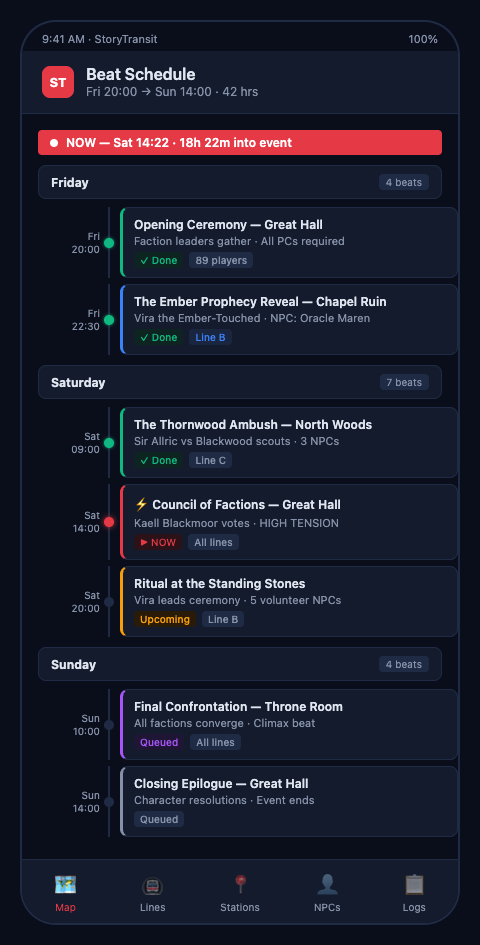
StoryTransit models the 48-hour event as a transit system running continuous service across three distinct operating windows: high-intensity day service, low-intensity overnight service, and peak morning service. Each window has different passenger volume, different NPC availability, and different runner energy — so each window needs a different type of story beat.
Day 1 afternoon — introduction beats. These stations establish active plot lines, introduce key NPCs, and give players orientation within the story. They should be high-energy, well-staffed, and scripted in enough detail that even a moderately tired costumed volunteer can deliver them cleanly. This is when you run your six NPC encounters that require the highest dramatic precision, because your volunteers are fresh and your runners are sharp.
Day 1 evening — escalation beats. Story complications increase. Faction tensions that were introduced in the afternoon now have a triggering event. These beats require active runner monitoring but not necessarily high NPC count. They work well with player-driven scenes that require minimal staff facilitation — players who have found their footing in the world are now running their own subplots with occasional runner injection.
Overnight (11 p.m. to 7 a.m.) — ambient and discovery beats. This is the lowest-complexity narrative window. Dormant stops activate for players who are awake and exploring — environmental discoveries, quiet character-to-character scenes, low-stakes subplot advances. Costumed volunteers run on a reduced rotation. Runners do not schedule major story beats in this window; they maintain the live-action timetabling so that nothing goes off-script and the morning shift can pick up cleanly.
Day 2 morning — reactivation beats. Players who slept through the night return to find story state has advanced. The morning block reorients the full player base to the current plot status and activates the story beats that require maximum player engagement. This is where you place the beats that depend on broad participation — faction negotiations, public reveals, large-scene confrontations.
Day 2 afternoon — resolution beats. Final station activations, conclusion of active plot lines, and setup for whatever carries forward to the next event. These beats should be achievable regardless of which plot adjustments have accumulated across the prior 30+ hours. Build in two or three alternative resolution paths so the story can end cleanly even if some threads are behind schedule.
Linking this to your plot station map gives you a physical overlay that runners can use to route between story beats — critical when the venue spans enough territory that a 20-minute walk separates one plot cluster from another. Planning your NPC schedules festival-style rotation alongside the beat schedule prevents the situation where the right story beat activates but the costumed volunteer assigned to it is off-shift.
Advanced Tactics for Continuous Event Pacing
Once the basic five-window framework is established, more refined scheduling practices become available.
Buffer stations between major beats. On a 48-hour event, story beats rarely fire on schedule. Build explicit buffer windows — stations that can activate or skip based on whether the preceding beat resolved cleanly. A buffer station is not dead time: it is a flexible NPC interaction or environmental discovery that advances a minor subplot if the major beat is running late, or can be bypassed if the major beat resolved ahead of schedule. This maintains continuous event pacing without forcing runners to make high-stakes improvisational decisions.
Schedule runner rest with the same discipline as story beats. Remote multi-day events need scheduled check-in windows to maintain coordination, and runner rest is as operationally critical as NPC deployment. Incident Command in the Backcountry: Adapting ICS for Remote Festivals Build the runner rotation into StoryTransit alongside the beat schedule. Assign every overnight beat block a specific runner who is rested and scheduled for that window rather than whoever is still awake.
Design plot beats for the energy of the window they occupy. Flow state in live performance requires a challenge-skill match — when the challenge exceeds the current skill or energy level, quality perception drops. The experience of the flow state in live music performance Scheduling complex, multi-faction negotiation beats in the 3 a.m. slot violates this principle even if your volunteers are technically awake. Match beat complexity to available human energy, not just clock position.
How editors coordinate foreshadowed arc coordination across long-form productions — ensuring setup beats pay off across many sessions — mirrors the 48-hour scheduling challenge. The setup beats in your afternoon block need to pay off in the morning block, regardless of what happens overnight. Building those payoff connections explicitly into your station records prevents the story from losing coherence across the sleep break.
Schedule for the Night Shift
A 48-hour LARP that feels coherent to players across the full runtime is one where the event plot timeline was designed around human energy curves, not just narrative logic. The story beats that fire at noon on Day 2 need to be worth the wait for players who have been in the story since Friday afternoon.
There is a pacing principle worth building into your 48-hour live-action timetabling: the perceived length of the event correlates more strongly with story density than with clock time. A four-hour block with two major beats, active NPCs, and player-driven subplot activity feels shorter and more satisfying than a four-hour block with one minor beat and long ambient stretches. This means your scheduling goal is not to distribute beats evenly across time — it is to maintain a story density floor that keeps players engaged throughout the runtime, with intentional low-density windows during overnight and during natural rest periods.
StoryTransit tracks story density as a function of active stations per time window. When your beat schedule shows a four-hour window with only passive activity, it is a signal to either schedule a dormant stop activation or reposition a mobile NPC encounter into that window to maintain density. The 48-hour event plot timeline is a living document that runners adjust as the event runs — not a fixed schedule that everyone executes regardless of what the story is doing.
StoryTransit gives LARP event organizers a 48-hour scheduling framework built into the plot dashboard — beat blocks by window, runner assignments by shift, and dormant stops that activate on condition rather than clock. If you are planning a continuous live-action event and need a live-action timetabling system that accounts for everything that changes between setup day and teardown, join the waitlist for LARP organizers.