Managing NPC Schedules Across a Three-Day Festival LARP
Why Three-Day NPC Management Is a Different Problem
A single-day LARP with eight costumed volunteers is a scheduling problem you can manage with a shared document and good communication. Add a second day, and you introduce shift rotation, fatigue accumulation, and the reality that volunteers who were sharp on Friday afternoon may be significantly less effective by Sunday morning.
Add a third day and you have a different category of problem. Festival staffing is the make-or-break element of multi-day events — labor shortages and no-shows derail three-day events at a much higher rate than shorter formats because the margin for error shrinks as the event progresses. Staffing and Labor Guide – Festival and Event Production Communication breakdowns and skill mismatches are leading causes of event staffing failures specifically at the multi-day scale. 5 Event Staffing Challenges in 2025 & How to Solve Them
The specific NPC schedule management failure mode at three-day festival LARPs looks like this: a costumed volunteer who was briefed on their role at the Friday morning session has forgotten half of their briefing by Saturday afternoon. The runner who gave that briefing is on a different rotation and unavailable to re-brief. The volunteer improvises. The improvisation is close enough that no runner notices, but the plot thread dependent on that scene now has an incorrect premise embedded in it that will surface awkwardly on Sunday.
This is not a volunteer quality problem. It is a system design problem. NPC cognitive performance degrades significantly by day three without scheduled rest blocks — this is a physiological reality, not a commentary on commitment. The consequences of sleep deprivation on cognitive performance – PMC The NPC schedule management framework needs to account for this, not expect volunteers to overcome it.
A Transit Model for Three-Day NPC Scheduling
StoryTransit models NPC schedules the way a transit authority models crew deployment. Drivers do not run continuous service — they work assigned shifts, have rest minimums, and cannot be redeployed to unfamiliar routes without a route briefing. Costumed volunteers follow the same operational logic.
Here is the three-day NPC planning framework:
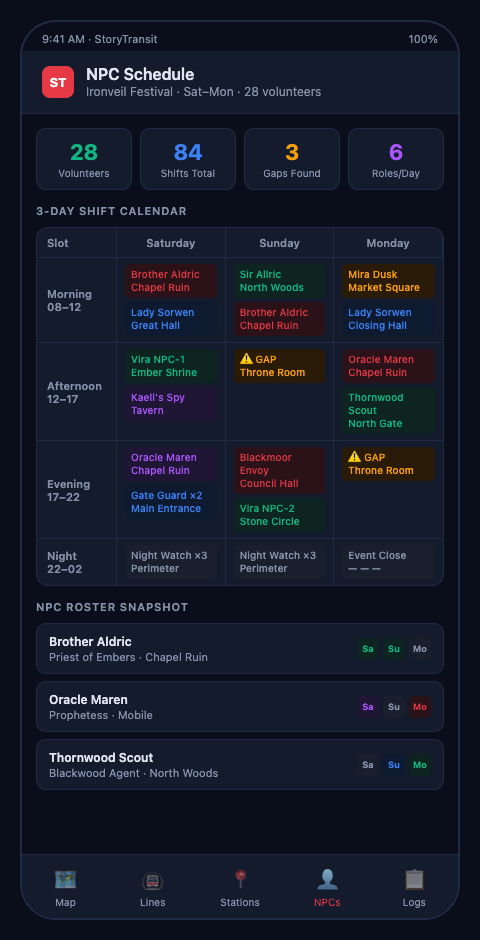
Day-block shift structure. Divide the three days into six shift blocks: Day 1 morning, Day 1 afternoon/evening, Day 2 morning, Day 2 afternoon/evening, Day 3 morning, Day 3 afternoon. Each NPC is assigned to a maximum of four shift blocks across the event — two consecutive, one off, two more, one off. This ensures every volunteer has mandatory rest built into the schedule rather than relying on them to self-manage fatigue. Event Staff Scheduling for Large Events – Shiftboard
Plot-line pairing by shift block. Assign each shift block a set of active plot lines, and assign NPC roles per shift block rather than per individual. This means the volunteer running the werewolf role on Day 1 afternoon may hand off to a different volunteer for the Day 2 morning version of the same character. Each handoff requires a written briefing document — not a verbal summary — that covers: current scene state, what the character knows, what has already been revealed to players, and what the next story beat requires. Designing the Volunteer Experience
Master production schedule tracking. A master production schedule that tracks every facility element across all three days is the standard for professional festival operations. Creating a Master Festival Production Schedule For NPC schedules, this means the festival event staffing plan lives in a single document that every runner can query: who is on which role, in which shift block, with what briefing status, and what their rest window is. StoryTransit maintains this as a living record — when a volunteer no-shows, the available-NPC column shows immediately who can cover and what briefing they will need.
The extended LARP logistics of three-day NPC management connect directly to the pre-event work of assigning NPCs to plots systematically. Plot-role assignments made pre-event become the input to the shift-block schedule — you cannot build a three-day NPC rotation without knowing which roles need to be filled for which plot lines. The downstream challenge of keeping runners informed about NPC status across shifts is covered in the NPC team communication practices that make handoff information reach the right people at the right time.
Advanced Multi-Day NPC Planning Practices
Once the shift-block structure is established, more sophisticated NPC management becomes practical.
Tiered briefing depth by shift block. Not every shift block requires a full re-briefing. Design three briefing tiers: full briefing (new volunteer to the role — 15 minutes), continuation briefing (returning volunteer who was last active more than 12 hours ago — 5 minutes), and status check (returning volunteer who was last active within the same day — 2 minutes). This prevents the situation where briefing overhead consumes runner time at every shift transition while also ensuring no volunteer goes into a scene without current plot status.
Reserve NPC capacity across all three days. Large-scale events like Profound Decisions' Empire production run 400+ crew across distinct teams with assigned coordination responsibilities. Profound Decisions – Event Crew The operational principle is that reserve capacity is structured into the crew deployment, not improvised from whoever is standing nearby when a gap appears. For three-day festival LARPs, this means planning for 15-20% NPC capacity above your minimum requirement for every shift block, and designating specific volunteers as floaters who can cover any role in their assigned plot-line cluster.
Debrief NPC performance by shift block, not by event. Post-event debriefs accumulate too much distance from the specific scenes that need review. Run a five-minute NPC debrief at the end of each shift block — what worked, what was unclear, what information the incoming shift needs immediately. This connects to the broader forum combat rounds pacing challenge in asynchronous game management: information that should flow between participants in real time cannot be batched without accumulating drift. LARP NPC handoffs have the same property.
Track NPC role saturation across the weekend. Some NPC roles carry high emotional or physical intensity — the villain who takes confrontations, the NPC delivering grief scenes, the combat-intensive creature roles. Track how many consecutive shift blocks a volunteer has spent in a high-intensity role and build in mandatory low-intensity shift blocks before they return. Volunteer experience must be designed intentionally to prevent burnout. Designing the Volunteer Experience
Build a no-show contingency protocol before day one. At multi-day events, volunteer no-shows happen at a higher rate than single-day events — travel problems, illness, and life events accumulate over three days. Your NPC schedule management plan should include a documented no-show protocol: which roles can run short, which cannot, and which floater volunteers are cleared to cover which specific role types. When a no-show happens on Saturday morning, the runner checks the protocol rather than improvising a coverage solution mid-event. This keeps the production communication clean and prevents a cascade of improvised decisions that leave the rest of the weekend structurally compromised.
A master festival production schedule should track every facility element and crew assignment across all three days. Creating a Master Festival Production Schedule For NPC schedule management specifically, the master schedule becomes the single source of truth for the whole runner team — who is on, who is off, who is a floater, and what briefing status each volunteer holds going into each shift block.
Build the Rotation Before You Announce the Event
LARP event organizers who build their three-day NPC rotation before opening player registration find that staffing problems surface in planning rather than on the venue. When the master production schedule shows that Day 2 afternoon needs twelve costumed volunteers but you only have nine committed, you still have time to recruit. When that gap surfaces during runtime on Saturday, you are improvising under pressure.
There is one more scheduling reality that three-day festival LARPs force into view: the NPC experience is itself a product. Volunteers who have a clear schedule, adequate rest, meaningful role continuity, and a debrief process that makes them feel heard will return for your next event. Volunteers who experience disorganization, last-minute role changes, and unclear briefings will not. Multi-day NPC planning is not just operational logistics — it is volunteer retention.
Build a post-event feedback mechanism specifically for NPC volunteers, separate from the player feedback process. Ask about briefing clarity, rest adequacy, role assignment fairness, and communication quality. The answers will identify exactly which components of your NPC schedule management framework need improvement before the next event. Over two or three event cycles, this feedback loop produces a volunteer team that is progressively better prepared and progressively more likely to staff your events at scale.
StoryTransit gives festival event staffing planners a shift-block assignment dashboard that integrates with your plot station map — so NPC deployment and story beat scheduling are visible in the same system. If you are planning a three-day festival LARP and want a multi-day NPC planning framework that accounts for fatigue, handoff, and reserve capacity, join the waitlist for LARP organizers.