Managing Combat Rounds Across a Week of Forum Posts
Why PbP Combat Breaks Down
PbP combat is the format's most commonly cited failure point. Pbp combat management requires structural solutions that turn-based forum encounters simply don't need from a synchronous RPG system. Asynchronous forum combat without pacing structures routinely spans weeks per round, killing tactical momentum. At one-post-per-day pace, a six-person combat encounter takes six weeks to complete a single round — and that's an optimistic estimate that assumes every player posts within their window.
Managing the one-post-per-day documentation discipline during combat is where most GMs fall behind: combat generates more state to track per post than any other scene type, and the documentation overhead compounds faster than the GM expects when they're also writing round-state summaries and monitoring skip timers. The tactical problem is compounding. A player posting their character's action on day four has to reconstruct the battlefield state from three earlier posts, two of which reference positions established in a previous round they may not clearly remember. Combat systems designed for synchronous play require all participants to hold the same mental model simultaneously — a model that evaporates over days of asynchronous posting.
The emotional problem is equally damaging. High-excitement scenes must move fast to sustain engagement; slow-resolving mechanics break player immersion in combat specifically. Combat is supposed to create tension. A six-week round is the opposite of tense. Players who joined your forum game for the slow-burn narrative experience will tolerate slow combat for a while, then start skipping turns, then stop posting.
Activity gaps in co-play events predict guild member churn. The same pattern appears in PbP: combat rounds that stall cause the players not currently in their turn window to disengage from the campaign more broadly. Combat pacing isn't just a combat problem — it's a campaign retention problem.
The Combat Station Framework
StoryTransit maps combat as a rapid-transit sequence: each round is a station, each turn is a stop, and the GM's job is to keep the train moving without waiting indefinitely at any single stop.
The framework has three structural components:
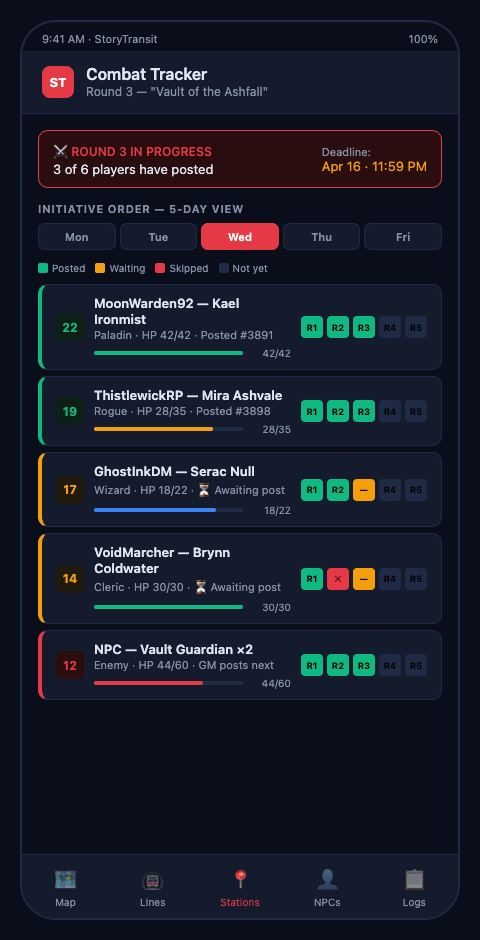
Round-state posts. After each complete round, post a round-state summary as a standalone IC or OOC post. This post contains: current initiative order, each character's position and condition, any environmental changes from the round, and the one tactical question each player faces at the start of the next round. This is the station announcement — players boarding the next round don't need to trace back through the round to find their situation.
The round-state post solves the tactical reconstruction problem. Players who posted early in a round and are now waiting for their next turn see exactly what the battlefield looks like before they post. Players who missed a round can catch up from the round-state post without rereading the full thread.
Turn windows with skip logic. Define explicit turn windows — typically 24 to 48 hours per player — with published skip logic. If a player doesn't post within their window, their character takes a defined default action (hold position, defend, delay) and the round continues. Publish this rule before combat starts, not during it.
Turn-based systems designed for asynchronous play require explicit time-boxing per decision to prevent abandonment. The skip logic removes the structural incentive to wait: combat continues regardless of whether all players post, which means players who do post don't lose engagement watching the round stall on someone else's turn.
Combat state tools. For complex encounters, external state tracking reduces the reconstruction burden on both GM and players. Roll20's initiative tracker and turn-order tools let PbP GMs log combat state between posts — a visual reference that players can consult rather than reconstructing from text. A screenshot of the initiative tracker embedded in each round-state post creates a persistent visual anchor for the tactical situation.
StoryTransit's play-by-post thread pacing model treats combat not as a departure from the story map but as a compressed segment of it: high-station density, short intervals between stops, explicit state at each round boundary. Weekly player posting expectations need to be stated explicitly before combat begins — if your campaign's baseline expectation is one post per day, a combat encounter with six participants requires every player to post within their 24-hour window or the round stalls. Players who don't know this in advance treat the combat like any other IC thread, and the round takes three weeks instead of six days.
Advanced Tactics: Compressing Combat Without Losing Tension
The six-week round problem is real, but the solution isn't to abandon tactical combat for narrative resolution. Players who chose a mechanically complex system for your forum game made that choice because they want the tactical engagement. Removing it entirely doesn't fix the pacing problem — it changes the game.
The better approach is selective compression. Not all combat phases are equally important. The opening round — positioning, initial actions, first surprise reveals — is narratively high-value and worth playing at full resolution. The middle rounds of a straightforward combat can be compressed: "Three rounds pass as the party systematically disables the guards. By round six, only the commander remains." The climactic final confrontation is worth full-round resolution again.
This is explicit narrative pacing applied to forum combat management: identify which rounds carry story weight and resolve those fully; compress the rounds that are primarily mechanical throughput.
For multi-thread campaigns where combat runs in parallel with other storylines, parallel forum storylines covers how to manage the velocity difference between a combat thread (which needs to move quickly) and a roleplay thread (which can breathe). Letting a combat thread run at full pace while roleplay threads wait creates structural imbalance across the story map.
For live-event comparisons, player beat tracking in LARP settings addresses the challenge of tracking player actions in real-time — a different format with the same underlying challenge: how do you maintain coherent state when participants are acting asynchronously? The round-state post discipline described above is the forum-native equivalent of the LARP runner's periodic state broadcast, adapted to an environment where the "broadcast" is a permanent archived post rather than a radio call.
Keep the Battle Moving
Pre-combat setup as the primary intervention. Most pbp combat management problems are created before the first round begins. GMs who run combat without establishing turn order, skip logic, and compression expectations at scene open spend the entire combat reacting to structural ambiguity instead of running an encounter. Five minutes of OOC setup before the first IC combat post — initiative order posted, turn windows declared, compression point pre-announced ("I'll compress rounds four and five if we're not at a climactic moment") — saves hours of GM intervention during the combat itself.
This setup also manages player expectations about the encounter's significance. Players who know upfront that this is a three-round skirmish that will compress after round two don't write elaborate tactical posts for round two — they write focused, efficient IC posts that advance the combat without over-investing in a mechanical throughput sequence. Pre-combat setup is the most leveraged GM action in forum combat management, with the lowest cost and the highest return.
Combat that stalls isn't just bad for momentum — it's a reliable campaign-ender. Players who lose tactical context across two weeks of turn-waiting don't re-engage with the scene; they start wondering why they're playing this particular game.
Narrative anchoring between rounds. The round-state post handles tactical context, but forum combat rounds also need emotional anchoring between mechanical updates. After every two to three rounds, include one sentence of narrative atmosphere in the round-state post — not a full IC post, just a line that reconnects the mechanical stakes to the story stakes. "The commander is bleeding from three wounds and still laughing" does more to maintain player investment than "Initiative: commander has 34 HP remaining." Players who have been tracking positions and actions across six days of posting need the occasional reminder that the combat is happening inside a story, not a spreadsheet.
Combat scope definition. One of the most consistent pbp combat management failures is scope ambiguity: the GM designed a skirmish and the players are playing it as a climactic battle. Or vice versa. Before a combat scene opens, post an OOC note that signals the encounter's narrative weight: "This is a major confrontation — expect six to eight full rounds" versus "This is a brief ambush — I'll compress after round two." This lets players calibrate their IC post investment. Players who write elaborate tactical posts in a two-round skirmish aren't making a mistake — they were never told the encounter's scope.
The round-state post, skip logic, and selective compression approach keep forum combat moving without sacrificing the tactical engagement players chose your game for. StoryTransit gives play-by-post forum GMs a combat thread architecture that tracks round state, preserves tactical context between posts, and integrates combat pacing with the broader story map. Join the waitlist for play-by-post GMs to see how the combat station framework fits your current encounter design.