Tracking Which Players Hit Which Story Beats Live
The Problem With Not Knowing Where Your Players Are in the Story
Your Sunday morning faction confrontation was designed to land hard. Three plotlines were supposed to converge: the players who learned about the betrayal on Friday night, the players who found the relic on Saturday afternoon, and the players who completed the werewolf curse arc by midnight Saturday.
Sunday morning arrives and twenty-two players show up to the confrontation. Eight of them have no idea what the betrayal is. Fourteen of them never found the relic. The scene plays out for the faction leads who did the work, and the rest of the attendees are confused bystanders at a story beat they weren't prepared for.
This is the player progression monitoring failure. The organizer didn't know, going into Sunday, which player groups had actually completed the prerequisite beats—because nobody was tracking LARP beat completion during the event. The Nordic Larp Wiki's entry on plot describes storylines as trackable player goals that can be "accomplished" during a larp. The word "trackable" is doing a lot of work there. Tracking requires a system.
Immersion and Shared Imagination research from Sarah Lynne Bowman identifies character immersion as the primary success metric larpers use. Missed story beats break immersion—not because of bad acting, but because the player arrives at a scene without the narrative context that makes it meaningful.
What Player Beat Tracking Tracks
Player beat tracking at a live LARP event is not the same as tracking NPC deployments or station completions. Those track whether a scene happened. Player beat tracking tracks whether specific players received and engaged with specific story information.
The distinction matters. An NPC can deliver a scene, mark the station as complete, and move on—while the players who witnessed it were focused on an unrelated conversation and absorbed nothing. The station log says the beat was delivered. The player log says the players who needed it weren't there.
For each major story beat, the player tracking log should record: which player group was present, whether they engaged with the beat's central information, and what state they're in as a result. That last element is the crucial one. A player who "completed" the relic discovery but only retrieved half the relevant information is at a different point in the arc than one who got the full scene.
The partial completion state is where most player beat tracking systems break down. It's easier to log binary complete/incomplete, but LARP story beats rarely work that way. A scene that involves a revelation, a challenge, and a player decision can be partially completed if the player received the revelation but missed the decision point, or made the decision but without understanding the challenge context. Logging partial completion with a brief note—"received item, did not hear NPC explanation"—gives dispatch enough information to send a follow-up encounter rather than assuming the beat is done.
Research on cognitive load and multi-task tracking from UCSB shows that tracking multiple concurrent tasks degrades accuracy significantly. Visual logging tools reduce cognitive load errors by externalizing the tracking rather than holding it in memory. Your dispatch station can't hold the player beat state of a hundred players in working memory. It needs a visual log.
Building the Live Player Beat Log
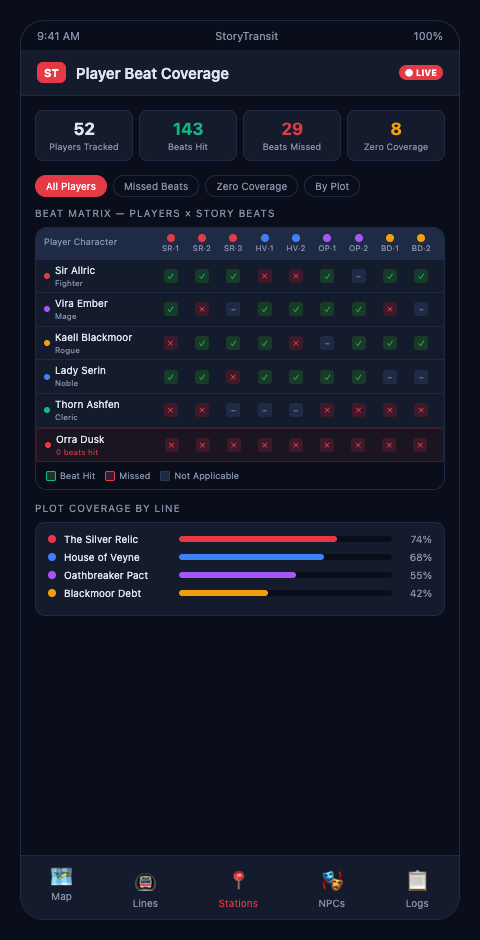
The live event logging format for player beats works as a matrix: plotlines on one axis, player groups on the other, stations as cells. When a player group completes a beat, that cell gets marked. When they skip or miss a beat, it stays blank. StoryTransit's player story beat tracking layer is built around this matrix format—LARP beat completion updates flow from runners in the field directly into the dashboard, giving dispatch a live view of player progression monitoring without requiring a dedicated logging clerk.
At runtime, the matrix shows you which player groups have completed the prerequisite beats for upcoming scenes—and which ones haven't. When you're thirty minutes from Sunday's faction confrontation, you can look at the matrix and see exactly which groups need a rapid-delivery catch-up beat to have the context they need.
For real-time beat tracking to function as a player monitoring tool, the matrix updates need to come from your runners in the field, not just from NPC reports. Runners who walk the venue and observe player engagement—not just NPC deployment—provide the human layer of verification that the station log can't supply.
Integrating Player Tracking With NPC Dispatch
The player beat matrix connects directly to NPC dispatch. When the matrix shows that a player group is behind on a plotline, the dispatch station's next action is clear: find the NPC assigned to that group's next station and route them to where the players are.
This is the operational connection between runtime logging basics and player tracking. The station log tells you what was delivered. The player log tells you who received it. The dispatch action closes the gap.
The FEMA NIMS ICS framework timestamps all logged events and provides real-time accountability across multi-team operations. Applied to player tracking at a LARP event, that means every player beat entry in your log has a timestamp and a location note. When you're diagnosing at Sunday's debrief why certain players missed the Sunday climax, you're reading a record rather than reconstructing from memory.
Scaling Player Tracking to Large Events
At a small LARP with thirty players and four plotlines, one organized person with a clipboard at dispatch can maintain the player beat matrix. At a hundred players across fifteen plotlines, you need structured runner reports and a dedicated tracking role.
The Larp Census 2014 establishes the scale of player populations that LARP organizers manage—29,751 larpers across 123 territories, confirming that multi-hundred-player events are standard. At that scale, player beat tracking requires deliberate systemization. What do adults who participate in LARP actually value from their experience? Survey research from Nordic Larp reveals that story beat types tied to character development drive the highest satisfaction and repeat attendance. Tracking which beats reach which players isn't administrative overhead—it's quality assurance for the experience you're promising.
Prioritizing Which Beats to Track
Not every story beat at a weekend LARP needs to be tracked at the player group level. A minor scene—a brief NPC interaction that provides flavor rather than essential story information—doesn't require a matrix entry. Tracking everything produces noise that obscures the signal.
Identify your tier-one beats: the story beats that are prerequisites for the Sunday climax, that introduce major characters or revelations, or that set up the decision points where player choices matter. These are the beats that must reach the intended player groups for the event to work as designed. Track these exhaustively.
Tier-two beats are scenes that enrich the storyline but aren't prerequisites. Track these when runners observe them but don't expend radio capacity specifically to confirm them. Tier-three beats are atmosphere and flavor. Don't track them at all.
The tier-one list for a typical weekend LARP should be fifteen to twenty beats across all major plotlines. That's the tracking scope that's operationally sustainable during a busy event.
The Runner Report Protocol
For player beat tracking to work at scale, runners need a standardized way to report player group status back to dispatch. Without a protocol, runner reports are inconsistent—some runners note player names, others note faction names, others just note "group of four near the forge."
A workable runner report format: [TIME] [RUNNER ID] [PLAYER GROUP IDENTIFIER] completed [STATION NAME] on [LINE COLOR]. That's the minimum. If the player group's engagement was partial—they got the item but not the conversation, or they heard the NPC but asked no questions—the runner adds "partial" to the report. Dispatch marks the cell accordingly.
The protocol matters because it's what separates a player beat matrix that's accurate from one that's optimistic. A station marked "complete" by NPC report is not the same as one marked "complete" by runner observation of player engagement. Both entries matter, and they're different data.
Using the Matrix to Redirect Player Groups
The most active use of the player beat matrix during an event is redirection. When you see, mid-event, that a player group has missed two consecutive stations on their primary plotline, you don't wait for them to find their way back. You redirect.
Redirection at a live LARP event looks like: dispatch a runner to intercept the group; runner delivers a brief in-character prompt (an NPC appears, a prop is found, a third player delivers a message) that points them toward the missed beat; the missed station gets marked as "redirected" in the matrix.
This is the active version of player beat tracking—not just recording where players are, but using that record to close gaps in real time. The matrix is a diagnostic tool, but only if you're reading it forward and acting on it during the event.
After-action review methodology uses outcome comparison as the basis for improvement recommendations. For player tracking, that means the matrix at event close—showing which groups hit which beats—is the input to the post-event review, not just a record to file.
Thread tracker setup in actual play podcasting tracks which plot threads each character engaged with across an episode—the live event equivalent is the player beat matrix, mapping engagement rather than editorial content.
StoryTransit is built for LARP event organizers who need live player progression monitoring that works at the pace of the event. Organizers who run weekend events with parallel plotlines can join the waitlist to get early access—the player beat tracking features are designed around the specific constraints of live events where you can't pause and review.