The LARP Organizer's Guide to Tracking Story Beats in Real Time
The Gap Between the Plot Timetable and the Live Event
You wrote the plot timetable. Scene by scene, NPC by NPC, station by station, you planned which story beats would hit at what time across your weekend LARP. Saturday 2 PM: the bloodstain is discovered. Saturday 4 PM: the relic surfaces. Sunday morning: the faction confrontation.
By Saturday at 3:30 PM, none of it has happened on schedule. Players detoured into an unplanned conversation with an NPC who improvised a new thread. The costumed volunteer scheduled for the bloodstain reveal never received their call because the radio channel was busy. Three story beats are backlogged and the players who were supposed to hit them have wandered across the sixty-acre venue into completely different scenes.
Real-time story beat tracking is the discipline that keeps this situation recoverable. Without it, you're discovering at Sunday's debrief that plot B was never triggered, and there's nothing to do about it. With it, you catch the drift by Saturday evening and redirect in time to salvage the arc.
Creating Quests Dynamically for Live Action Role-playing games identifies exactly this problem: LARP designers must track player-driven pivots in real time because rigid pre-planned quest sequences fail under live conditions. The tracking system has to match the volatility of the event.
The Three Layers of Real-Time Beat Tracking
Effective story beat logging at a live LARP event operates on three simultaneous layers: the station log, the player log, and the NPC deployment log.
Station log. For each plot station on your map, you track one of four states: pending (not yet triggered), active (the scene is running now), completed (the beat has resolved), or skipped (the window has passed). This is your operational heartbeat. Every radio check-in from a runner should include at minimum one station status update.
Player log. For each major player group or named character, you track which stations they've hit and which ones they haven't. This is the layer that tells you whether the players who are supposed to carry the climax arc forward have actually received the setup they need. A character who misses two key story beats on Saturday won't understand the Sunday confrontation—and that's your failure, not theirs.
NPC deployment log. For each costumed volunteer or NPC, you track where they're assigned, when they were deployed, and when their scene concluded. This log prevents double-booking, surfaces when an NPC has been idle too long, and tells you when a station is uncovered and needs reassignment.
Academic research on GM overview failure in large events documents how LARP GMs cannot maintain a full event overview when many participants interact simultaneously—the exact failure mode that real-time beat logging is designed to prevent. The transit map format extends those control-communication structures into a live-updating visual tool.
The Incident Command System used in large-scale emergency operations provides the operational model: timestamped activity logs, unit tracking, and structured communication flows for parallel-track operations. The same architecture that lets a fire incident commander track twenty teams across a wildfire site works at a LARP event with twenty simultaneous plot threads.
Structuring the Beat Log at Your Dispatch Station
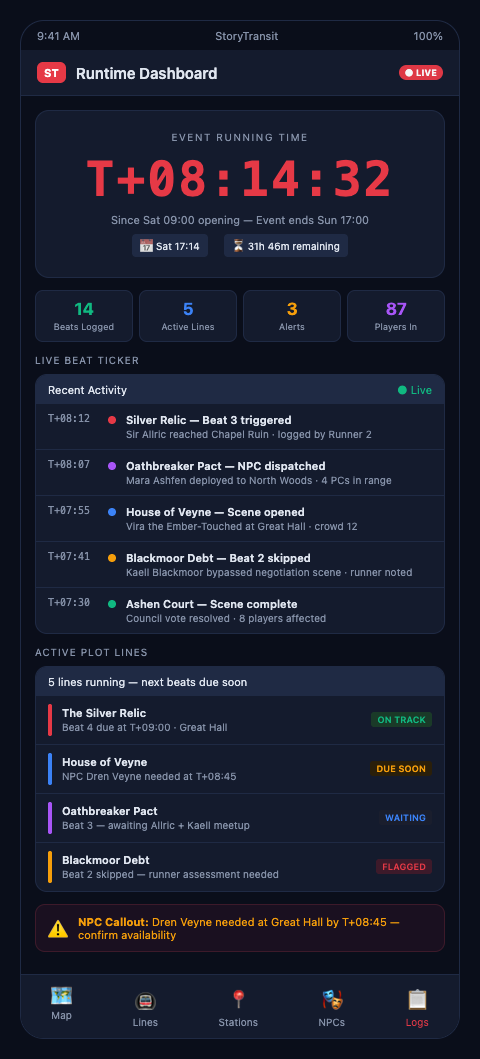
Your dispatch station is the physical equivalent of a transit control room. Someone is there with the full story map visible, receiving radio updates from runners, updating station status, and dispatching NPCs to uncovered beats.
For player beat tracking to function at runtime, the dispatch station needs three things: a single shared view of station states (not individual runner notebooks), a standardized radio protocol for status updates, and a queued list of NPCs available for immediate deployment.
The radio protocol matters more than most organizers expect. When every runner uses different language to report status, the dispatch station spends its time translating instead of routing. Standardize to four calls: "Station [name], now active," "Station [name], complete," "Station [name], skipped," "Request NPC for [name]." That's it. Everything else is noise. StoryTransit's dispatch layer is built around exactly this discipline: live plot monitoring and event coordination from a single dashboard, with status updates that flow in one direction—field to dispatch—rather than bouncing across radio channels as unstructured conversation.
The queued NPC list is the third dispatch station requirement that most organizers underinvest in. At any point during the event, dispatch needs to know which costumed volunteers are available for immediate deployment. If that list isn't maintained—updated as NPCs are dispatched and return—the dispatcher has to make radio calls to find available crew instead of routing them. Those secondary calls create additional radio traffic that degrades the signal of the primary status updates.
Handling Simultaneous Demands
Peak dispatch load at a weekend LARP typically occurs in the two hours before each major scene or climax, when multiple plotlines are simultaneously trying to run their penultimate stations. Three NPCs are needed, two are in active scenes, one is eating dinner, and the dispatcher has four runners calling in at once.
The triage protocol for this situation: prioritize stations on the primary arc for the upcoming climax first, then secondary arcs that feed into the same climax, then standalone arcs that can continue without the climax context. Mark the deprioritized stations as delayed, note the time, and dispatch back to them as soon as coverage is available.
The key practice is making the triage decision explicit and logging it. "Station delayed, priority redirect" in the log tells you, at the post-event debrief, that the station wasn't skipped by accident—it was deliberately delayed by a triage call. That distinction matters when you're evaluating whether the event's story structure held up under operational pressure.
Mid-Event Adjustments and Beat Recovery
The point of real-time beat tracking is not perfect adherence to the timetable. It's recovery. When the tracking system tells you that Saturday's plot B has three consecutive stations still pending at 6 PM, you have enough information to act: compress the stations, reassign the NPC, and send a runner to intercept the relevant player group before they commit to an incompatible arc.
Volunteer NPC task timing must be negotiated and adjusted continuously during events to sustain quality—as Designing the Volunteer Experience from Nordic Larp documents. Your real-time beat log is what makes those mid-event negotiations possible. Without the log, you're making adjustments based on impressions. With it, you're making adjustments based on data.
Plot and Character Design from Nordic Larp notes that NPC availability and plot beat scheduling must be tracked and adjusted in real time during events. The tracking structure is not overhead on top of running the event—it is the mechanism for running the event.
For mid-event adjustments that need to happen without breaking player immersion, the beat log gives you the information you need before you commit to a change. You're not guessing about what players have seen; you're looking at the record.
Keeping the Log Alive During the Event's Busiest Hours
The hardest moment for real-time beat tracking is not the slow morning—it's Saturday evening when every plot thread is running simultaneously, the radio is busy, runners are fielding questions from players, and the dispatch station is managing six NPC calls at once. That's when logging lapses, and those lapses are exactly where your post-event analysis will hit the biggest gaps.
Two practices keep the log alive under peak load. First: assign a dedicated log keeper whose only job at peak hours is updating station states from radio traffic. They're not dispatching. They're not answering questions. They're listening and recording. Second: schedule two forced logging checkpoints per day—moments where all runners pause for a thirty-second radio check that forces every station to report its current status, regardless of what else is happening.
The forced checkpoint feels disruptive until you've done it once and realized it takes less than two minutes total and gives you a coherent picture of the event's state at a defined moment. Without it, the log has gaps that correspond exactly to when things went wrong—which are the gaps you most need filled.
After the Event: What the Log Tells You
The after-action review protocol requires comparing intended outcomes to actual outcomes to identify improvement areas. Your story beat log is the primary document for that review.
At event close, your log should show: which story beats were completed, which were skipped, which player groups hit each major arc, and which NPC deployments went as planned versus required improvisation. That's the difference between a post-event conversation built on memory and one built on record.
When your log shows that a specific plotline had four skipped stations on Saturday afternoon, you can trace why: look at the NPC deployment log for that same time window, find the gap in coverage, and trace it back to whether the problem was assignment (the NPC was never scheduled), communication (the dispatch call was never made), or execution (the NPC was deployed but the players weren't there). Each diagnosis suggests a different fix for next time.
The organizers who run tight, coherent weekend LARPs year after year aren't just experienced—they have documented logs of what failed and why. The log is the institutional memory that makes improvement possible. Every useful LARP organizer guide on runtime operations eventually arrives at this point: documentation is not overhead, it is the mechanism that keeps the event recoverable when plans diverge from reality.
Live thread tracking in other real-time narrative formats—like actual play recording—faces similar challenges: you need to know what happened and when, across multiple parallel threads, with no ability to pause and review.
StoryTransit is designed for LARP event organizers who run weekend events with parallel plotlines and need a real-time beat tracking system that matches the pace of the event. LARP organizers on the waitlist get early access to the runtime logging and dispatch features—join now to help shape how the tool handles your specific event format.