Best Practices for Mid-Event Plot Adjustments Without Breaking Immersion
The Immersion Cost of Mid-Event Plot Changes
It is Saturday afternoon, about four hours into your second story beat block. A player-driven pivot has made your Plot C irrelevant — the NPC who was supposed to deliver the key evidence is now widely believed to be a traitor, and three factions are heading to confront her instead of cooperate. You need to adjust on the fly. But your radio dispatcher is juggling six NPC encounters simultaneously, two costumed volunteers are off-shift, and your plot bible has no contingency written for this branch.
So you break immersion. You pull a runner out of character to brief a volunteer in front of players. Thirty seconds of off-game cross-talk ripples across the scene. The fiction deflates. The route to immersion: a conceptual framework for cross-disciplinary immersive theatre
This is not an unusual failure mode. Mid-event pivots without contingency planning create cascading failures in live productions, and most LARP production communication happens through improvised radio calls rather than structured protocols. 8 Event Profs Share Failures and Tough Lessons Learned The cost is real: once immersion breaks for a group of players, re-engagement requires them to rebuild the mental and emotional frame that makes live-action work. Not everyone manages it before the scene ends.
The challenge is not whether to make mid-event plot adjustments — you will always need to. The challenge is building adjustment protocols that are invisible to players.
Immersion in live performance is a spectrum, not a binary state. The route to immersion: a conceptual framework for cross-disciplinary immersive theatre Brief off-game interventions rarely prevent players from re-engaging if the interruption is clean, brief, and conducted at a distance from active scenes. The problem is not the adjustment itself — it is the unplanned, visible, mid-scene communication that signals to players that the production has lost control. Building adjustment protocols that move off-game communication to back-of-house channels is what turns a necessary operational intervention into an invisible story pivot.
The immersive live events market has reached $110 billion globally, with premium segment growth driven specifically by events that maintain fictional integrity across long-duration formats. Global Immersive Entertainment Market 2030 (Mordor Intelligence) LARP organizers compete in this market whether they know it or not. Every immersion break is a product quality issue, not just a narrative inconvenience.
A Transit Framework for Live Plot Pivots
StoryTransit models each plot line as a transit route with named stations. When you need to make a mid-event plot adjustment, you are not rewriting the plot bible in real time. You are rerouting a line — closing a station, activating a dormant one, or switching a costumed volunteer to a new platform.
That distinction matters. Rerouting is a mechanical operation. Rewriting is a creative crisis. The transit model keeps adjustments in the mechanical category.
The key to making this work is that every runner has access to the full station map in real time. When a pivot occurs, the runner does not need to mentally reconstruct which plot lines are affected — they open StoryTransit, look at the affected station, see which lines it sits on, and check the contingency branch field. The adjustment protocol is already written. The runner executes it rather than inventing it.
Maintain contingency branches in the station record. Before the event, write a single contingency note for each major station: "If players treat NPC X as hostile, route to Branch B — see dormant stop B3." You are not writing full alternate scenes. You are writing a one-sentence redirect. When a live pivot hits, the runner opens StoryTransit, finds the station, reads the note, and radios the relevant volunteer with the branch instruction. Total off-game communication: fifteen seconds, conducted in a back-of-house corridor rather than in the middle of a scene.
Use radio protocols that protect immersion. Live-event radio protocols assign separate channels per plot thread, so cross-talk between runners does not bleed into the event soundscape. Event Radio Protocols — EventMB Establish a dedicated channel for plot-pivot calls — distinct from the NPC dispatch channel and the logistics channel. When a runner broadcasts a pivot update, only the volunteers running that line receive it.
Pre-code plot adjustments for NPCs. Brief costumed volunteers on potential branches before the event. The werewolf volunteer at the campfire does not need to know the full plot adjustment rationale — they need to know: "If players arrive hostile, use script B. If players arrive cooperative, use script A." This is the NPC equivalent of a service alert. The line reroutes; the passenger only notices a different set of stops.
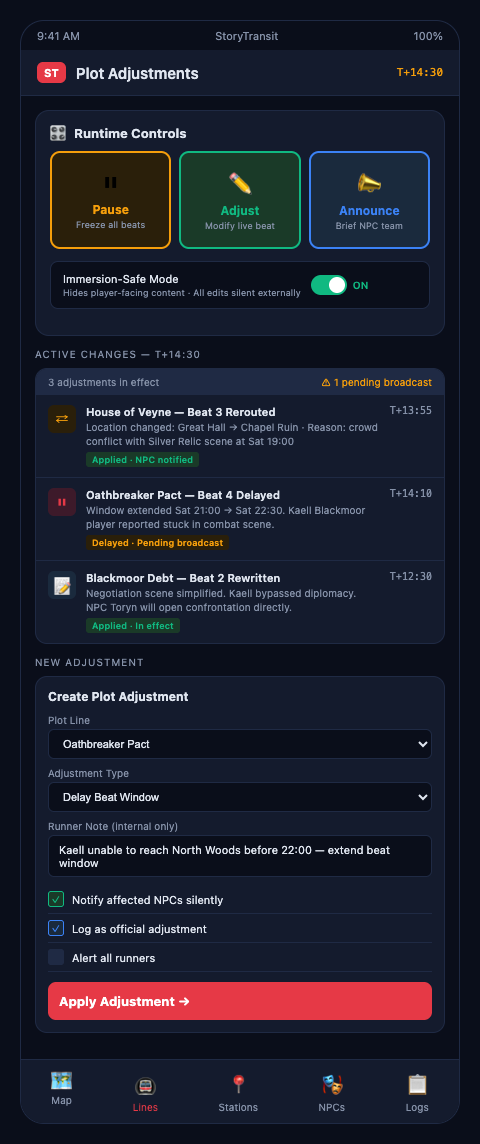
Mark pivots as active in the plot dashboard. When a live pivot is executed, update the station status in StoryTransit immediately. Flag the original station as bypassed, flag the activated branch as live, and timestamp the change. This creates an audit trail that helps you at post-event debrief and prevents a second runner from accidentally triggering the original beat later in the runtime. Narrative Improvisation: Simulating Game Master Choices
Handling player-driven pivots as a downstream consequence of immersion-preserving adjustment is a separate skill — but the upstream infrastructure is the same. Likewise, when a key player drops from an event and their absence requires plot restructuring, the branch-based approach is what prevents a spiral; good LARP dropout recovery depends on having named branches, not blank pages.
Advanced Practices for LARP Plot Flexibility
Once the basic branch protocol is in place, more sophisticated approaches become practical.
Meta-technique integration for runner communication. Meta-techniques — established off-game signals that allow brief interruptions to the fiction — let staff communicate directly with NPCs in the field without visible immersion breaks. Meta-technique – Nordic Larp Wiki A runner using an established sign (a crossed hand gesture, a specific phrase) can redirect a costumed volunteer mid-scene in the same way a stage manager signals an actor in theater. Players in the scene recognize the signal as administrative and re-engage immediately.
Calibration windows between major beats. Schedule explicit fifteen-minute windows between story beat blocks where runners sync status across all active lines. These are not breaks from the event — costumed volunteers continue ambient play — but runners step back from active dispatch to confirm which stations were reached, which were skipped, and which adjustments are queued. This prevents accumulated drift from becoming a structural problem by hour eight.
Volunteer safety word integration. Safety and calibration mechanics — established off-game signals that allow brief interruptions to the fiction — work alongside adjustment protocols rather than independently of them. Creating a Culture of Trust through Safety and Calibration Larp Mechanics When a runner needs to redirect a costumed volunteer mid-scene using an established signal, players in the scene process it as a brief administrative pause and re-engage immediately. Build your volunteer briefing to explain exactly what the signal looks like and means, so there is no confusion that breaks the fiction further when the signal is used.
Carry-forward documentation for overnight events. On multi-day events, the immersion cost of mid-event adjustments compounds because the runner team changes between night and morning shifts. Maintain a carry-forward log in StoryTransit that records every adjustment made during the previous shift — branch activations, station closures, volunteer re-briefings. The incoming shift reads the log before taking over dispatch, rather than inheriting an undocumented state.
The way editors edit unresolved threads in post-production — creating coherence from material that didn't fully resolve during recording — maps onto the runtime adjustment problem. The difference is that LARP runners do not get a post-production pass. Their edit has to happen while the audience is present.
Make Adjustments Invisible
LARP plot flexibility is not about having a plan for everything. It is about having an adjustment mechanism that does not require anyone to step outside the fiction to use it. When your transit map is visible to the whole runner team in real time, plot changes become operational decisions rather than creative emergencies.
There is also a practical confidence benefit to having a documented adjustment protocol. Runners who know that contingency branches exist and are accessible in StoryTransit make faster, more decisive live pivot calls than runners who are improvising from blank-page uncertainty. The hesitation that produces visible off-game problem-solving — two runners huddling near players, one on radio relaying half a conversation — is reduced when the runner has a pre-built path to follow.
The mid-event adjustment workflow in StoryTransit follows the transit model at every step: identify the affected station, locate the contingency branch, update the status, broadcast the change to relevant runners, and log the adjustment. Five steps, all mechanical, all executable within two minutes of the pivot occurring. That is the window between a plot adjustment and an immersion break — and a documented system is what keeps you inside it.
StoryTransit was built for LARP event organizers who need to make on-the-fly story changes without losing the weekend. If you are running weekend-long live-action events where immersion is the product you are selling, join the waitlist for LARP organizers — we are building toward a runtime tool that keeps your plot lines moving even when the plot itself changes.