Best Practices for Editing Around Unresolved Plot Threads
The Editor's Invisible Constraint
An editor working on episode 22 of a long-running actual play podcast is not just cleaning audio. Every cut is a judgment about what the audience needs now versus what the story needs later. The problem is that editors are typically given the recording, a rough brief, and a runtime target — not a complete inventory of which story threads are still live and which moments contain foreshadowing the GM is counting on.
The result: scenes get cut because they seem tangential, only for the GM to message three weeks later asking why the cursed compass setup is gone. Or a conversation between Kaelith and a minor NPC gets trimmed to hit runtime, and nobody realizes until episode 35 that the trimmed moment contained the only hint establishing the NPC as a double agent.
Foreshadowing only pays off if the planted clues survive to their resolution. Editors who cut setup moments break future story promises — not because they're careless, but because nobody gave them a map of what was promised. Narrative continuity errors break audience trust, and unresolved threads left open by editing create continuity snarls that compound across every subsequent episode.
The invisible constraint is asymmetric. Editors know exactly what they cut. They don't know what that cut costs the story two months later. That asymmetry is the core problem — and it doesn't improve with editor experience. A veteran editor without narrative context will still make bad cuts; a junior editor with complete thread documentation will protect the right scenes. The solution is information, not skill. The editing best practices covered here are built around giving the editor that information through a structured editor workflow — before the DAW opens, not after the cut is locked. When plot resolution for a major arc depends on hints surviving from episode 8 to episode 35, the documentation system is what makes that possible.
The Thread-Flag System: Treating Open Arcs as Protected Infrastructure
StoryTransit maps your podcast's narrative as a transit network. Unresolved plot threads are live lines — they carry active traffic and cannot be taken offline without a redirect plan. Resolved threads are archived stations. Dormant threads are stops that exist on the map but haven't seen a train in several episodes.
The editing workflow around open arcs works in three layers.
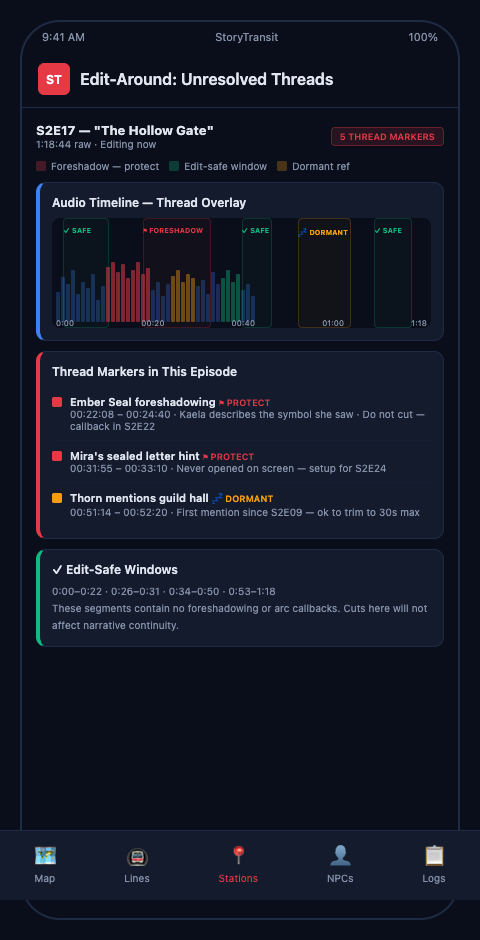
Layer 1: Thread inventory before the edit. Before the editor opens the recording, the producer generates a thread status export from StoryTransit. This is a simple list: each live thread, its last activation point, and its current narrative status (developing, stalled, approaching resolution). The editor doesn't need to understand the full story — they need to know which moments are load-bearing. For shows that have accumulated episodes without this system, a back catalog audit is the first step — it surfaces which threads are actually still live before any pre-edit brief can be written accurately.
The thread inventory also establishes edit priorities. Scenes touching threads that are approaching resolution carry higher narrative weight than scenes touching threads that are just developing — a hint that will pay off in three episodes is more protected than a hint whose payoff is still seasons away. This priority gradient allows editors to make proportionate judgments rather than treating all flagged material equally.
Layer 2: Scene flagging during the rough cut. As the editor works through the recording, any scene touching a live thread gets flagged rather than cut outright. The flag doesn't block the cut — it creates a review checkpoint. A scene that seems disposable but carries a live thread goes into a hold bin rather than the deleted folder. Podcast post-production workflows must account for narrative context, not just audio cleanup.
The hold bin is not a permanent archive — it's a deliberate delay mechanism. Flagged scenes sit in review while the editor continues working. By the time the rough cut is complete, the producer has a consolidated list of narrative decision points, not a continuous stream of interruptions during the edit process. This batching improves efficiency for both the editor and the producer.
Layer 3: Producer review of flagged holds. The producer reviews the hold bin against the thread map. Some flagged scenes will be genuinely cuttable — the thread is established enough that the moment isn't load-bearing. Others will be critical, and the producer can work with the editor to find a tighter cut that preserves the narrative function without the runtime cost. TV script coordinators track open story threads per episode and serve exactly this function; in an actual play podcast, the producer fills that role.
The producer review also generates useful data: over time, the pattern of which threads generate the most flagged scenes tells you which arcs are accumulating narrative weight and which are running thin. A thread that produces five flagged scenes in one episode is building toward something. A thread with no flagged scenes in three episodes is probably stalling.
Advanced Editing Tactics for Live Threads
Once the flag system is in place, editors can go further with techniques that actively work around open story arcs instead of just protecting them.
Cold open threading. If a scene containing a live thread activation is too long to run in context, extract the load-bearing moment and use it as a cold open for the episode. This preserves the narrative function, creates a strong episode hook, and solves the runtime problem simultaneously. The cold open acts as an anchor — subscribers who tune in mid-series get a thread signal in the first thirty seconds, which helps orient them before the main content begins.
Show notes anchoring. For threads that get trimmed but not eliminated, put the context in show notes. Listeners who are tracking the arc closely will find it; listeners who aren't won't be burdened. This is not a substitute for preserving foreshadowing in the audio — but it's a practical safety net for borderline cuts where the narrative cost is low and the runtime savings are real.
Foreshadowing balance tracking. Screenplay foreshadowing requires tracking planted hints so future episodes can resolve them coherently. StoryTransit's thread map lets producers maintain a running log of planted hints per thread, so editors always know what's been established and what still needs to survive to its payoff. When the log shows five planted hints for a thread and only one surviving to air, that's an immediate red flag — the payoff will feel hollow because the setup is thin.
The back catalog audit trigger. When an editor flags a scene and the producer can't remember whether the thread is still live or was resolved three seasons ago, that's a signal to run a full archive review. Surfacing thread status across the full run eliminates the guesswork that makes editing decisions feel risky. Running the audit once a season is a good practice for any show past the 20-episode mark.
The work of protecting foreshadowed arcs doesn't stop at the edit — it requires ongoing coordination with the GM before, during, and after production. That coordination is covered in depth in foreshadowed arc coordination, which builds on the thread-flag system described here. Producers working in adjacent serialized formats will recognize the same challenge in how plot reconciliation debrief functions in LARP contexts — where live narrative events create the same kind of unresolved thread inventory that editors must navigate.
The Real Cost of Getting This Wrong
The audience tracks open story arcs better than most producers realize. Listeners who've followed a show for 20 episodes notice when a thread they've been watching simply stops appearing. Writers rooms track open threads across episodes with explicit future-payoff documentation — actual play producers need the same infrastructure, even without a team of staff writers.
The pattern of dropped threads is cumulative. One forgotten arc might go unnoticed. Three or four, across two seasons, and the audience starts to feel that the show doesn't pay off what it sets up. That perception — "the promises never resolve" — is one of the hardest reputation problems to correct, because it requires not just fixing the current arc but restoring trust in future promises.
There's also an internal cost that producers underestimate: decision fatigue. An editor who doesn't have a thread inventory spends cognitive energy on every borderline cut trying to assess its narrative importance from context alone. That effort compounds across a three-hour session with dozens of borderline decisions. When the thread inventory exists, borderline cuts have clear flags; when it doesn't, every cut is a judgment call made under uncertainty. The thread-flag system doesn't just protect the story — it makes the editing process less exhausting.
The practical implementation is lighter than it sounds. A thread inventory before the edit takes fifteen minutes to generate from the story map. Flagging scenes during the rough cut adds a minute or two per hour of raw audio. The producer review of flagged holds is typically under thirty minutes. Total overhead across the full episode workflow: under an hour. The cost of getting it wrong — a broken arc, a re-edit, a listener complaint, a GM relationship strained by post-edit conflicts — is substantially higher.
StoryTransit gives editors and producers a shared view of which arcs are live, which moments are load-bearing, and what has been promised to the audience. The thread-flag workflow closes the gap between what the GM intended and what actually reaches the listener's feed. When the workflow is running, editors edit with confidence rather than anxiety, and producers review flagged scenes rather than chasing down context after the cut is already locked.
Actual play podcast producers who want to stop second-guessing every cut can join the waitlist for StoryTransit. Early access includes the thread-flag workflow templates and the pre-edit thread inventory export. Join the Waitlist for Actual Play Producers and start editing with the full story map in view.