Advanced Plot Reconciliation Techniques for Post-Event Debriefs
The Gap Between Planned and Experienced Story
Every LARP has two narratives: the one the organizers wrote and the one the players lived. Post-event debriefs exist to map the distance between them—but most debrief formats aren't built to do that work rigorously.
The fundamental challenge is documented in Analog Game Studies: Game Wrap, the most common post-play format, surfaces individual secrets and plot surprises but doesn't systematically compare the intended story arc to the emergent one. Players share what they experienced; GMs share what they planned; but no one explicitly measures the delta between the two. What gets surfaced in a Game Wrap is what participants remember and what they're willing to share publicly—a sample of experience, not a comprehensive audit of coverage.
The Nordic Larp Wiki's debrief guide frames the debrief as a tool for revealing hidden plots and reconciling individual experience into collective story—a useful framing, but one that still treats reconciliation as an emergent product of conversation rather than a structured analytical process. This works reasonably well at small events. At larger events with twenty or more parallel plotlines, it consistently underestimates how much was missed.
For organizers running weekend-long events, unstructured debriefs produce an inaccurate picture of what actually happened. The story beats that get discussed are the ones players remember most strongly—not necessarily the ones most critical to evaluate. A spectacular moment at the main plot station overshadows the three satellite beats that never ran at all. The debrief ends, everyone goes home, and the missed beats are never documented, never analyzed, and never fixed for the next event.
Advanced debrief techniques move beyond conversation-driven recall toward a systematic story reconciliation process built around explicit documentation from the event itself. The goal isn't a richer conversation—it's a gap map.
The Transit Map Approach to Post-Event Reconciliation
The most effective post-event debrief framework for LARP organizers borrows from the transit metaphor that governs StoryTransit's core design. When you mapped your event as a transit system—plot threads as lines, story beats as stations—the post-event review becomes a line audit.
A line audit asks three questions for each parallel plotline: Which stations were visited? Which were bypassed intentionally? And which were dormant for the full runtime with no player contact? The answers aren't generated from memory—they're read from the documentation you built during the event.
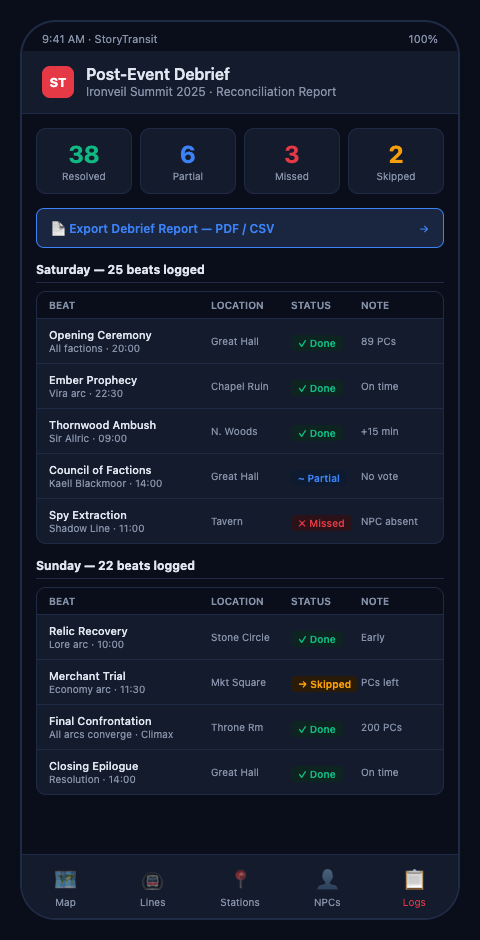
This is where pre-event documentation becomes a post-event asset. Every story beat logged in StoryTransit with a completion timestamp gives the post-event team a direct record of what ran. Every dormant stop—a station with no recorded player contact—is a concrete data point for the story reconciliation process. The debrief conversation shifts from "does anyone remember if the merchant faction storyline ran?" to "the dashboard shows three merchant line stations with no contact after 4pm Saturday—here's what was assigned there and here's what the zone NPC reported."
The hot wash methodology from Public Health Ontario, designed for multi-team events in high-stakes settings, structures immediate post-event reviews around three questions: what worked, what had gaps, and what recommendations follow. That structure maps directly to the transit line audit format for LARP: which lines ran clean, which had dormant stops, and what changes would prevent each gap from recurring.
The Three-Phase Reconciliation Protocol
Phase 1: The Hot Wash (within two hours of event close). Gather all plot runners before memory degrades. Each runner reports on their assigned line: which beats ran, which didn't, and what player decisions caused departures from the planned route. This session produces the raw data for the full debrief—but its primary value is capturing information that will be forgotten by morning. AlertMedia's After-Action Review framework recommends this immediate capture phase as the foundation of any organizational learning process—before the formal structured review, before interpretation, before anyone has had time to rationalize what happened. In LARP terms, this means plot runners report observed facts rather than conclusions: "Beat 7 didn't run because the players went to Zone 3 instead of Zone 4" rather than "Zone 4 coverage was inadequate."
Phase 2: The Line Audit (within forty-eight hours). Using the documentation from the event—the plot dashboard, the station logs, the NPC completion reports—map every planned story beat against its actual status. Categorize each beat as: completed, partial contact, bypassed intentionally, or dormant with no player contact. The Leaving Mundania post-LARP debrief guide describes this as "closing the narrative"—ensuring every opened storyline has a documented resolution, even if that resolution is "this beat will carry forward to the next event." The line audit produces a complete gap map—not an impressionistic list of things that went wrong, but a beat-by-beat accounting of every planned story element.
Phase 3: The LARP Post-Mortem Analysis (within two weeks). This is the formal reconciliation session that generates actionable changes for the next event. Compare the line audit data against the original plot bible. Where beats were consistently bypassed, examine whether the trigger conditions were clear to players and whether the zone NPC had adequate information to prompt engagement. Where dormant stops clustered in specific zones, examine whether those zones had adequate NPC coverage and whether the physical location was accessible during the relevant session windows.
What the Debrief Data Should Feed
The value of advanced plot reconciliation isn't the session itself—it's the decisions it produces. Each gap category from the line audit should generate a specific type of fix.
Dormant stops due to NPC deployment failures produce changes to the dispatcher protocol: more frequent check-ins, lower thresholds for triggering pool NPC deployment, or redesigned zone assignments that reduce the likelihood of a single NPC becoming overwhelmed.
Dormant stops due to player navigation failures produce changes to player hooks: the in-game mechanisms that direct characters toward specific zones and plot stations. If players consistently chose Zone 3 over Zone 4, the hooks pointing to Zone 4 weren't compelling enough or weren't delivered early enough in the runtime.
Dormant stops due to structural design failures—beats that depended on prerequisites that never ran—produce changes to the plot bible architecture. These are the most significant findings from the post-mortem analysis, because they indicate that certain parallel plotlines were structurally fragile: a single missed beat could strand the entire subsequent sequence.
The "Play to Find Out" reflection framework from Analog Game Studies notes that LARP narratives sit on a spectrum from established to emergent. The post-mortem analysis is where you document where your event landed on that spectrum and whether the outcome was intentional. An event that was designed to be highly emergent but produced dormant stops across eight plotlines didn't achieve intentional emergence—it achieved coverage failure.
Advanced Techniques for Organizers
Comparative beat mapping. Build a two-column document: intended beats on the left, actual beats on the right. Entries that don't align are your reconciliation targets. This document becomes the first section of your next event's plot bible—not the narrative backstory, but the gap map from the previous event.
Player-reported arc completion surveys. Send a short post-event survey asking one question: "Did you feel your character's main storyline reached a resolution?" Aggregate responses by faction and cross-reference against the line audit. Factions reporting low resolution rates are the most likely locations of missed beats—and they may identify gaps that the line audit missed because the dormant stops weren't documented during runtime.
The dormant stop root-cause question. For every beat that never ran, document the root cause in one of three categories: NPC deployment failure, player navigation failure, or structural design failure. Each category has a different fix. Running the same generic "how do we improve coverage?" discussion without root-cause categorization produces vague intentions that don't change anything.
Build the reconciliation cadence into event infrastructure. The most common reason advanced debrief techniques don't get implemented consistently is time: organizers are exhausted after the event, and the structured reconciliation sessions get compressed or skipped. Build the three-phase schedule into your event calendar before the event runs—the hot wash at hour two post-close, the line audit at day two, the post-mortem at day fourteen. Treat these sessions as mandatory operations, not optional retrospectives. The organizers who run the most consistently high-quality large-scale events treat the reconciliation cycle as part of the event's structure, not its aftermath.
Tracking which parallel plotlines were reconciled and which gaps are being carried forward to the next event is exactly what a plot bible with version history enables. Each event's reconciliation output becomes the first chapter of the next event's design document—a continuous loop from story execution to analysis to improved design.
For a systematic review of how to build the audit protocol that makes this reconciliation possible, the post on auditing unreached beats extends this framework into a full coverage audit methodology. The decisions that get made during runtime—before the debrief—shape what the reconciliation session finds, which is why mid-event adjustments covers those real-time choices that feed directly into the post-event picture. For documentary and archiving practices in other serialized formats, advanced chapter archiving surfaces complementary methodologies from the forum GM space.
StoryTransit gives LARP event organizers a live plot dashboard during the event and a complete reconciliation record after it. The same data that helps plot runners dispatch costumed volunteers in real time becomes the source material for your post-event debrief. Join the Waitlist for LARP Organizers to see how the platform handles the full cycle from plot design through post-event story reconciliation process.