Advanced Techniques for Archiving Completed PbP Chapters
Why Moving Threads to an Archive Subforum Is Not Enough
Forum software's built-in archive mechanism—moving completed threads to a read-only subforum—solves only one problem: it signals that a chapter is over. It doesn't solve the problem of future retrieval. A forum archive subforum with 40 completed threads is functionally opaque. Every thread is one click, then one page of pagination, and the relevant post is somewhere in the middle.
Library of Congress documentation on web harvesting confirms that dynamic web content—including forum threads with pagination and JavaScript-rendered elements—is consistently harder to capture and retrieve than static pages. For PbP GMs, this means the default archive is fragile: it survives as long as the hosting platform does, and it's navigable only to players who remember enough context to know where to look.
Research on digital preservation from the Digital Preservation Coalition recommends that any long-term web archive include metadata, timestamps, and relationship mapping between documents. Applied to PbP, this means an advanced completed chapter archive should document not just what happened but how it connects to what came before and what it enables next.
The Chapter Documentation Framework
Advanced PbP archiving treats each completed chapter as a transit system snapshot: a record of which lines were active, which stations were reached, what state each line was in at chapter close, and which dormant stops were left for future chapters. This snapshot serves multiple future purposes—for onboarding new players, for running the audit unresolved threads process, and for maintaining internal consistency when writing Chapter 8 and needing to reference something established in Chapter 2.
The framework has four layers:
Layer 1: The Chapter Summary Document. A GM-authored OOC post (or linked external document) covering: chapter timeframe, major plot events resolved, major character developments, faction status changes, and any open threads carried into the next chapter. This is the highest-level layer—the transit system map at chapter close. Target length is 400–600 words: long enough to capture the chapter's narrative shape, short enough that players actually read it.
Layer 2: The IC Highlight Log. A curated list of 10–20 IC posts from the chapter, linked and briefly annotated. These are the posts that establish facts other players will need to recall: the NPC who made a promise, the revelation that changes a faction's motives, the character decision with downstream consequences. Not a full index—a navigational shortcut. The annotation on each link is critical: "Thread 22, page 3: Aldric pledges the guild's support to the Rebel Council." Without the annotation, the link is a dead end; with it, the player knows exactly what they'll find before clicking.
Layer 3: The NPC and Faction State Record. Every named NPC who appeared in the chapter gets a status entry at chapter close: current disposition, last known location, any outstanding obligations or hooks. Factions get a parallel record: alignment shifts, power changes, any public or private commitments made. This is the layer that prevents play-by-post world consistency failures in later chapters. The NPC record doesn't need to be long—three fields per NPC (name, status, last IC appearance with link) is sufficient for most campaigns.
Layer 4: The Thread Map. A reference document linking each major storyline arc to its relevant IC threads within the chapter. Not just "Thread A through Thread F"—but "the Merchant Quarter arc: Threads 14, 22, and 31, with the pivotal exchange in Thread 22 on page 3." This layer is the most labor-intensive to produce and the most valuable to have. It converts an opaque archive subforum into a navigable index—any player who needs to review a specific arc can go directly to the relevant threads without searching through the full chapter.
The four layers are additive: a GM who only has bandwidth for Layer 1 is still significantly better positioned than one with no chapter documentation at all. Research on sustaining online communities of practice confirms that structured documentation was critical to sustaining institutional memory in long-running communities—and that partial documentation produced under real-world time constraints still outperformed no documentation significantly.
StoryTransit and the Archive Layer Problem
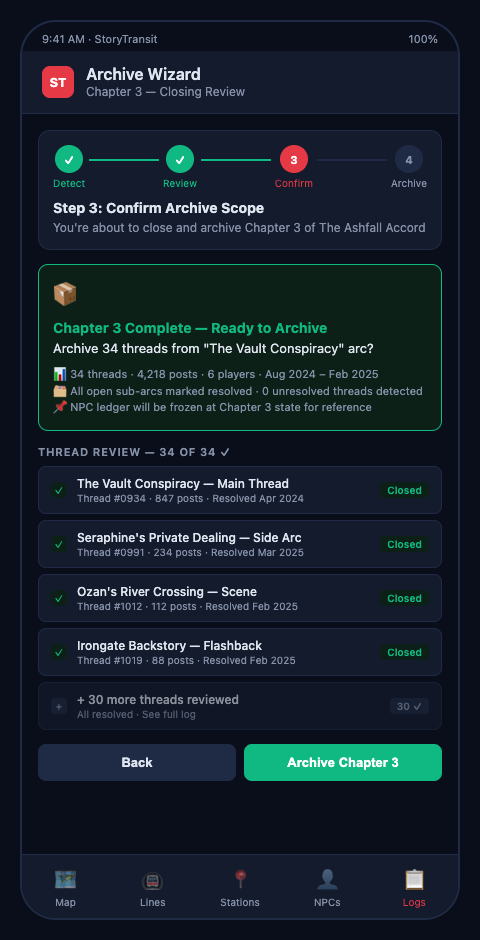
StoryTransit addresses the archive layer problem by embedding the documentation framework into the campaign's transit map structure. When a chapter closes, every resolved line in the map gets tagged with its resolution state and the chapter it was resolved in. Dormant stops that are being carried forward are flagged explicitly, not left as orphaned entries in an archive subforum.
Wikis as collaborative knowledge management tools research shows that community-maintained wikis allow members to access shared event memory even if they weren't present—exactly what a chapter archive should do for players who joined mid-campaign or took a break. The transit map functions as that wiki layer, but structured around narrative lines rather than general topic headings. The distinction matters: a general wiki organized by topic puts the burden of navigation on the reader (find the relevant topic, read the relevant section). A transit map organized by storyline line puts the navigation burden on the GM at chapter close (tag the line, note the station, log the outstanding hooks) and returns it to the reader as a pre-structured path.
Consulting veteran forum documentation practices reinforces the same lesson: the GMs who sustain campaigns over years spend less time on comprehensive documentation and more time on targeted retrieval infrastructure. The goal isn't a complete transcript—it's a map that answers the question "where was this arc when Chapter 3 ended?"
Decade timeline techniques from long-running homebrew DnD campaigns also apply here. The structural problem of maintaining world consistency across a 10-year tabletop campaign is identical in shape to the problem across 30 PbP chapters—and the solutions converge on the same principle: front-load documentation at chapter close rather than reconstructing later.
The chapter archiving framework also serves a forward-looking function: it makes future plot development easier. When a GM is planning Chapter 8 and wants to reintroduce a subplot from Chapter 3, the Layer 4 thread map tells them exactly which threads covered that subplot, which IC posts were pivotal, and what state the subplot was in at the end of Chapter 3. The planning time saved by having this retrieval infrastructure is often greater than the time spent building it at chapter close—but this return on investment only becomes visible once the campaign has multiple archived chapters.
Advanced Archiving Tactics
Chapter close IC post conventions. The last IC post of a chapter should follow a template: a brief in-world epilogue that names the thread's final state explicitly. This gives the archive a natural endpoint post that players can search for when trying to find where a chapter ended. The convention doesn't require length—a 200-word IC post that clearly marks the transition point is more valuable than a longer post that leaves the chapter's status ambiguous.
Cross-chapter reference tagging. When writing IC content in Chapter 5 that references something from Chapter 2, add an OOC note in the post linking to the source: "(ref: Chapter 2, Thread 14, page 2)." This creates backlinks that make the archive navigable from future posts rather than requiring players to search for source material independently. Over time, these cross-references convert the paginated archive into something closer to a hyperlinked document—players can follow the trail of a world fact backward through the campaign's history without sequential reading.
Automated chapter archive indexing. Academic guidance on web archiving recommends systematic crawling with metadata at the time of capture—not retroactively. Applied to PbP: run your archive documentation process at chapter close, not six months later when player memory has faded and threads may have already drifted in the pagination order. Chapter documentation produced immediately after close is roughly three times more accurate than documentation produced from memory months later.
Chapter documentation handoff for new players. When a new player joins, their onboarding package includes not just the current chapter summary but the Layer 1 documents for the two preceding chapters. This gives them the two-chapter history window that contextualizes current events without requiring them to excavate the full archive. Two chapters of context—roughly 6–8 months of campaign history for a one-post-per-day game—is enough to make a new player functionally oriented without overwhelming them.
The chapter wiki approach. Research on wiki-based community knowledge systems shows that community-designed knowledge management tools produce more useful retrieval structures than top-down documentation. For long-running PbP, a chapter wiki that players can collectively edit—adding their own recollections of significant events, annotating NPC interactions, flagging inconsistencies—builds a richer archive than any single-author documentation effort. The GM sets the structure; the players populate it.
Campaign management tool comparisons such as those between World Anvil, Obsidian Portal, and Kanka confirm that forum preservation is an underserved need in the current tool landscape—most tools are built for active campaign management, not retroactive chapter documentation.
StoryTransit's chapter archiving layer is built for exactly the four-layer framework described here. When you close a chapter in the tool, every active transit line gets a chapter-close snapshot automatically, and the documentation structure prompts you through each layer before archiving. Play-by-post GMs on the waitlist get early access to the chapter archiving feature—and the ability to retroactively apply the framework to campaigns already in progress. Join the waitlist and reclaim your campaign's history.