How Veteran Forum GMs Self-Document Their Worlds
Why Retroactive Documentation Always Fails
Ask a GM who's been running a forum game for two years to document everything they know about their world, and you'll get an incomplete document with critical gaps. Not because the GM lacks knowledge—they know the world intimately—but because the process of extracting that knowledge from memory is imprecise. Things established in IC posts eighteen months ago that feel like settled world facts are actually sitting in threads on page 12 of a subforum, and the exact wording—which matters for future consistency—is inaccessible from memory alone.
Fortune 500 companies lose $31.5 billion annually to organizational knowledge loss, primarily through tacit knowledge that exists only in people's heads. The parallel for a GM world is exact: every world fact that lives in IC posts but not in a structured reference document is tacit knowledge waiting to be lost. A subforum pruning event, a server migration, or simply the passage of time and deepening pagination all accelerate that loss.
Organizational learning research analyzing 2,511 articles confirms that structured documentation is the output of organizational learning—the mechanism by which things known get preserved. Applied to veteran forum GM documentation: the world records you build aren't overhead, they're the output of your creative work made retrievable.
The Self-Documenting World System
Veteran forum GM documentation follows a consistent pattern across practitioners: documentation happens at post time, not after the fact. Every time an IC post establishes a world fact—a new location is named, an NPC's loyalty is revealed, a faction makes an irreversible decision—that fact gets captured in a structured reference immediately. Not in a bulk "I'll document this chapter later" session, but in the 5–10 minutes after the relevant post goes up.
This discipline looks burdensome from the outside but becomes lightweight with practice. A veteran GM's post-time documentation habit takes roughly as long as reading the IC thread response that prompted it. The cost of not doing it—attempting to reconstruct world facts from memory six months later—is far higher. The cost of organizational knowledge loss in professional environments runs to $31.5B annually for Fortune 500 companies; for a GM, the equivalent is hours spent searching paginated archives for a world fact that should have been logged when it was first established.
The self-documenting world has three primary components:
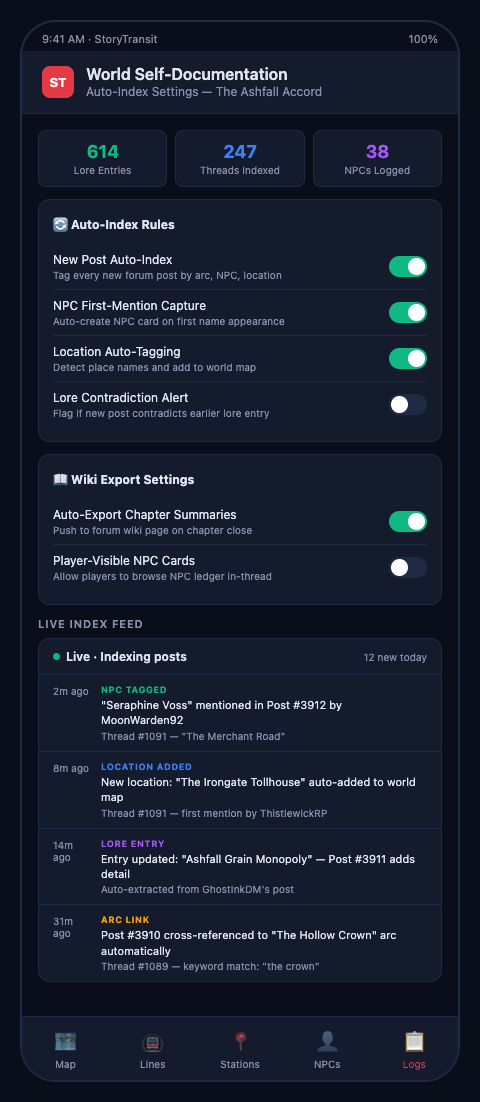
The World Facts Register. A running document organized by category: locations, named NPCs, factions, established lore, and mechanical facts (currencies, laws, known magic systems). Each entry has three fields: the fact itself, the date it was established, and the IC thread and post number where it appears. This last field is the critical one—it converts the document from a memory aid into a play-by-post archive navigation tool. The forum GM toolkit for intermediate GMs typically includes the first layer of this system—a basic spreadsheet or wiki for tracking world facts. When a player asks "wait, was the merchant guild loyal to the crown or the rebels?", you have a link to the exact post where that was established. The register can live in a Google Doc, a dedicated OOC wiki thread, or an external tool like World Anvil—the format matters less than the discipline of updating it at post time.
The Pending Threads Log. Every plot thread that's been seeded but not yet resolved lives in this document with its current status. This is the GM's equivalent of a transit operator's dormant stops list—things on the map that haven't had a train stop there yet. Unlike the World Facts Register, which captures established facts, the Pending Threads Log tracks promises: things the narrative has implied will happen but hasn't yet. A pending thread entry has four fields: the promise (what was implied), the IC thread where it was seeded (with link), the current status (active, dormant, paused with intent), and the planned resolution approach.
The NPC Relationship Map. Named NPCs have relationships with each other that change over the course of a campaign. The relationship map tracks these changes with timestamps: "Kira went from neutral to hostile toward the council faction after the harbor incident (IC thread 47, page 2)." This prevents the common failure where a GM writes an NPC acting in a way inconsistent with how they've been established—because the NPC's history is visible and searchable. For campaigns with many named NPCs, the relationship map is the single most valuable reference document when writing IC posts involving established characters.
StoryTransit's Role in Self-Documentation
StoryTransit builds the self-documenting world system into the transit map structure. As GMs mark new stations on storyline lines, the platform prompts for world fact capture: what was established at this station? What NPCs appeared and what was their status? What outstanding hooks were seeded?
Knowledge repository research on organizational memory systems identifies the core function of a knowledge repository as centralizing both tacit and explicit knowledge for retrieval. StoryTransit functions as this repository for GM world records—not a passive file storage system but an active map that connects world facts to the story beats where they were established.
Wiki-based collaborative knowledge systems confirm that communities maintain event memory more reliably when the documentation is integrated into their primary workflow rather than maintained as a separate project. For PbP GMs, this means the best documentation system is one that lives inside your story management workflow—not a separate wiki you have to remember to update.
Veteran forum documentation builds on that foundation with the relationship mapping and pending threads infrastructure that sustain a campaign beyond the first year.
Forum platform migration is a stress test for any self-documenting world system: if your documentation lives only in the forum's thread structure, migration means rebuilding your reference documents from scratch. Veteran GMs maintain documentation external to the forum platform for exactly this reason.
Veteran plot libraries in LARP organizing share the structural logic: the practitioners who sustain long-term creative projects are the ones who externalize their world knowledge into retrievable systems rather than keeping it in memory.
Advanced Self-Documentation Tactics
The post-time habit. The discipline that separates veteran from intermediate forum GM documentation is the post-time capture habit. Within 30 minutes of an IC post that establishes a significant world fact, the GM updates the relevant section of the World Facts Register. This sounds burdensome but takes 5–10 minutes per significant post—far less time than retroactive reconstruction later. Not every IC post requires documentation: the threshold is whether the post establishes a fact that other characters or future plot developments could reference. A post containing only in-world dialogue doesn't need logging; a post where an NPC makes a commitment that will have story consequences does.
The OOC reference anchor. For particularly important world facts, post an OOC reference note in the relevant subforum's reference thread immediately after the IC post. This creates a publicly accessible anchor that players can find and that doesn't require them to read the full IC thread to get the fact. "Established in IC Thread 22: the Merchant Guild's allegiance has shifted to the Rebel Council." This OOC anchor does double duty: it notifies active players of the development without requiring them to have read the IC post, and it creates a searchable record that future players can find when they need to understand the current factional landscape.
Tagging conventions for archive navigation. Veteran GMs often use consistent tagging in OOC notes to make archive navigation tractable. A tag like [LORE], [NPC-STATUS], or [FACTION-CHANGE] in OOC post subjects lets players search the OOC subforum for specific types of information rather than reading every post. The tagging system only works if it's applied consistently—one tag system used for 18 months is worth more than three different systems tried sequentially.
The world state snapshot. At the start of each new chapter—not just at chapter close—produce a brief "world state snapshot": where are each faction's allegiances right now, what are the five most active outstanding plot threads, and which NPCs have changed their status since the last snapshot. This snapshot is posted in the OOC thread and also appended to the World Facts Register with a timestamp. It provides a chapter-open orientation document that both veterans and new players can use to calibrate their understanding before writing their first posts in the new chapter.
Managing organizational memory frameworks from consulting research confirm that both explicit and tacit knowledge require different capture mechanisms—and that the most sustainable systems are the ones embedded into existing workflows rather than maintained separately. The tagging system, the post-time habit, and the OOC reference anchor are all examples of embedded capture: they occur as part of the GM's natural posting workflow rather than as separate documentation sessions.
Prepping for DnD with Obsidian Portal documents how practitioners maintain full campaign history across sessions using adventure logs—a practitioner model that confirms the post-time documentation habit is sustainable over long periods when the tool matches the workflow.
For GMs who want to build a self-documenting world system into their existing campaign—even one already several years deep—StoryTransit's import tools are designed for retroactive onboarding. Join the waitlist for play-by-post forum GMs and get access to the archive import features that let you structure your existing world records into the transit map framework without starting from zero.