How Veteran LARP Organizers Build Reusable Plot Libraries
Why Veteran Organizers Stop Starting From Zero
The difference between an organizer running their third event and their tenth isn't usually creativity—it's infrastructure. By event ten, the veteran has a library of plot modules that have been tested against real player groups, refined based on debrief feedback, and formatted for easy reassignment across different venues and cast compositions.
NERO LARP, one of the longest-running boffer LARP systems in North America, maintains fifteen FileMaker databases per chapter tracking NPCs, monsters, items, and plot content—a plot asset library built over decades of continuous events. That infrastructure doesn't just make individual events easier to run. It creates organizational memory that survives staff turnover, venue changes, and evolving player demographics. When the head plot writer steps down, the library remains. New staff can understand what the event has done, what worked, and what's available for reuse without reconstructing that knowledge from memory.
The principle behind a reusable plot library mirrors the logic of any well-maintained content system. Lucidea's knowledge management research identifies the three conditions for successful reuse: a good supply of content, content that's easy to find, and content formatted appropriately for its intended reuse context. Plot modules fail on the second and third conditions far more often than the first. Most veteran LARP organizers have a large supply of plot ideas, past scenarios, and documented story beats. What they consistently lack is a retrieval architecture that lets them find and deploy that content quickly during event prep.
Building a plot asset library that actually gets used requires deliberate attention to format and retrieval design—not just accumulation of past event documents in a shared folder somewhere.
The Modular Plot Design Framework
The transit metaphor maps cleanly onto how a reusable plot library should be organized. Each plot module is a self-contained route segment: it has a defined start condition, a sequence of story beats (stations), and an end condition that resolves the segment's internal narrative thread. The segment can be attached to different transit lines depending on the current event's plot structure, and it can be run by different plot runners with minimal retraining because all the operational information is embedded in the module documentation.
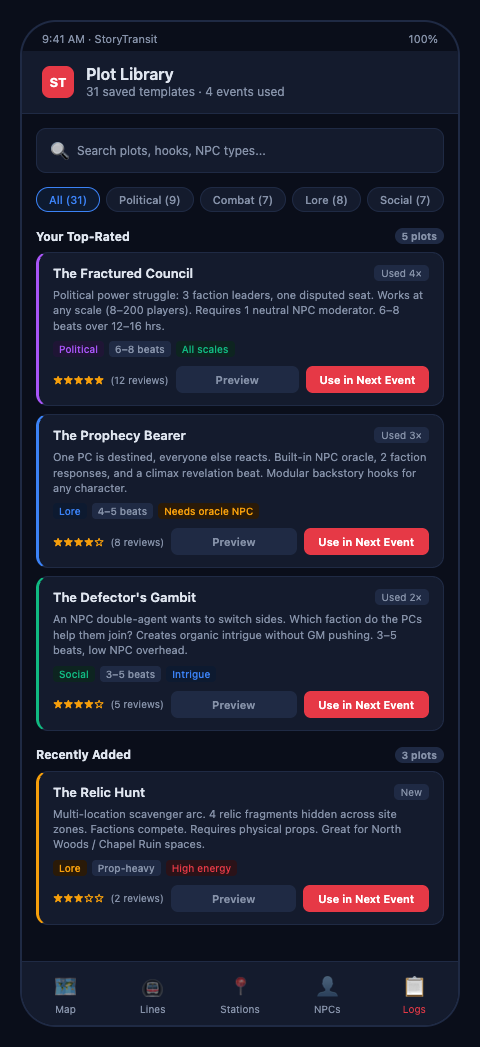
StoryTransit's structure supports this modular approach directly. Plot threads are defined as transit lines with discrete story beats as stations. When a veteran organizer builds a new event, they pull existing station sequences from the library and attach them to new transit lines rather than writing every beat from scratch. The library's station sequences retain their internal narrative logic while connecting to event-specific plot threads—a faction conflict module from three events ago can become a subplot in this weekend's main storyline by attaching it to the relevant faction line.
Franchise LARP research documents how events like College of Wizardry and Witcher School reuse world-building infrastructure—space configurations, character archetypes, mythology structures, staff role definitions—across repeated runs. The plot library is the story-layer equivalent of this infrastructure: reusable narrative modules that maintain consistent quality without requiring full reconstruction each time. The framework they use maps to eight infrastructure categories, all of which can be partially or fully pre-built and reused.
BCMS's modular content strategy research frames the same principle in content system terms: pre-defined blocks dynamically assembled and updated for each deployment. A veteran organizer's plot library functions as exactly this kind of modular content system, with event prep replacing custom content creation with intelligent assembly of tested modules that have already been proven against real audiences.
How to Structure a Plot Asset Library
The module card format. Each plot module in the library should have a standardized card with six fields: title, setting requirements (what type of venue or world context the module needs to function), minimum NPC count, estimated runtime, triggering condition, and resolution condition. This card format makes modules scannable during event prep—an organizer can assess a module's fit for the current event in thirty seconds rather than reading through several pages of narrative. The card is the interface to the module, not the module itself.
Categorize by story beat type. Build your library around a taxonomy of beat types: revelation beats (a character learns something significant that changes their understanding of the world or their alliances), confrontation beats (a direct conflict between factions or characters requiring active player decision-making), resolution beats (a long-running storyline reaches a conclusion), and bridge beats (a transitional scene connecting two larger arcs). Organizing by type lets you quickly identify what your current event's plot structure is missing and pull the appropriate module to fill that gap.
Version and debrief-annotate every module. After each event, annotate the modules that ran with debrief notes: how long the module actually took versus the estimate, whether the NPC count was adequate or excessive, whether player engagement was high or low, and what changes would improve performance. Over time, each module accumulates a performance history that makes future deployment decisions more reliable. A module with three consecutive high-engagement annotations is a proven asset. A module with consistent low-engagement annotations needs redesign before its next deployment.
Build trigger flexibility into every module. The most reusable modules have triggering conditions that can be satisfied by multiple different character types, faction configurations, or narrative contexts. A module that can only be triggered by a specific character class or a specific faction will sit in the library unused at events with different demographics. Write trigger conditions as broadly as the module's internal logic allows: "any character with military history or law enforcement background" rather than "the Knight of the Western Order specifically."
The Library Maintenance Problem
Building a plot asset library is easier than maintaining one. Most veteran organizers who build initial libraries find that the library drifts out of usefulness within two to three years if no one actively maintains it. Modules that were designed for a venue the event no longer uses. NPC count estimates based on a larger staff roster than the current team. Triggering conditions that reference factions or characters from several events ago.
Library maintenance requires an assigned owner—typically the head plot writer or a designated library curator—with an annual audit process. The audit reviews every module in the library against three questions: does this module still fit the event's current setting and world context, is the NPC count estimate still accurate, and has this module been deployed enough times to warrant keeping it versus retiring it to an archive folder.
Modules that pass the audit stay in the active library. Modules that need updates get flagged for revision before the next event. Modules that no longer fit the event get moved to an archive—preserved in case a future event revisits that setting or context, but clearly separated from the active deployment pool.
The Library as Organizational Memory
A veteran LARP organizer's plot library has a second function beyond operational efficiency: it preserves organizational memory against the inevitable staff turnover that every long-running event experiences. When the head plot writer who ran the event for seven years steps back, their creative and operational knowledge doesn't have to leave with them.
This institutional memory function is underappreciated. Most long-running LARP communities have experienced the "knowledge loss" event—the departure of a key organizer after which the event spent two or three years rediscovering what the previous team had learned. A well-maintained plot library documents that knowledge in deployable form: not just "here's what we did," but "here's a tested module you can deploy at the next event."
Tabletop RPG system research on procedural content generation establishes that RPG systems function as content-generating grammars—reusable structures that produce varied outputs from consistent underlying rules. A LARP plot library is the same structure: a grammar for generating event content, where the modules are the rules and the events are the outputs. New plot writers learning the library learn the event's grammar, not just its history.
LARP Portal's plot-building methodology emphasizes modular, replayable story structures as the foundation of sustainable campaign events. The methodology is practical: if your plot modules can't be deployed across multiple events with reasonable adaptation, they're documents, not assets.
LARP Portal's community-building research identifies collaborative content structures that transfer between staffers and survive staff turnover as one of the most durable community assets a recurring event can build. The plot library is the most tangible form that asset takes—it's the organizational memory of what the event has done and what has worked.
For organizers who want to understand how the foundational tooling layer supports a library approach, the intermediate LARP toolkit post covers the operational infrastructure that plot libraries depend on. The relationship between plot libraries and future software support is covered in the future LARP software post, which explores how the next generation of digital LARP organizer tools will need to handle modular content retrieval and version management. For how veteran GMs in adjacent formats handle the documentation and reuse challenge over long time horizons, veteran forum documentation covers comparable methods from the forum GM world with some directly transferable library-building practices.
StoryTransit is designed for LARP event organizers who've been running events long enough to have accumulated plot assets worth preserving and systematically reusing. The platform's modular transit structure makes building and deploying a plot asset library a native workflow rather than an afterthought layered on top of a narrative document system. Join the Waitlist for LARP Organizers and bring your library into a system built for modular plot design at scale.