The Intermediate LARP Organizer's Toolkit for Event Tracking
The Intermediate Organizer Problem
You have run a few multi-plot events. Your plot bible runs to forty or fifty pages. You have a small NPC team — maybe eight to twelve costumed volunteers — and a venue that takes more than twenty minutes to walk across. You have done this enough to know that spreadsheets break down under runtime conditions and that a folder of Google Docs is not a plot dashboard.
But you also have not hit the scale where a full enterprise event management platform makes sense. LARP Portal and LarpManager are both capable tools — LARP Portal integrates PC, NPC, and Staff modules across 100+ configurable features. LARP Portal Features LarpManager handles registrations, payments, handouts, and character management free of charge. LarpManager – Everything you need to run your Larp These are excellent platforms for large-scale productions. For an event with sixty players and three runners, they can feel like infrastructure overhead.
The intermediate LARP organizer toolkit is not a single platform. It is a set of specific functions that any tool combination needs to cover — and understanding what those functions are is what separates organized intermediate events from "we made it through but barely." At this scale, the LARP operations kit is whatever combination of tools covers runtime status, NPC dispatch, and post-event review in a format every runner on your team can use without a lengthy orientation.
The LARP events market is growing at 13.8% CAGR with North American revenue reaching $0.7 billion in 2025. Global LARP Events Market Size, Growth & Revenue 2025–2033 The organizers scaling with this growth are building operational infrastructure incrementally — adding tools as event complexity grows rather than all at once.
The intermediate level is where most LARP organizers spend the most time. You have moved past the improvised first-event stage and have not yet reached the production scale where full-time logistics support makes sense. At this level, every hour spent reconstructing plot status during runtime is an hour not spent managing the story, and every volunteer who shows up under-briefed is a scene that fires incorrectly. The toolkit you build now determines how cleanly your events run as they grow.
Core Components of an Intermediate Event Tracking Toolkit
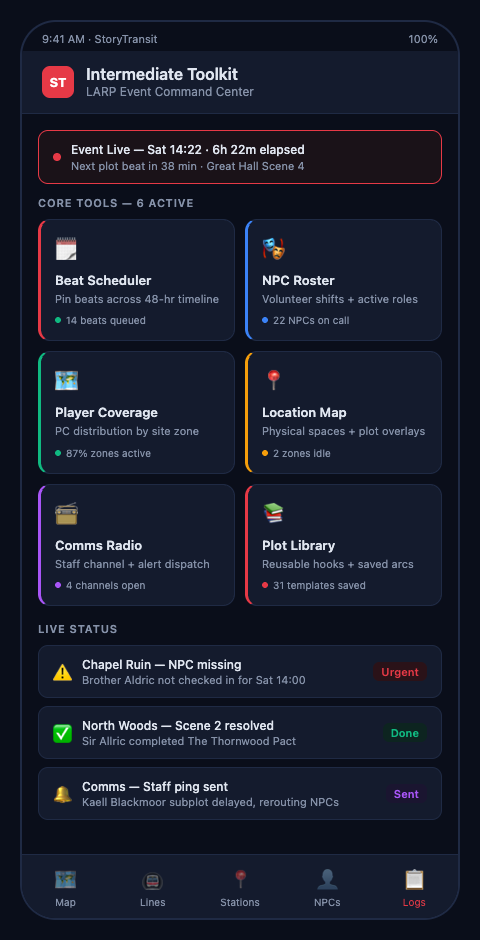
StoryTransit approaches event tracking as a transit system: each plot line is a route, each story beat is a station, and the event tracking toolkit is the control room infrastructure. For intermediate events, the control room does not need to be elaborate — but it needs to cover five specific functions.
Function 1: Pre-event plot documentation with station-level detail. Your plot bible describes the narrative. Your station records describe the operational execution — what triggers each beat, who delivers it, what state it leaves behind. These are separate documents with different purposes. At the intermediate level, station records can live in a shared document with clear structure, but they need to exist as discrete records rather than narrative paragraphs. Each record should answer: trigger, actor (which NPC or runner), player-facing content, and post-scene status.
Function 2: A runtime status board visible to all runners. During the event, you need one place where any runner can look and see the current state of every active plot line. Not a radio channel — a visual record. At the intermediate level, this can be a shared spreadsheet with live editing access. What matters is that it is shared, visible, and updated during runtime rather than after. The LARP organizer toolkit breaks down when this component is missing, because runners default to individual memory and memory conflicts produce coordination failures.
Function 3: NPC dispatch and scene assignment records. Which costumed volunteer is assigned to which station, when they go on, and what they have been briefed on. At the intermediate level, this is a simple table: NPC name, plot line, station, shift window, briefing status. When a pivot requires re-assigning a volunteer, this table tells you immediately who is available and which scenes they are already carrying. Organizing and Running a Successful LARP Event
Function 4: Post-event review documentation. Centralized platforms reduce errors, and post-event reviews with structured documentation improve future runs. Event Management Best Practices for Unmatched Efficiency At the intermediate level, a one-hour post-event review using a structured template — what fired as planned, what was adjusted, what failed silently, what players fed back — generates more operational value than weeks of pre-event speculation. The review notes become the foundation of the next event's contingency planning. A template with four fields — what worked, what failed, what was adjusted at runtime, and what should be different next time — covers most of what the review needs to capture. Keep it short and complete it before the team disperses.
Function 5: A persistent plot thread archive. At the intermediate level, many events involve recurring characters, ongoing faction dynamics, and plot threads that carry forward from one event to the next. The event tracking toolkit needs a place to archive plot state at the end of each event — what resolved, what is ongoing, what was introduced but not developed. Legacy administration tools like Grapevine have served this function for years. Grapevine LARP Administration Utility Intermediate organizers need the equivalent in whatever toolkit they are building.
The future LARP software landscape is moving toward integrated platforms that cover all five functions in one product. In the meantime, understanding what each function requires is what lets intermediate organizers assemble a workable toolkit from the tools already available to them. Experienced operators who have built their own systems over many events tend to develop what might be called veteran plot libraries — reusable documentation templates and NPC frameworks that function as a toolkit accumulated over time.
Building the Toolkit Incrementally
The intermediate organizer toolkit does not need to be assembled before the first multi-plot event. It gets built across events, adding components as their absence creates friction.
Start with the runtime status board. If you only implement one component from the list above, make it the shared runtime status board. Most intermediate organizers already have the pre-event documentation covered — it is the runtime visibility that breaks down first. A shared document with real-time editing access that all runners can update from their phones is a meaningful upgrade over radio-only coordination.
Add NPC dispatch records before you scale NPC count. At six volunteers, individual briefings are manageable. At twelve, they are not. Add the NPC dispatch table before the volunteer count grows past the point where individual briefing is practical. This is a common intermediate organizer mistake: building toolkit components reactively after the problem they solve has already caused an incident.
Build post-event review into the event structure, not as an add-on. Schedule the review before the event, not after. Assign one person to capture notes. Use a template rather than an open conversation. The review documentation feeds directly into pre-event planning for the next run, making each event incrementally more operational than the last. This mirrors the approach effective project teams use after complex productions. Workshop Practice, in Practice – A Functional Workshop Structure Method
Do not build all five functions at once. Intermediate organizer toolkit failures often come from over-engineering before you have the event volume to validate the system. Start with the runtime status board. Add the NPC dispatch table before your next event. Add post-event review documentation the event after that. By the third or fourth run, the toolkit is functional without having required a significant upfront investment.
The intermediate DM toolkit concept in tabletop gaming captures the same idea: the tools you need at an intermediate level are different from what you needed as a beginner, and different again from what you will need at advanced scale. Building for where you are now, with awareness of where you are going, is the operational logic that prevents toolkit gaps from becoming event failures.
One final consideration for intermediate organizers building toward larger events: the toolkit you build now should be designed for handoff. If you are the only person who knows how to use your event management system, you have not built a toolkit — you have built a dependency. Every component of your organizer toolkit should be legible to a runner who is joining your event for the first time. Documentation that requires institutional knowledge to interpret is documentation that fails the moment you are not available to explain it. The organizer tools that survive across multiple events and multiple organizers are the ones built around shared, documented formats—not around one person's memory of how the event management toolkit was structured.
Build the Infrastructure Before You Need It
The LARP organizers who build their event tracking toolkit between events rather than during them are the ones who run weekend-long events that feel stable regardless of what the story does. The infrastructure is invisible when it works — runners make confident calls, volunteers get clear briefs, and plot beats fire on time.
The toolkit is also a communication tool for your runner team. When you can show a new runner a runtime status board that has clear column labels, a shared NPC dispatch table, and documented station records, they understand the event structure without a lengthy orientation conversation. The toolkit does organizational work that would otherwise require direct runner attention. Every component you build between events is attention you free up during events.
StoryTransit is built for intermediate LARP organizers who have outgrown improvised systems and want a purpose-built plot dashboard that covers runtime status, NPC dispatch, and post-event documentation. If you are running multi-plot live-action events and feel the gaps in your current toolkit, join the waitlist for LARP organizers and get early access before your next event.