The Intermediate DM's Toolkit for Campaign Continuity
The Gap Between Good Sessions and a Good Campaign
You can run a brilliant individual session and still be building a bad campaign. The two skills are related but not the same. Running good sessions rewards improvisational skill, table energy, and encounter craft. Building a good campaign requires something different: the ability to maintain continuity across dozens of sessions, keep dozens of NPCs consistent, and honor promises you made to your players 40 sessions ago.
EN World's thread on running homebrew campaigns captures the frustration: DMs cite continuity tracking and accumulating loose threads as the primary challenge in homebrew campaigns. Not combat balance, not world design, not player management — continuity. The threads pile up, the notes fragment, and somewhere around Session 30 you're winging things you already established.
The memory science explains why this happens even to organized DMs. The Ebbinghaus Forgetting Curve shows that humans forget approximately 50% of new information within an hour and 90% within seven days without reinforcement. If you established a detail about the Brenhorn Village blacksmith in Session 12 and haven't referenced it since, you've almost certainly forgotten it by Session 50 — and so has your player, until the moment it becomes relevant and your inconsistency is exposed.
Sly Flourish's survey of 4,000 DMs found NPC prep and note organization as the highest-impact prep activities — not adventure design, not encounter balance. The DMs running memorable campaigns are the ones who show up to sessions with organized records, not just creative ideas.
The intermediate DM toolkit for campaign continuity is about building the external memory system that compensates for your brain's natural forgetting curve.
The Continuity Toolkit: Five Core Components
Think of campaign continuity as a transit operations center. The city's trains run smoothly not because the drivers have perfect memory, but because every piece of relevant information is available in the operations center the moment it's needed. Your DM toolkit is that operations center.
Component 1: The NPC Continuity Sheet. Every NPC who has appeared more than twice gets their own record: name, role, location, current agenda, commitments made to the party, and any unresolved threads. This isn't a full character sheet — it's a status record. The blacksmith in Brenhorn Village either promised the party a discount on enchanted weapons or didn't. Your NPC continuity sheet tells you which.
Component 2: The Subplot Status Board. A single document listing every active subplot in the campaign, tagged by status: active, dormant, or resolved. Active subplots need attention this session or next. Dormant subplots are on the map but waiting. Resolved subplots get archived. If you don't know the current status of every active subplot without digging through session notes, your status board needs building.
Component 3: The Faction Disposition Tracker. For each major faction, record their current goals, their current resources, their attitude toward the party, and their most recent significant action. Factions advance even when the party isn't interacting with them. Your tracker lets you calculate what changed between sessions without relying on memory.
Component 4: The Session Log Archive. Every session gets a brief log: in-world date, real-world date, key decisions made, NPCs encountered, subplots advanced or opened, and unresolved questions. This archive is your searchable history. When a player asks "didn't we already tell the guard captain about the cult?" your session log answers in 30 seconds.
Component 5: The Foreshadowing Payoff Receipt. Every time you plant a foreshadowing element — a mysterious brand on a dead captain's shoulder, a half-elf bard asking about a rival who disappeared — log it with the session number and a brief description of the intended payoff. This list is your promise ledger. Any receipt that's been open for more than 25 sessions is overdue for activation.
Future continuity tools for homebrew DMs covers where tooling for these workflows is heading — but the five components above are available to build right now with any note-taking system.
Veteran self-documenting worldbuilders have developed sophisticated personal systems for these same disciplines, and the intermediate DM's toolkit borrows their best practices without requiring years of experience to implement.
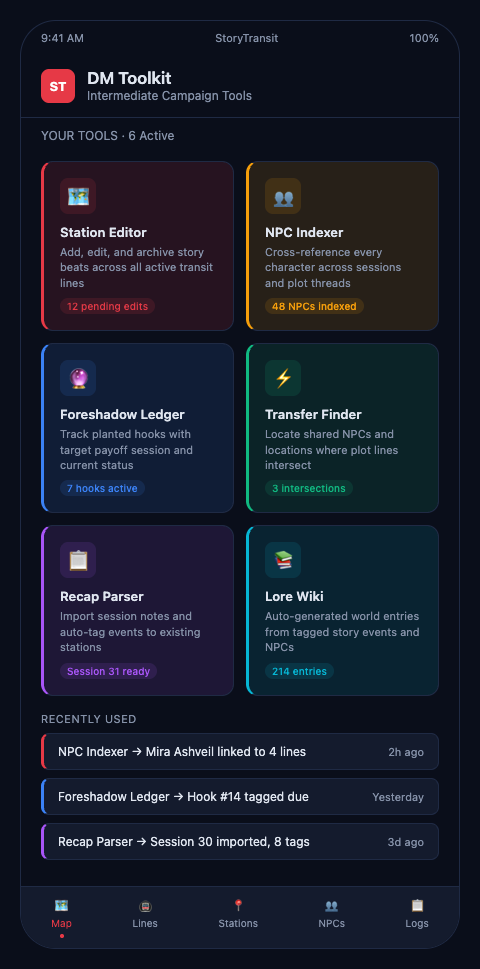
StoryTransit consolidates all five components into a single campaign continuity dashboard, structured specifically for homebrew D&D dungeon masters running long-form narratives.
Implementing Your Toolkit Without Burning Out
The failure mode for intermediate DMs discovering continuity tooling is over-engineering. You build an elaborate wiki, spend more time documenting than playing, and then abandon the system when it stops feeling like fun. The goal is sustainable documentation, not perfect documentation.
Start with three of the five components, not all five. The NPC continuity sheet, the subplot status board, and the session log archive are the core triad. Add the faction tracker once you have four or more factions with distinct agendas. Add the foreshadowing receipt once you've established that you're consistently planting long-range seeds.
LegendKeeper offers interactive maps, real-time multiplayer, and auto-interlinking for campaign continuity — a strong option if you want a visual, interconnected system. Master the Dungeon's campaign management tools provide dedicated NPC pages with relationships, motivations, and secrets that align closely with the NPC continuity sheet component.
The five components work as a system, not as independent tools. When you update the session log archive after each session, that update should trigger a review of the subplot status board — did any subplots advance, stall, or resolve? If a subplot resolved, retire it and check your foreshadowing receipt list for any seeds that were connected to it. If a faction took an action, update the faction disposition tracker. Maintaining the components in sync is what keeps the system useful; a session log archive that doesn't connect to the subplot board is just a diary.
Build a pre-session checklist that touches all five components in under 10 minutes: review active subplots (status board), check any NPC you'll use today (continuity sheets), note any faction actions since last session (disposition tracker), confirm any foreshadowing seeds due for reinforcement (receipt list), and scan the last two session log entries for unresolved questions. That 10-minute review is the dungeon master resources discipline that separates consistent campaigns from ones that drift. It's less glamorous than session prep, but it's where campaign continuity actually lives.
Stanford's decade of data on multitasking shows that chronic multitaskers demonstrate inferior working memory and struggle to filter irrelevant information — a direct argument for D&D organization tools that externalize information rather than forcing DMs to juggle it cognitively during sessions.
The intermediate forum toolkit for play-by-post GMs, described in the intermediate forum GM toolkit post, addresses many of the same documentation challenges in an asynchronous context — the parallels between managing long PbP threads and long tabletop campaigns are strong.
Advanced Tactics for Continuity Discipline
Weekly toolkit review. Before each session's prep, spend 10 minutes reviewing your subplot status board and faction tracker. Identify one dormant subplot to activate and one faction action to describe. This prevents the accumulation of stale threads and keeps your world feeling dynamic without requiring massive prep sessions.
The 10-session audit. Every 10 sessions, run a full toolkit review. Archive resolved subplots. Flag NPC continuity sheets that haven't been updated recently. Check your foreshadowing receipt list for any seeds that have been open longer than 20 sessions. The 10-session audit is your maintenance window — skip it and entropy accumulates.
Tagging by party knowledge. In your NPC continuity sheets and faction tracker, tag every significant piece of information as "party knows," "party suspects," "party doesn't know," or "party got wrong." The last category is critical. If the party believes the Brenhorn Village blacksmith is aligned with the cult and he isn't, that false belief is a continuity element that needs to persist until the party discovers the truth.
Cross-referencing subplots to NPCs. Every active subplot should name at least two NPCs who can be used to advance it. This prevents the common failure where a subplot stalls because the relevant NPC was killed by the party and you have no other vector for that thread. Pre-building NPC networks per subplot is basic but effective continuity insurance.
The intermediate DM toolkit isn't about creating bureaucracy — it's about building the operations center that lets you run your creative best at the table instead of scrambling to remember what you established in Session 12. The tools exist. Use them.
Stop Running Your Campaign from Memory
Every homebrew DM who has felt that creeping dread of "I think I said something contradictory" knows what insufficient continuity tooling costs in confidence and coherence. Build the five components above, review them before every session, and audit them every 10 sessions. Your campaign at Session 100 will be as coherent as Session 10 — and that coherence is what separates a good campaign from one your players talk about for years.
StoryTransit was designed from the ground up as the intermediate DM toolkit for campaign continuity — not a general wiki, but a structured system built for the specific documentation challenges of long-running homebrew D&D. Join the waitlist and get the operations center your campaign deserves.