The Intermediate Forum GM's Toolkit for Thread Management
What Changes at the Intermediate Level
A beginner forum GM manages one IC thread and one OOC thread. Story continuity lives in their head. Thread organization is a pinned post that lists the rules. This works fine for campaigns with three to five players and a runtime under two months.
The intermediate forum GM runs campaigns that last longer, involve more players, and contain more concurrent plot threads than any single person can track mentally. At the intermediate pbp level, the structural question isn't "how do I organize my forum?" — it's "how do I build a system that keeps the story coherent across sixty, ninety, or a hundred and twenty IC posts spread across a dozen threads?" Forum organization that worked for a beginner campaign — a pinned rules post and a single IC thread — actively breaks at this scale. You need actual thread tools, not conventions.
62% of GMs abandon campaign managers within six months, with onboarding friction and lock-in as the primary reasons. This statistic describes the intermediate stage failure mode precisely: GMs invest in complex tools, find the overhead unsustainable, abandon the tool entirely, and fall back on mental tracking — which also fails at the scale they're now operating at.
The TTRPG market reached $2.4 billion in 2024, with GM tool adoption growing 38% since 2020. The tool landscape is expanding faster than most intermediate GMs can evaluate it. The challenge isn't finding tools — it's knowing which tools solve which problems.
The Intermediate Forum GM Toolkit
StoryTransit models forum GM thread management as a transit system: threads are routes, story beats are stations, and the GM's job is to maintain the map so everyone knows where every line is going. A well-documented play-by-post toolkit is what allows a GM to maintain consistent post cadence without spending twenty minutes of context reconstruction before every IC post.
At the intermediate level, that map requires four categories of tool:
1. Campaign spine documentation. The equivalent of the transit authority's master route plan. This is your campaign bible — a document that records your active plot lines, their current stations, their intended destinations, and the open promises each line carries. This doesn't need to be elaborate. A minimal notes system indexed by NPC, location, and plot beats lets GMs prep faster without losing campaign context. The key is that it exists outside your head, is updated after each session, and is searchable.
2. Player-facing wiki. The transit map players can see. Not the full campaign bible — just the information characters would plausibly know: NPC names and roles, faction relationships, in-game locations, recently concluded scene summaries. Tools like World Anvil and Kanka are purpose-built for this layer. Kanka supports 375,000+ GMs with free unlimited campaigns including character and timeline tracking. World Anvil adds interactive maps and session notes. Neither is essential; both are significantly better than maintaining player-facing documentation in a forum thread.
3. Thread status dashboard. A single OOC post — pinned or regularly bumped — that lists every active IC thread with its current scene, last active date, and player participants. This is the live transit board: a glanceable status view that tells any player exactly which threads are active and which are waiting. Update it when threads open and close. It takes three minutes per update and saves everyone the pagination archaeology of trying to locate their current scene.
4. Promise log. The tool intermediate GMs most commonly lack. A running record of every story commitment made in IC threads: villain threats, NPC vows, faction consequences announced, PC actions with deferred mechanical outcomes. These are the stations your routes are supposed to stop at. Without a promise log, you're running lines with untracked scheduled stops — and the story drifts when you miss them.
Campaign managers differ from worldbuilding tools: GMs need session-linking and player-access features specifically. The intermediate toolkit described above deliberately separates these functions: campaign spine is for the GM, wiki is for players, status dashboard is operational, promise log is narrative accountability.
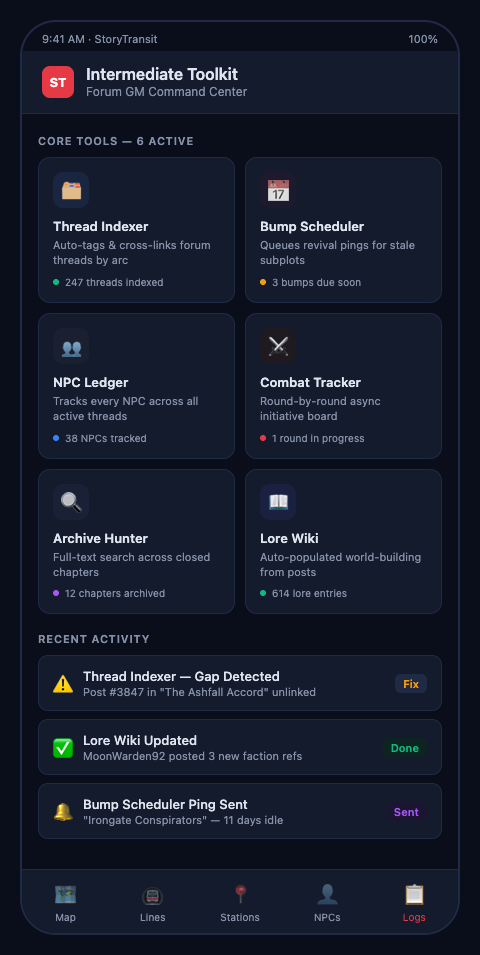
Advanced Tactics: Building for the Long Campaign
Intermediate tools break down when campaigns run past four months. The campaign bible grows unwieldy. The promise log becomes a backlog. The thread status dashboard has twenty entries. These are good problems — they mean your campaign survived — but they require a toolkit evolution. The intermediate DM toolkit for tabletop campaign continuity runs into the same structural evolution at a similar cadence: parallel problems, parallel solutions, different specific tools.
Archival rotation. When a plot line closes, move its entries from active documentation to an archive section. Keep the last state and resolution on record; remove it from the active view. A bloated active view is as useless as no tracking at all.
Delegation. In campaigns with five or more players, designate a player as session recorder. They maintain the player-facing wiki summary after each major scene. This distributes documentation overhead and gives engaged players a structural role. It also means you have two independent records of what happened — useful when your memory and the archive disagree.
When the toolkit becomes the bottleneck. The four-layer toolkit described above has a failure mode that intermediate GMs hit at month five or six: the documentation discipline that was manageable at month two is now a maintenance burden because the campaign has grown in three dimensions simultaneously — more players, more plot threads, more archive depth. When the toolkit starts taking longer to maintain than the IC posts take to write, something has to give.
The right response is pruning, not abandonment. Archive completed plot lines. Collapse the NPC list to active-only. Move the promise log from a comprehensive record to a thirty-day rolling window. The goal of the intermediate toolkit isn't to document everything — it's to maintain the minimum viable context that lets you write the next IC post accurately. As the campaign grows, "minimum viable" may mean less documentation per item, not more.
One benchmark that works: if your pre-IC-post context retrieval takes more than two minutes, your toolkit has accumulated more than it needs to. Trim until retrieval is fast, then stop trimming.
The forum organization audit. Every two months, spend fifteen minutes assessing thread structure: which subforums have threads that could be consolidated, which thread names no longer accurately describe their current content, which pinned posts are outdated. Forum organization degrades continuously in a long-running campaign because the forum was structured for the campaign as it was, not as it became. Small periodic adjustments cost less than a major restructure when the organization has become unnavigable.
For the long-horizon view, the future pbp tools guide covers where forum GM tooling is heading as AI-assisted narrative tracking matures. If you're building your intermediate toolkit now, it's worth knowing which manual processes are likely to become automated in the next two years.
Veteran forum GMs who self-document their worlds eventually extend this same toolkit into world records that serve multiple campaigns across years, but that extension is a separate discipline from the intermediate-level concerns addressed here.
Build the System That Outlasts Month Four
What "intermediate" actually means in pbp terms. Beginner forum GM problems are about getting started: which platform, how to structure threads, how to write IC posts players respond to. Intermediate forum GM problems are about sustaining: why the system that worked in month two doesn't work in month five, which tools to add and in what order, and how to maintain GM energy across a campaign that won't end for another eight months. The toolkit above addresses this second category. It assumes you can already run a campaign — the question is whether you can run one that lasts.
The intermediate forum GM's biggest risk isn't running out of story ideas — it's running out of organizational infrastructure at the exact moment the campaign becomes complex enough to need it. Most GMs hit this wall at month three or four, improvise through it, and either collapse or accidentally discover one of the four toolkit layers described above.
StoryTransit gives play-by-post forum GMs a structured approach to thread management that integrates campaign documentation, player-facing reference, operational status tracking, and narrative promise logging into a coherent system. Join the waitlist for play-by-post GMs to see how the toolkit architecture fits your current campaign stage.