The Future of Play-by-Post Storytelling Tools
The Infrastructure Gap in PbP Tooling
Forum software solved the wrong problem for play-by-post. phpBB, vBulletin, Jcink, and their successors were built to host discussions—threaded conversations with reply functions, subforum organization, and pagination. These features are adequate for debate forums and fan communities. They're structurally misaligned with long-form collaborative fiction, where the relevant unit isn't "the reply" but "the story beat," and where the critical challenge isn't thread organization but narrative continuity across hundreds of posts.
Asynchronous text-based communication research confirms that async text tools enable deep collaborative reflection—the mode that makes PbP's storytelling so rich. But the research also shows that the tools must actively support that collaboration, not just host it passively. Current forum platforms host PbP; they don't support it.
The specific gaps are predictable and consistent across platforms. The forum GM toolkit that intermediate GMs build manually today — campaign spine documentation, thread status dashboards, promise logs — exists specifically to fill these gaps. Forum software has no concept of a "plot arc"—it knows threads and subforums. It has no dormancy detection for narrative threads—it tracks last-post timestamps for search purposes, not story continuity purposes. It has no player arc visibility tools—every player sees the same flat archive, regardless of which storylines they're involved in. And it has no chapter documentation structure—closing a chapter means moving threads to an archive subforum, a gesture toward structure with none of the substance.
The TTRPG market valued at $1.87B in 2024 and projected to reach $5.11B by 2033 suggests the demand for better GM software is real and growing. Play-by-post sits inside that market with no purpose-built tooling—a gap that purpose-designed future pbp tools are positioned to fill. World Anvil has moved furthest toward addressing this gap from the worldbuilding side, with timelines, maps, and session notes—but it's built for the GM's private documentation rather than the collaborative forum storytelling workflow itself.
What Forum Storytelling Innovation Looks Like
The next generation of forum narrative platforms will treat the story as the primary object, not the thread. This distinction matters: if the thread is primary, the tool's job is organizing threads. If the story is primary, the tool's job is mapping narrative structure and making that structure navigable.
StoryTransit is built on the second model. The transit metaphor makes this concrete: transit lines (plot arcs) and stations (story beats) are first-class objects in the platform. IC posts attach to stations; threads attach to lines. The story structure is always visible, regardless of how many pages of archived posts sit underneath it. This means a GM running a three-year campaign can navigate to a specific story beat from Year One through the transit map rather than scrolling through paginated archive threads.
Several near-future capabilities will define competitive forum narrative platforms:
AI-assisted thread surface. Microsoft Research's GENEVA project demonstrates that large language models can generate and track branching narratives at a structural level. The application to PbP isn't AI writing IC posts—it's AI reading the existing archive and surfacing dormant subplots that the GM hasn't visited in 60+ days, flagging inconsistencies between established facts and recent posts, and generating continuity prompts. AI tools are already in use by 50%+ of game studios for narrative management; PbP-specific versions are the logical next step. The practical form this takes for GMs is a weekly digest: here are the three storyline threads that have gone quiet, here are two IC posts that may contradict an established world fact, here are the next narrative stations that were planned but haven't been reached.
Player-facing story maps. Current GM software builds tools for the GM's private use. Future platforms will include player-facing views: a transit map showing which lines each player's character is currently riding, what stations are upcoming, and which dormant stops have been seeded but not yet reached. This gives players the narrative context they need without requiring them to read 40 pages of archive. The player-facing view is necessarily filtered: players see the lines their characters are on, plus the publicly visible intersections—not the GM's full map including future plot developments and private NPC motivations.
Structured onboarding flows. New player entry into mid-campaign PbP is currently ad-hoc—a GM-written welcome post, a link to the OOC catch-up thread, and a "read what you can." Research on how potential new members approach online communities shows that first experiences build the mental models that determine whether new members stay. Purpose-built onboarding flows, tied to the transit map, will let new players enter at a specific station with the exact context they need for that station—not the entire campaign history. A structured onboarding flow generates the player briefing automatically from the transit map data: here's your entry station, here's the line you're boarding, here are the three most relevant IC posts to read before your first post.
Dormancy analytics. Forum software can tell you when a thread was last posted to. It can't tell you whether that thread carries an unresolved narrative obligation, whether the plot stakes have shifted enough to affect the dormant arc, or how that dormancy compares to the posting frequency the thread had when it was active. Future forum narrative platforms will surface dormancy in context: not just "this thread hasn't had a post in 30 days" but "this thread carries three unresolved narrative hooks and its last posting frequency was 4 posts/week."
What to Demand From Your Forum GM Toolkit
Veteran forum documentation practices show that the GMs already running the best long-term campaigns have built these capabilities manually—through wiki maintenance, structured OOC posts, and meticulous intake logging. The next generation of GM software makes those practices automatic. When intake logging happens at post time because the tool prompts for it, the discipline becomes architectural rather than personal—it doesn't depend on the GM remembering to maintain it.
The forum GM toolkit available to PbP GMs today is largely a collection of workarounds: spreadsheets, wiki pages, and pinned OOC threads. Purpose-built play-by-post technology will consolidate these into a single interface where story structure, thread organization, and player management exist in the same tool. The consolidation matters because the workarounds create maintenance friction: updating three separate documents when a single narrative event occurs is enough friction to cause the system to fall behind within weeks.
Cross-niche, future continuity tools for homebrew DMs are converging on the same requirements: visual story mapping, dormancy detection, and archive navigation. PbP-specific implementations will add the asynchronous post-tracking and multi-player coordination that make forum storytelling innovation distinct from tabletop session planning.
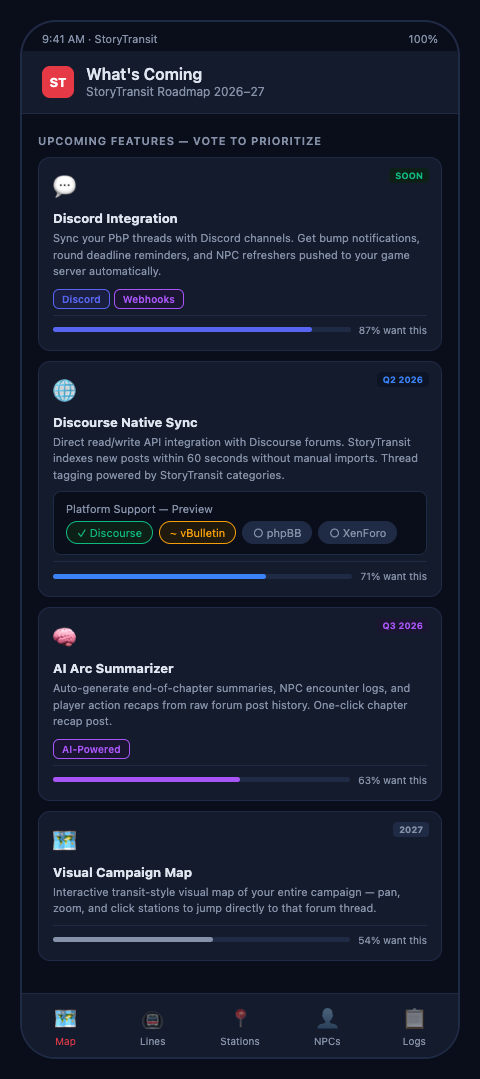
The timeline for these tools is not speculative. StoryTransit represents one implementation path, already in active development. The market demand is established, the underlying research on what PbP GMs need is consistent, and the technical capabilities required—narrative graph storage, async notification systems, player-facing filtered views—are all mature. The question for forum GMs evaluating their options isn't whether better tools are coming but which ones will fit their specific campaign needs when they arrive.
Advanced Considerations for Forum GMs Evaluating New Tools
Platform migration compatibility. Any future PbP tool must export its story structure data in a format that survives platform migrations. The worst outcome is building a detailed transit map in a tool that doesn't export to anything portable. Prioritize tools with open data formats or documented export workflows. Discourse's migration infrastructure has handled large-scale community moves across platforms; the lesson for GM tools is the same—portability is a non-negotiable feature, not an edge case.
Async-first design. Tools built for synchronous play (VTTs, session-planning tools) don't map cleanly onto PbP's one-post-per-day rhythm. Evaluate whether a tool's notification and status systems are built for asynchronous environments or adapted from synchronous ones. An async-first design surfaces dormant threads through periodic digest notifications rather than real-time alerts—the pacing model is weekly review, not hourly refresh.
Collaborative visibility. The GM-only dashboard is a legacy design. Future PbP tools should support configurable player views that give each player the narrative context relevant to their arcs without exposing every GM note or future plot development. The transit map is the natural player-facing view: each player sees their character's route and the lines they're currently riding, without seeing the GM's full map of all active and dormant storylines.
Archive depth. Ask how a tool handles campaigns with 2+ years of history. Does performance degrade with archive depth? Can you navigate to a specific plot beat from Year One without loading every post between then and now? Archive depth is where most current tools fail silently—they work fine for active content and become unusable as the history grows.
Integration with existing forum platforms. The ideal near-term tool doesn't replace the forum—it sits alongside it. GMs shouldn't have to migrate their existing IC threads to use a narrative tracking tool. The forum remains the posting environment; the tool provides the map layer on top. This integration model lowers adoption friction significantly and allows GMs to apply the transit map structure to campaigns already years deep.
StoryTransit is being built with these requirements as baseline, not stretch goals. Play-by-post forum GMs who join the waitlist now are directly shaping what the platform prioritizes—your use cases, your archive depths, and your player management needs are informing the development roadmap. Sign up and help build the future pbp tools the community actually needs.