The Future of Continuity Tools for Homebrew Dungeon Masters
The Gap Between What DMs Have and What They Need
A DM running a multi-year homebrew in 2025 has more tool options than ever — World Anvil, Kanka, Obsidian, Notion, physical index cards, and a dozen AI assistants. Yet the core continuity problem remains unsolved for most of them. A subplot seeded 47 sessions ago still gets dropped. An NPC's motivation shifts without anyone catching the inconsistency. A foreshadowing thread from Session 12 sits in a folder no one opens before Session 87.
The problem is not a lack of storage. It is a lack of structure designed specifically for narrative continuity across long D&D campaigns. The intermediate DM toolkit covers the current generation of tools that bridge between basic note-taking and purpose-built continuity systems — useful context for understanding the gap between what exists now and what is coming.
Lost in Stories: Consistency Bugs in Long Story Generation by LLMs documents how even AI systems contradict established facts and character traits in long narratives without specialized memory tools. If AI systems trained on vast text corpora struggle with long-narrative consistency, unassisted human DMs face the same fundamental challenge without the compute.
AI in TTRPGs shows that tools now exist to transcribe sessions, extract NPC and location entities, and generate recaps for ongoing campaign memory. These capabilities are directionally correct — but they solve the retrieval problem, not the structure problem. A DM who can search their notes more efficiently still needs those notes to be organized around a continuity framework.
The gap between current tools and purpose-built continuity infrastructure is wider than most DMs realize because the problem is invisible until the campaign is deep enough to surface it. A 10-session campaign can run on Notion and scattered notes with no observable cost. A 100-session campaign with the same infrastructure is paying continuity debt on every session — in the form of dropped threads, reactive inconsistency fixes, and the persistent anxiety of knowing there are things you have forgotten that you cannot remember that you have forgotten.
That last form of cognitive debt — not knowing what you do not know — is what the next generation of continuity tools is specifically targeting. Tools that surface what you have not checked recently, that flag when an NPC's behavior diverges from their last documented motivation, that count sessions since a subplot line last moved, are tools that address the problem that cannot be solved by storage or search alone.
The Transit Map as the Next-Generation Interface
The future of continuity tools for homebrew dungeon masters is not a better search engine over unstructured notes. It is a structured narrative map — specifically, a transit-style map where subplots are lines, plot beats are stations, and character arcs are routes.
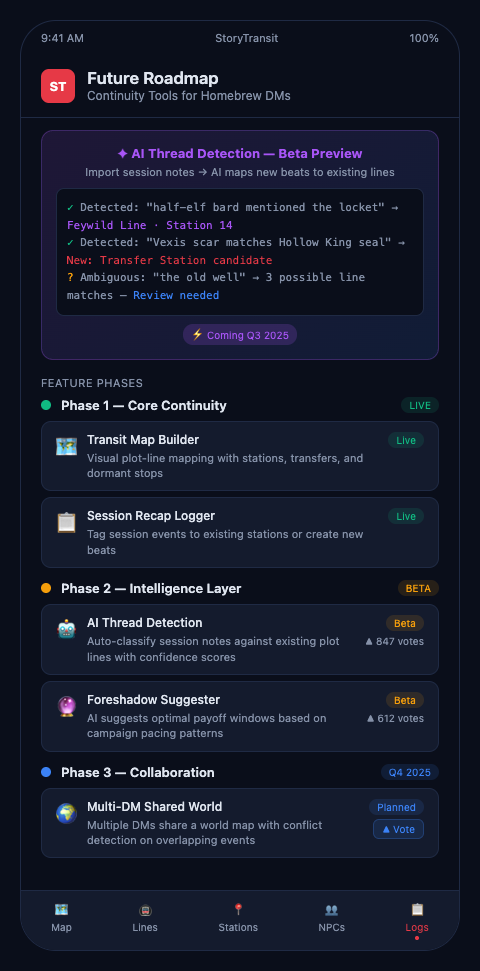
This is the architecture StoryTransit is building. The visual metaphor matters: a transit map communicates system state at a glance in a way that a wiki page, a document folder, or a tag cloud cannot. A DM who can see all of their subway lines at once — active, dormant, approaching a junction — has fundamentally different situational awareness than one scrolling through session notes.
Knowledge graph integration for AI story generation found that graph-structured approaches gave users fine-grained control over story generation and significantly reduced factual drift. The same structural principle applies to DM continuity tools: when world-state is represented as a graph of connected entities and events, not a flat document, the DM can see relationships that were previously invisible.
SCORE: Story Coherence and Retrieval Enhancement achieved a 23.6% improvement in story coherence and a 41.8% reduction in narrative hallucinations by implementing dynamic state tracking in AI story systems. The mechanism — maintaining a live world state that updates as events occur — is exactly what a next-generation DM continuity tool needs to replicate for homebrew campaigns.
The emerging capabilities breaking down by category:
Automatic session parsing: Tools that ingest session recordings or notes and extract NPC appearances, subplot progressions, and new foreshadowing seeds without manual entry. This removes the biggest friction point in DM documentation.
World state propagation: When an event is logged — an NPC dies, a faction falls, a subplot resolves — the tool automatically updates every connected entity. No more manually hunting through 200 hours of campaign history to find everything that referenced the fallen NPC.
Dormant subplot surfacing: Proactive alerts when a subplot line has been inactive for a defined number of sessions, with a summary of its current status and last relevant session. The system surfaces dormant stops before they become forgotten ones.
The Economics of the Coming Market
Worldwide TTRPG Market in 2024 valued the TTRPG market at approximately $2 billion with an 11.84% compound annual growth rate. At that scale, purpose-built continuity tooling for homebrew DMs is a commercially viable category, not a niche curiosity.
MythWeaver demonstrates the demand: it reduces campaign prep from three hours to thirty minutes using AI built specifically for tabletop continuity needs. Tools solving real DM pain points with quantifiable time savings attract sustained adoption.
The cognitive debt framing from arXiv is useful here: cognitive debt — accumulated mental overhead in complex systems — describes exactly why manual DM note-keeping becomes unsustainable as campaigns grow. The economics of long-campaign DM tooling are driven by the cost of that cognitive debt, which grows nonlinearly with campaign length.
The DM who invests three hours per week in campaign prep over five years has put in roughly 780 hours. If even 25% of that prep time is consumed by reconstructing what was previously established — reviewing old notes, tracing NPC histories, hunting for foreshadowing threads — that is nearly 200 hours of investment that produced no new campaign value. Continuity tools that reduce that reconstruction cost from 25% to 5% of prep time free up more than 150 hours of creative capacity over a five-year campaign's life. That is the economic case for purpose-built homebrew DM narrative platforms, and it is why the market for them is growing.
What to Look For in Campaign Management Technology
Relationship-first design: Tools that model the world as a network of connected entities, not a collection of documents. A villain's motivations, their faction affiliations, their subplot lines, and their history with the party should all be queryable from a single node. A DM preparing Session 87 should be able to pull up the Merchant Council and see, in seconds, every interaction the party has ever had with them, every promise made, every subplot line they anchor.
Active continuity checking: Not passive retrieval, but proactive flagging — the tool notices when a new event contradicts an established fact and surfaces the conflict before the session, not after. The difference between a DM who catches an inconsistency at prep time and one who discovers it at the table is the difference between a smooth retcon and a disruptive one.
Session-native workflows: The tool should fit into the DM's actual session prep workflow, not require a separate documentation session after every game. The best continuity infrastructure adds minimal friction to the process of prepping and running sessions — it captures documentation as a natural byproduct of the work the DM is already doing.
Dormant line surfacing: Proactive alerting when subplot lines have been inactive beyond a threshold — say, ten sessions with no movement. These alerts function as a conscience for the campaign, reminding the DM that a promise was made and has not yet been honored. Over 200 hours of campaign history, those reminders are the difference between a campaign that pays off its narrative debts and one that quietly accumulates them.
The practices that veteran self-documenting DMs use today are the manual precursors to what automated continuity tools will do — understanding those practices clarifies what the automation is actually replacing.
Play-by-post formats face the same continuity challenges with an additional archival layer. The future pbp tools post explores how continuity technology is evolving for asynchronous written campaigns alongside tabletop ones.
Get In Early on the Homebrew DM Narrative Platform
The homebrew DMs who will benefit most from next-generation continuity tools are the ones already running campaigns with real narrative stakes — campaigns where a dropped subplot actually costs something, where an inconsistent NPC actually breaks immersion, where 47 sessions of foreshadowing actually deserve to pay off. Those DMs are not waiting for a generic note-taking app to add a few TTRPG-specific fields. They need purpose-built infrastructure for the specific problem of narrative continuity at scale.
StoryTransit is being built specifically for the continuity problem that every long-running homebrew dungeon master faces. The waitlist is the direct path to shaping what the tool becomes — early members get input on which features ship first.
Homebrew D&D DMs running campaigns with real narrative stakes — years of sessions, dozens of NPCs, and subplots that deserve payoff — can join the waitlist now and be among the first to access the transit-map interface and automated continuity surfacing that the next generation of campaign management technology is converging on. Join the Waitlist for Homebrew D&D DMs before the tools leave you behind.