How Veteran DMs Build Self-Documenting Homebrew Worlds
The Documentation Debt That Accumulates in Silence
Every session that ends without documentation creates a small deficit. The NPC the party met, the faction whose allegiance shifted, the foreshadowing seed planted in the dungeon's antechamber — all of it lives in the DM's head until it gets written down. By Session 30, that deficit has become a library of unsorted mental notes. By Session 100, it is an archive that no single session's prep can adequately reconstruct. The dungeon master workflow that prevents this isn't more documentation effort — it's better D&D world design that builds campaign documentation into the structure of prep itself. Future continuity tools are automating this workflow, but the underlying principle — documentation as a structural byproduct of play, not a separate task — is the veteran DM insight that those tools are encoding.
Managing technical debt in a multidisciplinary data team identifies exactly this dynamic in complex systems: undocumented decisions accumulate cost proportional to their age. A decision documented at the moment it is made costs almost nothing to retrieve. The same decision, reconstructed from memory six months later, costs dramatically more — and may be wrong.
The veteran DM's answer to this is not to document more after sessions. It is to design the session workflow so that documentation happens naturally during prep and play. The world builds its own record as it is played.
With 50M lifetime D&D players and growing homebrew communities, the demand for DM documentation frameworks that do not require heroic post-session effort is not a niche concern — it is widespread.
The specific failure mode that self-documenting systems prevent is the retroactive reconstruction spiral. A DM who has not maintained documentation for 30 sessions faces a compounding problem: before they can prep Session 31, they need to reconstruct what was established in Sessions 1–30. That reconstruction takes time, introduces errors from memory gaps, and creates a documentation artifact that is a reconstruction rather than a contemporary record — meaning it carries the DM's current understanding of what happened, not what actually happened at the table. These two things diverge in ways that matter when players have their own memories of the same sessions.
Veteran DMs who have been running campaigns for five or more years universally describe some version of the same realization: the documentation system they were using was not sustainable, and at some point they had to either rebuild it from scratch or accept that their campaign's history was increasingly fictional. The ones who built self-documenting systems avoided that reckoning.
The Self-Documenting Design Principles
The transit system metaphor clarifies the core principle: a city transit map documents itself by recording the network — every line, station, and connection is part of the map's structure, not a separate annotation. When the network changes, the map updates. The documentation is the structure, not an addition to it.
Veteran DMs apply this principle through three interconnected practices:
Play-native capture: Every piece of world information has a designated location in the structure before it is created. A new NPC gets a node in the NPC web immediately upon introduction — not after the session. A new subplot gets a transit line immediately when it is seeded. The act of creating the story element and documenting it are the same act.
Structured session templates: Session prep uses a consistent template that generates documentation as a side effect. A prep template that includes "NPCs present this session," "subplots advanced," and "foreshadowing planted" produces a session log as a natural output of the prep process. No separate documentation step needed.
Consequence-forward design: After each session, the DM makes one forward-looking entry per significant event: what changed, and what it means for the world going forward. This is not a recap — it is a state update. A one-sentence consequence per significant event takes five minutes and creates a searchable world history.
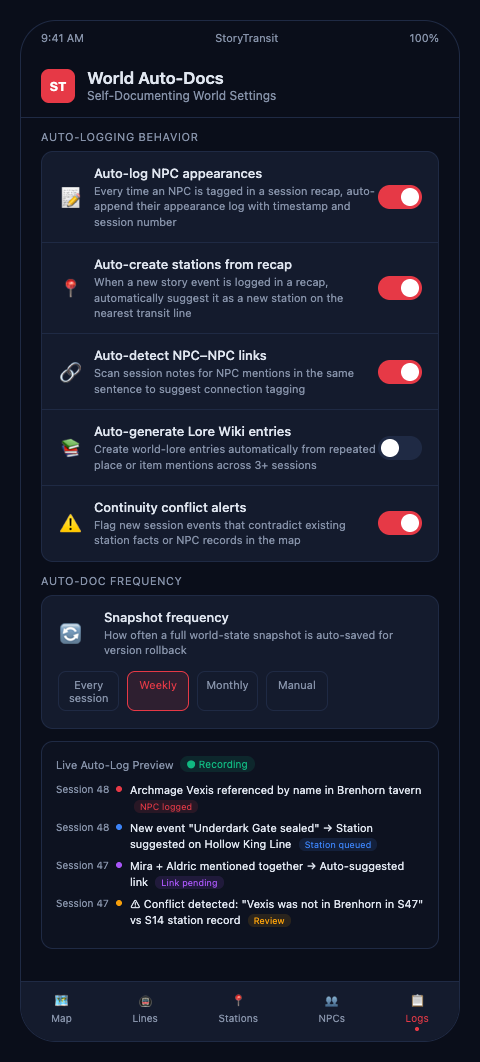
StoryTransit is built on this principle. The transit map updates during session prep — when a DM adds a new plot station, that station is documented in the world record immediately. The world's history is the map, not a separate archive.
Campaign wikis that auto-link sessions, NPCs, and locations demonstrate the same logic in existing tools: when documentation is structurally linked to play elements, it builds itself as the campaign progresses.
The World as Its Own Archive
How to Create a Wiki to Support Your Fantasy Worldbuilding captures the veteran principle precisely: wikis built during play create searchable world records that outlast any single DM's memory. The key phrase is "built during play" — not assembled after the fact.
A Guide to Series Bibles shows how professional television production handles the same challenge at scale. A 50-page series bible for a multi-season show functions as a self-documenting world reference — writers consult it, update it, and rely on it precisely because it was built to be a living document, not a retroactive archive.
DMs can apply the same framework. The "series bible" for a homebrew campaign is the transit map itself: every subplot line, every NPC node, every faction state. When that document is structured as a living record updated during prep, the DM always has a current-state reference, not just historical notes.
Personal Knowledge Management frameworks — Zettelkasten, PARA, and similar systems — give veterans the organizational architecture that makes this work. When notes are structured as linked atomic entries rather than document hierarchies, the world's information connects itself as it grows.
The transit map that StoryTransit provides operates on exactly this principle. Each subplot line is a living document — stations are added as beats occur, NPCs are linked to lines as they engage with them, and the map's current state is always the sum of every documented action. The DM who preps for Session 87 using the transit map is not searching through 86 sessions of notes. They are looking at the current state of a network that has updated itself one session at a time since Session 1.
This is the operational definition of a self-documenting world: the documentation is the structure, and the structure is always current. When a veteran DM introduces a new NPC at Session 30, that NPC's node in the network is created at that moment, connected to their faction and their subplot lines, and becomes part of the world's permanent record. Session 31's prep includes that NPC without any additional effort. That accumulated infrastructure is what makes veteran DMs look effortlessly well-prepared — they are not doing more prep work. They have better infrastructure from which to prep.
Advanced Veteran Documentation Methods
The self-documenting system is most valuable at the moments when it is hardest to maintain: mid-session, when the DM is managing four players' actions simultaneously. Veteran DMs build documentation habits that function under that pressure — not post-session workflows that require a quiet hour at midnight after a three-hour game. The NPC introduction protocol below is designed specifically to be executable in the two minutes between when an NPC is introduced and when the party begins engaging with them.
The NPC introduction protocol: Every time a new NPC is introduced, the DM immediately creates a minimal record: name, faction, one-sentence motivation, and one outstanding obligation. This three-minute step at introduction prevents the ten-minute reconstruction effort six months later.
The subplot lifecycle tracker: Every subplot line has four defined states — active, dormant, approaching resolution, resolved. The DM reviews these states at the start of every prep session, not as extra work but as the first step of prep. A five-minute state review keeps the transit map current without requiring a separate documentation session.
The "what did we establish" close: The last five minutes of every session, the DM says aloud: "What did we establish today?" Players often remember details the DM missed. This verbal close functions as a group documentation event — the party confirms world facts as they happen, reducing reconstruction ambiguity.
World Anvil, trusted by 375,000+ GMs as a self-documenting worldbuilding tool with auto-generated article links, demonstrates the market validation for this approach. The feature that makes World Anvil valuable — auto-linking between world entities — is exactly the self-documenting principle at work in tool form.
The self-documenting practices here are the manual foundation for what purpose-built tools automate. The gap between manual veteran practice and automated continuity tools is closing, and the veteran DM methods described above — play-native capture, structured templates, consequence-forward design — are the clearest guide to what that automation needs to replicate.
Building on the right tool foundation matters as much as the workflow habits. Intermediate DM toolkit covers the tool ecosystem that supports these practices at the intermediate level — useful context before committing to a full veteran documentation architecture.
Play-by-post DMs face the same self-documentation challenge with an archival dimension. Veteran forum documentation examines how long-running forum GMs build world records that survive platform migrations and multi-year gaps.
Build the World That Documents Itself
StoryTransit was designed to be the structural backbone of a self-documenting homebrew world — every subplot, NPC, and faction is a node in a transit map that updates as the campaign progresses. Veteran DMs who join the waitlist can help shape how those documentation workflows are built into the platform from the ground up.
The three design principles described above — play-native capture, structured session templates, and consequence-forward entries — can be implemented today without any special tooling. A session prep template with three consistent sections (NPCs present, subplots advanced, foreshadowing planted) takes about 20 minutes to draft once. Run it for five sessions and the documentation habit is established. The consequence-forward close takes five minutes at the end of each session. After ten sessions with both habits in place, you have ten structured records that can be searched, referenced, and built from — and you built them during prep and play, not in a separate documentation session afterward.
Homebrew D&D DMs who want their campaigns to build their own records rather than depend on post-session heroics can join the waitlist now. Join the Waitlist for Homebrew D&D DMs and start building the world archive that makes every future session easier to prepare.