The Future of LARP Event Management Software
What Current Tools Get Right and Wrong
The LARP software ecosystem has matured significantly over the last decade. Platforms like LarpManager offer all-in-one coverage for registrations, payments, character management, and handout distribution. LARP Portal provides over a hundred configurable modules integrating plot staff workflow, character histories, and event logistics. MyLARP handles in-game asset and event tracking for boffer LARP communities with character, skill, and item databases.
These tools solve the administrative infrastructure problem well. Character sheets are accessible. Registration data is organized. Pre-event handouts go out on time. For organizers who previously managed all of this across spreadsheets, email threads, and physical binders, the improvement is substantial.
What they don't solve is the runtime narrative problem: when an 80-page plot bible is active across a sixty-acre venue with forty costumed volunteers, how does the plot dashboard reflect live state? Which parallel plotlines are running on schedule? Which plot stations have gone cold? Which story beats have been completed and which are still waiting for a player group to trigger them? Current tools have no answer to these questions because they were designed for pre-event administration, not live-event coordination.
The LARP event management market reached $1.42B in 2024 and is growing at 9.3% CAGR, with digital platform adoption as a primary driver. But most of that growth reflects expansion in event administration tools—character management, registration systems, payment processing—rather than live narrative coordination. The gap between what organizers need during runtime and what current tools provide is the space where the next generation of live-action software trends will emerge.
StoryTransit is built specifically for that gap: a narrative tracking layer that operates during runtime, not just before and after the event. Plot runners track story beats as they complete. The radio dispatcher sees a live departure board rather than a static document. Dormant stops surface automatically when a plot station has had no player contact for ninety minutes, so costumed volunteers can be redirected before an entire plotline collapses.
The Transit Metaphor as Design Principle
The future of LARP event management software will look less like a database and more like a transit operations center. The core metaphor—plot threads as transit lines, story beats as stations, character arcs as routes—isn't just a visualization choice. It's an operational logic that maps naturally to how large-scale live-action events actually function.
A transit system has a clear organizational hierarchy: network operators who design the routes, conductors who run specific lines, and passengers whose journeys are tracked in aggregate. LARP events have an identical structure: the head organizer who writes the plot bible, plot runners who conduct their assigned storylines, and players whose character arcs are the routes through the system.
What makes transit operations software useful is that it tracks state in real time and surfaces exceptions: delayed trains, closed stations, unexpected capacity surges. LARP event management software needs the same capability. A plot station that hasn't had player contact in ninety minutes is a delayed train. A costumed volunteer assigned to three simultaneous NPCs is a capacity problem. These are detectable, addressable conditions—but only if the software is designed to surface them in real time rather than reconstructing them in post-event analysis.
Microsoft Research's GENEVA project uses large language models to generate and visualize branching narrative graphs for game designers—a preview of how AI-assisted tools will eventually help organizers detect narrative gaps before runtime, not just after. The PANGeA framework published by AAAI extends this further, using LLMs to generate NPC dialogue and quests consistent with the main plot arc in real time, ensuring that AI-assisted improvisation by costumed volunteers stays within the bounds of the established plot bible.
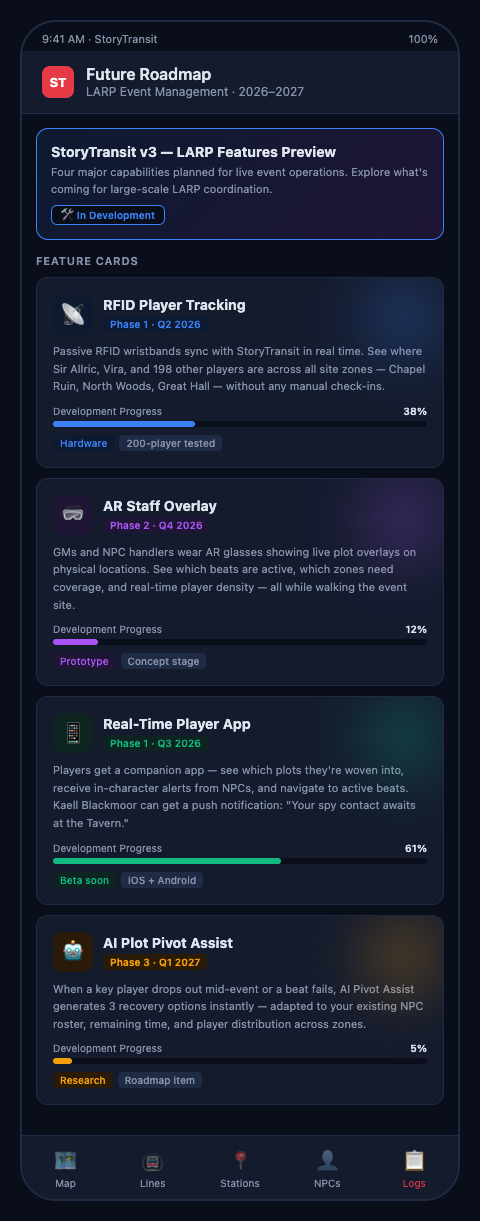
Five Capabilities the Next Generation Must Have
1. Offline-first architecture. Sixty-acre venues don't have reliable WiFi. Any live narrative tracking tool that requires constant connectivity will fail during the moments when coordination matters most—typically at the farthest plot stations from the central GOD tent, where coverage is already thinnest. Future event tech for LARP must function offline and sync when connectivity is available, storing state locally and resolving conflicts intelligently when multiple devices reconnect.
2. Real-time NPC dispatch. The radio dispatcher function—currently handled by a person with a radio and a printed grid updated with pen marks—needs digital support. A live dashboard showing NPC assignments, zone locations, current story beat statuses, and available pool NPCs would let a single dispatcher manage coverage across a larger venue more reliably than any printed system. The dispatcher function is the most high-leverage single role in a large-scale event, and it currently operates with the least tooling support.
3. Post-event reconciliation export. Every plot decision made during runtime—which beats ran, which were skipped, which NPCs were redeployed, which dormant stops were flagged and recovered—should produce a structured export that feeds directly into the post-event debrief. Right now, that data lives in plot runners' memories and fades within hours of event close.
4. Character arc tracking across events. Campaign LARPs with recurring players need to track character arcs across multiple events. When a player's backstory hook was first introduced, when it was activated, when it was resolved—that data currently lives in scattered notes across multiple organizers' files. Future digital LARP organizer tools will maintain that history in a queryable format, letting organizers pull a character's full arc history in seconds when planning their next appearance in the plot.
5. AI-assisted gap detection. Before runtime begins, an AI layer that reads the plot bible and identifies story beats with no assigned NPC, no physical location, or no player hook would catch planning gaps that are currently only discovered when the beat fails to fire during the event. This capability is where tools like GENEVA point toward practical LARP applications—not generating plot, but auditing it.
What Organizers Should Invest in Now
The full vision of AI-assisted, offline-first, campaign-tracking LARP software will take several years to mature. In the meantime, organizers running large-scale events should focus on the capabilities that are available today and that deliver immediate runtime value.
The single highest-leverage investment is the live plot dashboard: any system that gives the radio dispatcher a real-time view of which story beats have completed and which plot stations have gone dark. This doesn't require AI or complex infrastructure. It requires a structured tracking format, a communication protocol for zone NPCs to report status updates, and a display that someone is actively monitoring. Most events that have built this capability—even in manual form—report significant improvements in story beat coverage compared to their previous approach.
The second highest-leverage investment is the post-event reconciliation export: structured documentation of everything that happened during the event, produced within forty-eight hours of close. Without this export, the debrief is anecdotal. With it, the debrief is analytical. The difference in actionable output between those two modes is substantial.
The third highest-leverage investment is structured NPC briefing documentation. Every costumed volunteer who plays an NPC should receive a written brief that contains, at minimum: the character name and role, the story beats they're responsible for delivering, the trigger conditions for those beats, and what players they should be watching for. This documentation exists at the intersection of the plot bible and the staffing system—it's the operational interface between the two. Events that invest in thorough NPC briefs consistently outperform those that rely on verbal briefings in pre-event NPC meetings, because written documentation can be referenced during the event when a volunteer forgets a detail under pressure.
These three investments—live plot dashboard, post-event reconciliation export, and NPC briefing documentation—are available to any organizer today, with or without specialized software. Events that implement all three move from anecdotal coverage tracking to documented coverage management. That shift alone closes a significant portion of the gap between what current LARP event management software provides and what future digital LARP organizer tools will eventually offer as standard features.
For organizers who want to understand what modular content systems veteran organizers already use to manage complex plot structures, the post on veteran plot libraries covers the organizational methods that future software will need to support at scale. Organizers newer to digital tooling can start with the intermediate LARP toolkit post, which covers the foundational operational layer before moving to advanced features. For how similar tool evolution looks in actual play podcast production, future podcast tools covers parallel development trajectories in that adjacent narrative format.
The North American LARP industry grew to $1.2B in 2024 with digital platform adoption accelerating. The organizers who invest in runtime narrative tracking now—rather than waiting for the perfect tool—will be running the most operationally sophisticated large-scale events in the field as the tooling category matures around them.
StoryTransit is designed for LARP event organizers who've outgrown static spreadsheets and printed dashboards. If you run weekend-long events and need live plot coverage visibility that holds up across a full sixty-acre venue and a forty-NPC roster, we want to hear from you. Join the Waitlist for LARP Organizers and help shape what the platform becomes.