The Future of Actual Play Podcast Narrative Tools
The Tooling Gap in a Growing Market
Tabletop Role-Playing Game (TTRPG) Market Size & Share — Industry Research projects the TTRPG market to grow from $2.15B in 2025 to $6.59B by 2035 at an 11.84% compound annual growth rate. Actual play is central to that growth: Worldwide TTRPG Market in 2024 — RPG Drop reports that 49% of new players globally joined through actual play livestreams or podcasts, and Spotify actual play content grew 110% between 2021 and 2023.
That audience growth creates a production problem. The tools available to actual play producers — note apps, wiki software, DAWs, generic project management platforms — were not built for serialized narrative management. They track episodes as discrete items, not as stations on interconnected transit lines. A GM running a 60-episode season manages dozens of active and dormant plot threads, multi-year character arcs, and subscriber expectations that now include continuity standards borrowed from prestige television.
AI vs Traditional Podcast Editing 2026 — Podcast Studio Glasgow confirms that AI editing now reaches production-ready audio output — but still lacks narrative judgment for complex story shows. The editing automation problem is largely solved. The narrative management problem is not.
What Future Narrative Tools Need to Do
The next generation of actual play narrative platforms will need to operate at the intersection of three production workflows that currently run separately: session documentation, episode editing, and subscriber-facing show notes. Today, a producer manages all three manually, often with different tools and no shared narrative state between them.
The transit metaphor describes what that shared narrative state looks like. Every plot thread is a line. Every significant scene is a station. Every episode either advances a line to a new station, holds it at its current stop, or places it in dormancy. A future actual play narrative platform tracks all of that state and surfaces it in the right format for whoever needs it — the GM in pre-session prep, the editor in the pre-edit narrative review, the show notes writer describing what happened, and the subscriber who missed the last three episodes and needs to catch up.
World Anvil: Worldbuilding Tools & RPG Campaign Manager represents the current state of the adjacent category — wiki-style worldbuilding with NPC tracking and interactive maps. It solves the lore documentation problem for GMs but doesn't connect to the episode production workflow. WritersRoom Pro — Digital TV Writers' Room solves the story-breaking and narrative management problem for television writers' rooms, but it's built for scripted fiction, not for live improvised TTRPG sessions where the narrative emerges in real time.
GM Assistant — Automated Notes for TTRPGs is an early indicator of where the category is heading — AI that transcribes RPG audio sessions into structured notes, reducing the post-session documentation burden. The limitation is that structured notes and narrative thread state are not the same thing. Notes capture what happened. Thread state describes where every active arc stands relative to its next station.
StoryTransit addresses that distinction directly. The transit map isn't a note-taking system — it's a narrative state tracker that makes every plot thread's current position visible and shareable across the production team.
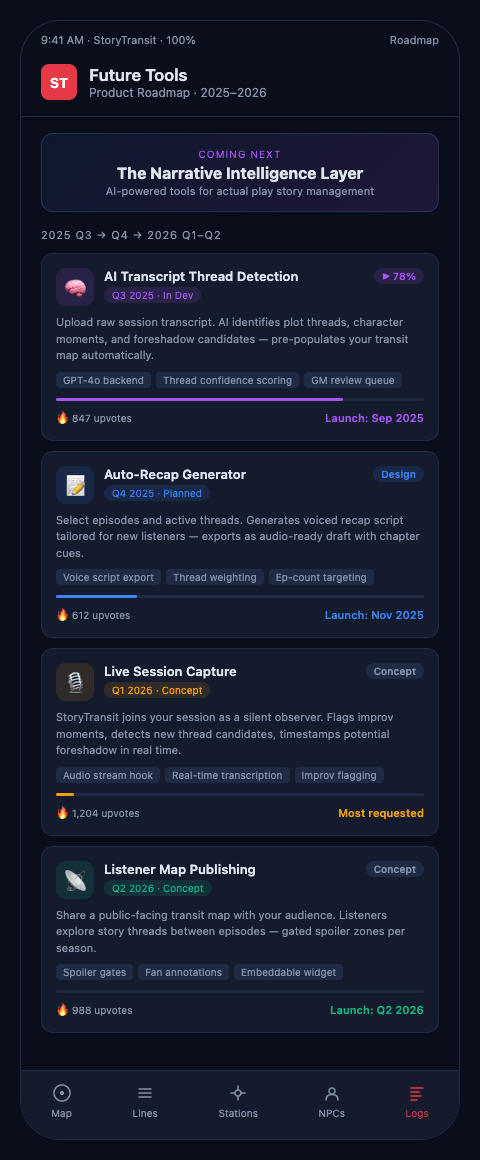
The Pipeline for AI-Assisted Narrative Management
The emerging pipeline for actual play technology looks like this: session audio feeds into AI transcription, transcription feeds into AI-assisted narrative extraction, extraction populates the thread tracker, and the thread tracker drives downstream production decisions for the editor and show notes writer.
AI Transcription Market Size 2030 — Grand View Research reports the AI transcription market at $4.8B in 2024 growing at 19% CAGR. The transcription layer is commoditizing. What's not commoditizing is the layer above it — the narrative judgment that determines which transcribed content represents a thread advance, a dormant stop activation, or a new line opening.
That narrative judgment layer is what veteran improv notes describes from the human side of the workflow — experienced producers who can distinguish a throwaway table moment from an improvised beat that opened a new character arc. Future story improvisation software will need to assist with that judgment, not just capture the raw material.
The practical implication for producers evaluating tools in 2025 and 2026: the right question to ask of any actual play narrative platform is not "does it transcribe my sessions?" — transcription is table stakes. The right question is "what does it do with the transcript?" A tool that produces a structured searchable summary is useful but doesn't solve the narrative state problem. A tool that maps transcript content to thread positions — identifying which moments represent line advances, station arrivals, or new arc openings — is operating at the layer where actual play technology is genuinely underdeveloped.
Podcast innovation claims in the actual play tool space are worth evaluating against this framework. Transcription is solved. Note summarization is largely solved. Narrative state tracking — knowing not just what happened but where every active arc stands relative to its planned trajectory — is the open problem. StoryTransit's transit map approach addresses that specific gap: it's not a note system, it's a state system, and the distinction matters enormously for productions managing 40-episode seasons.
In adjacent creative communities, the future pbp tools post documents a parallel set of emerging technologies for play-by-post game masters who face the same serialized narrative complexity problem in text-based formats. The producer editing toolkit provides the current-state foundation for the workflows that future tools will automate. Understanding what those workflows do manually is the prerequisite for knowing what to ask of automated systems — and for evaluating which podcast innovation claims are genuine versus marketing.
What the Next Actual Play Narrative Platform Needs to Solve
The gap between current tools and what the format requires comes down to three specific problems that no existing platform fully solves.
Real-time narrative state tracking. Most documentation tools are static — they capture what was true at the time of the entry, not the current state of each thread as it evolves through session after session. An actual play narrative platform that tracked thread state dynamically — updating line positions as sessions are logged, flagging dormant stops automatically, alerting the production when a thread hasn't been serviced in N sessions — would eliminate the manual tracking burden that currently falls on producers.
Cross-production-role accessibility. The GM, the editor, the show notes writer, and the social manager each need different views of the same narrative information. The GM needs current thread state at the scene level. The editor needs flagged load-bearing moments per episode. The show notes writer needs a plain-language "story so far" summary. The social manager needs the most anticipated upcoming arc moments. Current tools require each person to work from the same raw document and extract their own view. Future actual play technology will serve each role a tailored interface from a single underlying narrative state.
Back catalog integration. For shows with 50+ episodes, the most valuable narrative intelligence isn't about the current session — it's about the relationship between what's happening now and what was planted three seasons ago. A platform that could surface historical thread context automatically ("the last time this NPC appeared was episode 14, when they were described as having information about the Sunless Citadel connection") would compress the archaeology work that currently takes producers hours of manual catalog review.
StoryTransit is building toward this vision. The transit map isn't a completed product — it's a methodology for thinking about narrative state that the next generation of actual play technology will automate and extend.
Position for the Tools That Are Coming
The production disciplines that matter most right now — thread documentation, transit map maintenance, pre-edit narrative reviews — are the same disciplines that future actual play narrative platforms will automate and accelerate. Producers who have already built those disciplines into their workflow will adopt emerging tools faster and extract more value from them than producers who rely on memory and ad-hoc notes.
The practical implication: start documenting narrative state as if a tool exists that can use it systematically. That means treating every plot thread as a transit line with an explicit current station and a defined next stop. StoryTransit makes that documentation concrete and production-ready today.
Actual play podcast producers who are thinking past their current feed structure toward the long-term narrative architecture their show needs are building the skills that future actual play technology will amplify. Join the Waitlist for Actual Play Producers and help shape what the next generation of narrative tools for story-first shows looks like.