The Intermediate Actual Play Producer's Editing Toolkit
What Changes When You Level Up
A beginner actual play producer learns to use a DAW, cuts the obvious dead air, exports at the right bitrate, and ships the episode. That's a complete workflow for a show in its first five episodes. By episode fifteen, that workflow starts breaking down — not because the tools are wrong, but because the production challenges have outgrown them.
Intermediate production is defined by a new category of problem: structural editing decisions. Should this scene come first or third? Does this arc development belong in this episode or should it be held for the next? What's the right cold open to set up what's coming? These questions require narrative context, not just audio skills. And the tools that answer them are different from the tools that clean up a recording.
The intermediate producer is also typically managing more stakeholders. There's a GM whose narrative intentions need to be understood and protected. There may be an editor who's not in the sessions and needs context to make good cuts. There's a distribution pipeline with show notes, timestamps, and a feed that subscribers track. None of that complexity is handled by the basic DAW-and-export workflow of the beginner phase.
The audio editing software market was valued at USD 500 million in 2024, growing at 20% CAGR, which means the tool landscape is expanding faster than most producers can evaluate it. The intermediate toolkit is less about having every tool and more about having the right set for the specific demands of actual play post-production.
The Core Toolkit Breakdown
DAW: Reaper or Hindenburg. At the intermediate level, most producers have settled on one DAW. Reaper and Descript are the leading tools for intermediate actual play podcast editors. Reaper's flexibility makes it the preferred choice for producers doing heavy structural editing — its track management handles long sessions cleanly. Hindenburg Journalist Pro is purpose-built for spoken-word storytelling with automatic leveling, which makes it attractive for actual play shows where dialogue clarity is paramount.
The DAW choice matters less than the editor's proficiency with it. A producer who knows Reaper well can do more with it than a producer switching to Hindenburg because of a recommendation. The inflection point is when the current DAW creates workflow friction specific to actual play production — extremely long files, multi-track session recordings, or complex cross-fade work at scene boundaries.
Text-based editing: Descript. Descript's text-based editing and AI filler-word removal streamline long actual play session edits. For actual play shows, the ability to edit audio by editing the transcript changes the workflow entirely — structural cuts become legible rather than positional. Intermediate producers who handle their own editing consistently cite Descript as the tool that made long-session editing tractable. It's also the fastest way to create show notes timestamps — the transcript search is faster than scrubbing audio.
AI transcription and review. Academic review of Descript vs. Otter.ai AI transcription for podcast production shows both tools have distinct strengths. For actual play producers, the primary value of transcription is not just accessibility — it's the ability to search the recording for specific character names, thread callbacks, or key moments during pre-edit review. A producer who can search "cursed compass" across a transcript finds the relevant scene in seconds instead of scrubbing audio for twenty minutes.
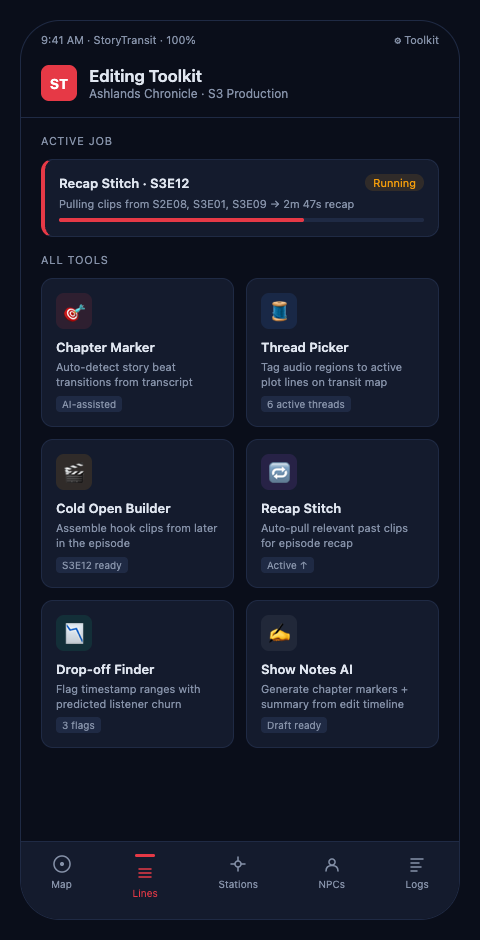
Narrative tracking: StoryTransit. The gap in most actual play editing toolkits is narrative context. DAWs handle audio. Transcription handles text. Neither handles story structure. StoryTransit fills that layer — a transit-map model that shows which threads are active, which stations appear in each episode, and which arcs are approaching resolution. This context is what allows the editor to make structural decisions rather than just technical ones. Without this layer, the toolkit is technically capable but narratively blind.
Project management: Notion or Airtable. Intermediate producers need a way to coordinate between the GM, the editor, and the distribution pipeline. The specific tool matters less than the workflow — what matters is that show notes, episode briefs, and arc status updates all live in one place. Coordination failures between these roles are where most intermediate production quality problems originate.
Building the Integrated Workflow
Owning individual tools is not the same as having a toolkit. The intermediate producer challenge is integration — connecting the tools so that information flows through the pipeline rather than getting trapped in each application.
The workflow that works for most intermediate actual play producers:
- Session recording goes into the DAW (Reaper or Hindenburg) for initial cleanup.
- Descript transcription runs in parallel, generating a text layer for structural review.
- The GM's session notes and the transcript feed into StoryTransit for story map update and pre-edit brief generation.
- Editor receives the audio file, the transcript, and the StoryTransit brief before beginning structural cuts.
- Post-edit, the arc status dashboard in StoryTransit gets updated with what survived the cut.
Each step produces an output that feeds the next. The audio cleanup produces a clean file; the transcription produces a searchable text layer; the StoryTransit brief produces narrative context for the edit; the edit produces the final episode; the reconciliation keeps the map current for the next session. When a step is skipped, the next step is harder — the editor who doesn't have a brief makes worse decisions; the story map that isn't updated after the edit becomes unreliable for the next session's brief.
Comprehensive podcast production guides cover the full toolkit from recording to distribution, but actual play production has specific demands — particularly around narrative continuity — that generic guides don't address. The integrated workflow above is built around those demands.
For producers ready to push beyond this toolkit, advanced audio editing covers how narrative-first principles reshape the editing process at the structural level. The future podcast tools piece looks at where the tooling is heading — useful context for producers making long-term software investment decisions. Producers in adjacent creative domains will find the intermediate LARP toolkit addresses a comparable toolkit evolution from beginner to intermediate in live-event contexts.
A note on tool adoption sequencing: the most common mistake in building this toolkit is implementing the audio and transcription tools first while leaving the narrative tracking layer out indefinitely. Audio tools deliver immediate, tangible results — the episode sounds better. The value of narrative tracking is harder to see until the moment it's absent and a continuity error surfaces in the episode feed. Producers who add StoryTransit to their workflow while the show is in its early episodes have a much lower retroactive documentation burden than producers who add it at episode 30 and need to reconstruct arc history from memory and episode audio. The right time to add narrative tracking is before you feel you need it.
The Toolkit Is a System, Not a List
The difference between a list of tools and a toolkit is integration. An intermediate actual play producer with Reaper, Descript, StoryTransit, and a functioning GM handoff protocol has a system. An intermediate producer with seven applications that don't communicate with each other has overhead — and overhead is what causes the quality ceiling that stops many shows from improving past a certain point.
Global DAW market was valued at USD 3.49 billion in 2025, which reflects how many people are now working in podcast production. Standing out as an actual play producer requires both technical quality and narrative quality — and the toolkit that delivers both is the one built around story structure, not just audio cleanup. Any show can achieve clean audio; the shows that build sustained audiences combine clean audio with narrative consistency.
The intermediate toolkit is also a foundation for scale. When the production workflow is documented and integrated, the team can add an editor, hand off tasks, or handle a higher episode volume without the quality dropping. When each step relies on one person's memory of what came before, scaling breaks the system.
One practical consideration for producers building this toolkit: invest in the narrative tracking layer before you feel you need it. Most producers add tools reactively — they notice an audio quality problem and get a better DAW, they have a continuity error and add documentation. The narrative tracking investment is different: by the time the problem is visible, there's already a back catalog of undocumented episodes that can't be reconstructed cheaply. Adding StoryTransit at episode five is a different proposition than adding it at episode 30 and having to retroactively document 29 episodes of arc history.
The core toolkit described here — DAW, text-based editing, transcription, narrative tracking, project management — represents the minimum viable setup for intermediate production that can scale. Each element handles a specific layer of the production problem. None of them is optional if the goal is consistent quality across a long-running episode feed.
StoryTransit is designed to sit at the center of the intermediate actual play producer's toolkit — the narrative layer that connects GM input to editor output. Actual play podcast producers who want to build an integrated production workflow can join the waitlist now. Join the Waitlist for Actual Play Producers and get early access to the story map tools before public launch.