Advanced Timeline Techniques for Decade-Spanning Campaigns
The Chronology Problem at Decade Scale
A campaign that has run for ten years of real time has almost certainly involved in-world time jumps, multiple historical eras, retconned lore, and NPC generations. The half-elf bard from Session 3 may now be an elder statesman in Session 200. The ruins of Brenhorn Village may be the foundation of a new city. A villain defeated 47 sessions ago may have descendants with grudges. Advanced timeline techniques for managing that layered history require treating D&D chronology and dungeon master history as structured artifacts, not just narrative background — the time skip subplots problem is where this becomes critical first.
Standard linear timelines — a spreadsheet of events sorted by date — cannot hold this complexity. They do not track causality, show which events retroactively rewrote earlier ones, or reveal which NPCs were present at which historical moments across two centuries of in-game time.
Retroactive continuity – Wikipedia documents how long-running fiction series suffer their worst continuity damage when retroactive changes are applied without tracking their downstream effects. A retcon introduced in Session 150 can quietly invalidate events from Sessions 12, 45, and 89 if there is no mechanism to trace the connections. Proactive timeline tracking prevents the need for retroactive fixes.
Campaigns: Starting Up Again After a Hiatus adds a parallel problem: multi-year campaigns with real-world hiatuses require documented timelines so the DM can restore chronological context quickly. The longer the campaign, the higher the cost of that restoration.
The decade-spanning DM is managing, in effect, a layered archaeological site. The surface layer is the current era of play. Below it are previous eras, previous political structures, previous generations of NPCs, and previous iterations of the world's geography. Any of those layers can become relevant at any moment — a player who investigates the ruins of Brenhorn Village is digging into a prior layer, and the DM needs to know exactly what is down there.
Without advanced timeline architecture, that excavation produces a confident improvisation that may contradict something established three years ago. With advanced timeline architecture, the DM can answer the player's question accurately because the layers of the world's history are mapped, not merely remembered.
Era Architecture: Treating History Like a Transit Network
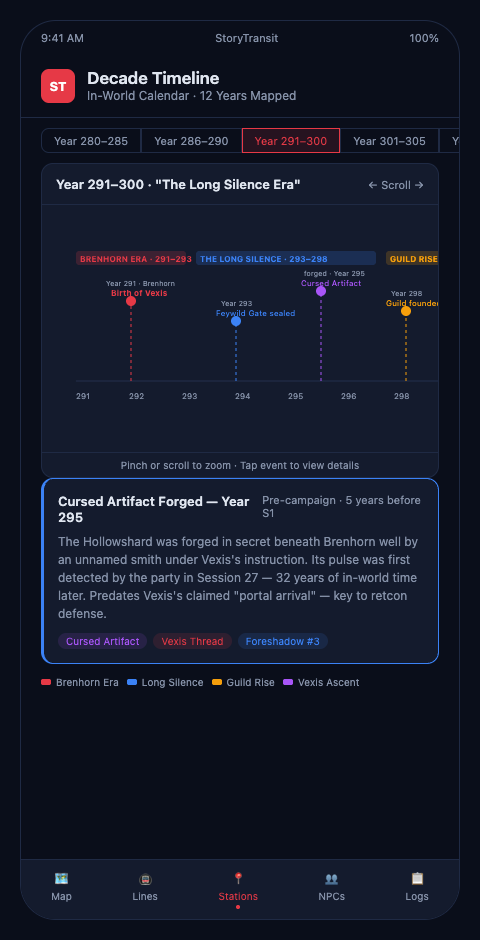
The advanced timeline technique that works for decade-spanning campaigns treats chronology as a layered transit network, not a single line. Each major era — each distinct period in the world's history with its own political landscape, active conflicts, and living NPC generation — is a named epoch. Events within an epoch are stations on that epoch's line. Connections between epochs are transfer points.
This is the architecture StoryTransit is built around. An epoch-based map shows at a glance which historical events are causally connected across eras, which NPC lineages cross epoch boundaries, and which subplots were seeded in one era and are due to flower in another.
Temporal knowledge graphs model complex event evolution better than linear timelines for exactly this reason: they capture causal relationships between events, not just their sequential order. A kingdom's founding in Era 1 is causally connected to a civil war in Era 3 and a peace treaty in Era 5. A linear timeline shows three separate entries. A temporal graph shows the line connecting them.
World Anvil's timeline features implement this approach for campaign management — linking dated events to specific NPCs and locations across multi-era campaigns so that a DM can trace any event's full causal chain. The tool doesn't replace the technique, but it illustrates why era-linked tracking is the standard for decade-scale play.
The four layers of advanced timeline architecture:
Era boundaries: Defined transition points where the world's fundamental conditions changed — a new ruler, a cataclysm, a generational shift. These are the transfer stations between epoch lines.
Causal chains: Every major event tagged with its direct causes (which prior events made it possible) and its direct effects (which future events it seeded). This makes retcons traceable.
NPC lifespans: Every named NPC assigned to specific epochs, with notes on which survived transitions and which did not. NPC continuity across eras is one of the hardest problems in decade-spanning D&D campaigns.
Subplot epoch flags: Every subplot line tagged with which epoch it was seeded in and which epoch it is expected to resolve in. A subplot seeded in Era 2 that remains unresolved in Era 5 is a dormant stop — visible, not lost.
Managing In-World Time Skips
Time skips are the most dangerous chronological event in a long D&D campaign. A five-year in-world jump can reshape every political relationship, NPC status, and faction power dynamic the party has built. Handled without a proper timeline system, a time skip rewrites the world in ways the DM cannot fully track.
Narrative time in fiction examines how authors manipulate chronology through flashbacks and flash-forwards — techniques that map directly onto in-game time skips and era mechanics. The discipline that novelists apply to managing nonlinear timelines is the same discipline a decade-spanning campaign DM needs.
Writing a Nonlinear Timeline puts the risk explicitly: nonlinear timelines require robust tracking to prevent causal paradoxes and maintain comprehension. In a campaign that jumps between past lore and present action, the timeline system must hold both simultaneously.
The practical protocol for time skips: before the skip, freeze the world state — record every active subplot, every NPC's current status, every faction's position. After the skip, run a "fast forward" pass through the timeline: given the elapsed time and the world's trajectory, what changed? Treat every change as a new event entry in the timeline, not a deletion of the old state.
The freeze-and-advance protocol has an additional benefit: it forces the DM to commit to the consequences of elapsed time rather than leaving them ambiguous. A five-year time skip in which nothing changes in the world is a wasted opportunity and a continuity liability — players will remember that wars were in progress, that the Merchant Council was in crisis, that the half-elf bard's rival was ascending. If none of those threads moved, the DM owes the players an explanation.
Running the fast-forward pass before the session — updating faction states, NPC statuses, and subplot positions as if five in-game years actually passed — produces a richer world and prevents the contradiction where a player asks "whatever happened to the siege of Kestholt?" and the DM realizes they have no answer because they never calculated it. The timeline architecture makes that calculation possible. Without it, every time skip is a continuity risk that compounds into the campaign's future.
Advanced Tactics for Homebrew Era Tracking
The era handoff document: At every era boundary, the DM produces a one-page "era handoff" summarizing what the new epoch inherits from the old one — surviving NPCs, unresolved subplots, active consequences. This document is the transfer station between epoch lines and the core deliverable of any homebrew era tracking discipline that spans multiple generations of in-world time.
Retcon auditing: When a retcon is introduced, run a backward trace through the causal chain. Which earlier events does this change affect? Flag every affected event and decide whether the retcon is additive (adding new information) or corrective (changing established facts). Corrective retcons require player acknowledgment.
Generational NPC tracking: For truly decade-spanning campaigns, maintain a "generations" overlay on the NPC timeline. NPCs born in Era 1 who are elderly in Era 4, children in Era 1 who are leaders in Era 3 — tracking generational progression prevents the impossible-age errors that break immersion in long campaigns.
The foreshadowing work required for era-spanning subplots is covered in detail in foreshadowing arcs — the same principles that govern 18-month foreshadowing chains apply to epoch-scale ones, just stretched across more real time. Maintaining subplot momentum across in-game time jumps is a critical skill once a campaign crosses the decade threshold — the mechanics become especially complex when in-world centuries have passed between eras of play.
For DMs who manage asynchronous campaigns where the challenge is archiving rather than live tracking, advanced pbp archiving explores how the same chronological discipline applies in written forum formats.
Build the Timeline Before the Decade Arrives
The DMs who manage decade-spanning campaigns successfully are not those with better memories. They are those who built a timeline architecture in year one that could absorb ten years of complexity without collapsing. StoryTransit's epoch-based transit map holds that complexity from the first session.
The retrospective rebuild of a decade-spanning campaign's timeline — going back through 200 sessions of notes to construct the causal chains that were never documented during play — is one of the most demanding projects a DM can undertake, and it produces a less accurate result than documentation built contemporaneously. The causal chains that existed in the DM's mind during Session 12 are not reliably recoverable at Session 200. The epoch boundaries that seemed obvious at the time leave no trace in undifferentiated session notes. The NPC who was alive in Era 1 and dead in Era 3 may not have a clear death date in any document.
Building the architecture before the decade arrives means that when Session 200 happens, the DM is not reconstructing a timeline. They are consulting one.
Homebrew D&D DMs building toward a decade-spanning campaign can join the waitlist now and get early access to the era-tracking tools, causal chain templates, and NPC lifespan overlays that make long D&D campaign chronology manageable. Join the Waitlist for Homebrew D&D DMs before your timeline becomes too tangled to untangle.