Foreshadowing Arcs 18 Months in Advance: A Practical Guide
The Payoff That Nobody Remembered Setting Up
Session 87. The party finally confronts the archlich. In a dramatic reveal, the villain removes their mask and the half-elf bard recognizes the face of their missing rival — the one who vanished under suspicious circumstances 47 sessions ago. The DM had planned this connection from Session 40. Layers upon layers of foreshadowing. Months of careful seeding.
Three players don't remember the rival at all. One player thinks the rival was a dwarf. Only the bard's player remembers, and they're already calculating how to use this in combat rather than processing the emotional weight of the reveal.
That failure isn't creative — it's logistical. The foreshadowing was excellent. The payoff was well-constructed. The reinforcement schedule between Session 40 and Session 87 was empty. Without three or four echo moments keeping the rival's existence alive in players' minds over those 47 sessions, the original seed decayed along the forgetting curve, and the reveal landed in a room full of people who had moved on. The receipt log and reinforcement schedule in this guide are the two mechanisms that prevent this exact outcome.
The Angry GM's analysis of foreshadowing quantifies the problem: players miss 60 to 80 percent of subtle foreshadowing. DMs must seed clues redundantly or payoffs fall flat. This isn't a failure of player attention — it's a structural problem with how most DMs plant and track foreshadowing arcs.
Chekhov's Gun, as Britannica's reference explains, means every narrative element introduced is a promise to the audience. Unresolved setups break narrative trust. But the reverse is also true: setups that were resolved but not remembered feel exactly like setups that were never resolved. The payoff only lands if the audience carries the setup through the intervening sessions.
Springer Nature research on foreshadowing in narrative comprehension found that readers form predictive models from foreshadowed cues, and payoffs that match predictions create narrative satisfaction. For that satisfaction to occur, the prediction must still be active in the audience's mind when the payoff arrives. 47 sessions is a long time to maintain an active prediction without reinforcement.
RPGDrop's 2024 market analysis reports over 200 million actual-play streaming hours in 2023 — showing that players in serialized TTRPG formats increasingly expect the kind of narrative payoff that long-range foreshadowing delivers. The audience expectation exists. The delivery system needs to match.
The Foreshadowing Transit Line
In the transit system metaphor, a foreshadowing arc is a line that starts at a hidden origin station — the seed — and runs forward through time to a terminus — the payoff. Most of the line is underground. Players don't see it running beneath the surface of the campaign; they only notice it when it emerges at a visible station.
The discipline is in maintaining the underground portion. You know the line exists. You planted the seed. But between Session 40 and Session 87, you'll prep and run 47 sessions of homebrew material — and without a system to surface that underground line at regular intervals, both you and your players will lose track of it.
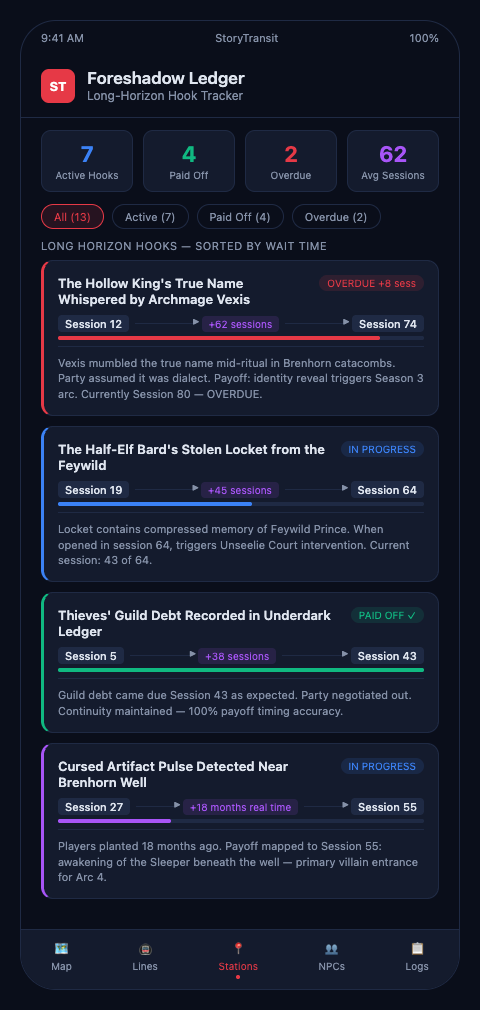
A foreshadowing receipt log is your underground line map. Every time you plant a seed, create an entry: session number, the specific seed (the half-elf bard's rival disappeared under suspicious circumstances), the intended payoff (rival becomes the archlich), the planned activation window (Sessions 80-90), and a reinforcement schedule (reintroduce the rival's name in Sessions 55, 65, 75).
The reinforcement schedule is the piece most DMs miss. Planting a seed once isn't enough. You need to keep the prediction active in your players' minds through intermittent reinforcement — a rumor, a journal entry found in a dungeon, a mention by a minor NPC who knew the rival. These reinforcements don't reveal the payoff; they refresh the memory of the setup so the payoff lands when it arrives.
Long-range foreshadowing arcs built in session zero worldbuilding have the strongest foundations because they're integrated into the world from the start rather than retrofitted into existing continuity. Seeds planted at session zero carry the implicit promise that the world was always built this way — which makes payoffs feel more inevitable and less like DM convenience.
Managing time skip subplots requires the same discipline. When a time skip compresses 47 sessions of in-game time into a narrative gap, foreshadowing seeds planted before the skip must be checked against their intended activation windows — some will need to pay off earlier than planned because the in-game timeline has accelerated.
StoryTransit's foreshadowing module tracks your receipt log alongside your session calendar, surfacing overdue seeds automatically and suggesting reinforcement opportunities based on upcoming plot stations.
Building Your 18-Month Foreshadowing System
The 18-month timeline isn't arbitrary. In a campaign running every two weeks, 18 months is roughly 36 sessions. That's enough sessions for a multi-stage foreshadowing arc to feel genuinely satisfying at payoff without requiring a campaign longer than most groups sustain.
Map your foreshadowing arc as a four-phase structure.
Phase 1: The Seed (Sessions 1-10 of the arc). One specific, memorable detail. Not vague atmosphere — a proper noun, a specific object, an unresolved question. The rival bard who vanished. The cursed lute. The brand on the dead captain's shoulder.
Phase 2: The Echo (Sessions 10-25 of the arc). Two to three reinforcing encounters that refresh the seed without revealing the payoff. The party finds a pamphlet for a concert the rival was supposed to perform. An NPC mentions hearing a lute playing from an abandoned building. The cult's symbol appears to match the brand they found earlier.
Phase 3: The Question (Sessions 25-35 of the arc). One scene where the setup becomes explicit — a player can now articulate the mystery clearly. The party learns the rival was recruited by a shadowy organization. They don't know what organization. But they know something happened, and they start actively looking.
Phase 4: The Payoff (Sessions 35-36+ of the arc). The reveal lands because the audience has been carrying an active prediction for at least 10 sessions. The archlich removes the mask. The bard recognizes the face. The mystery that's been running underground for 47 sessions stations surfaces at last.
Obsidian's graph view and linked notes let DMs seed foreshadowing connected to future arcs across years — a strong implementation tool for the four-phase structure above.
R.B. Kelly's analysis of foreshadowing craft articulates the core balance challenge: the best story twists feel both surprising and inevitable. Too much foreshadowing and the payoff is predictable. Too little and it feels random. The four-phase structure above targets that balance directly.
One calibration tool for the balance problem: count how many players spontaneously reference a foreshadowed element in the session before you planned the payoff. If at least two players mention it or ask about it unprompted, your reinforcement schedule worked — the prediction is active in enough minds that the payoff will land broadly. If no one has mentioned it since the echo phase, you need one more reinforcement scene before the payoff. The payoff session is not the time to discover your seed was too quiet.
Build the 18-month timeline into your campaign calendar before you plant the seed. Foreshadowing arcs that exist only in your head, without a scheduled activation window in your prep system, have a failure rate approaching 100%. The receipt log and the four-phase structure are useless unless you also set calendar reminders — or equivalent session-count triggers — that surface each arc at the right phase. Long-range D&D narrative design fails most often not because DMs lack the ideas, but because they lack the reminder system that makes the ideas executable 18 months after the plan was made.
Actual play editors who work with foreshadowed arc editing must coordinate the same long-range narrative discipline across multiple recording sessions — the editorial challenge mirrors the DM prep challenge with different constraints.
Advanced Tactics for Long-Range Foreshadowing
Redundant seeding. Plant every major foreshadowing setup in at least three different scenes through three different vectors: an NPC, a physical object, and an environmental detail. If players miss two of three seeds, they catch the third. If they catch all three, the payoff feels inevitable rather than planted.
Player-driven reinforcement. The best reinforcement happens when a player asks about a foreshadowed element rather than being told about it. Build NPC knowledge networks where at least two NPCs can speak knowledgeably about each foreshadowed thread. When a player pursues the thread, let the world answer — don't force it.
Payoff flexibility. Your planned payoff at Session 87 may no longer be the right payoff by the time you get there. Campaign narrative evolves. Build flexibility into your receipt log by noting both the specific payoff and the emotional beat it's meant to deliver. If you can deliver the emotional beat through a different specific payoff because the campaign evolved, do that. The beat matters more than the exact mechanism.
The 20-session audit. Every 20 sessions, review your entire foreshadowing receipt log. Flag anything with no reinforcement in the last 15 sessions. Either schedule a reinforcement scene in the next five sessions or retire the thread — but don't let seeds sit unwatered for more than 15 sessions if you want the payoff to land.
Long-range D&D narrative design is fundamentally a promise-keeping discipline. Every seed you plant is a promise. The foreshadowing receipt log is your ledger. Review it, honor it, and your players will experience the satisfying inevitability of a world that was always building toward this moment.
Plant It Now, Pay It Off Later
Homebrew story structure across 18 months of play requires more than good ideas — it requires a system that ensures those ideas survive the session-to-session chaos of long-running campaigns. Build your foreshadowing receipt log today, plant your seeds with redundancy, and schedule your reinforcement echoes so nothing disappears into the void between Session 40 and Session 87.
The receipt log entry format is deliberately simple: session number, the specific seed in one sentence, the intended payoff in one sentence, the planned activation window (a session range, not a precise session number), and the reinforcement schedule (three specific session numbers where you'll introduce an echo). Five fields. The first entry takes five minutes to write. After a year of weekly sessions, a receipt log of 20 to 30 entries represents every major foreshadowing arc in your campaign — a complete map of the promises you've made and the delivery schedule you've set. The 20-session audit described above is what keeps that map honest: an arc with no reinforcement since Session 40 and a planned payoff at Session 90 needs either an echo scene in the next five sessions or an explicit decision to move the payoff window earlier.
StoryTransit's long-range foreshadowing tools give homebrew D&D dungeon masters the receipt log, reinforcement scheduler, and payoff tracker they need to deliver on promises made months ago. Join the waitlist and stop hoping your players remember — start building systems that make sure they do.