How DMs Handle In-Game Time Skips Without Losing Subplot Momentum
What Happens to Your Subplots When You Skip Forward
The party finishes the siege of Brenhorn Village at the end of Session 62. Everyone agrees: "Let's skip three months — the rebuilding period would be boring to play through." Reasonable call. But you have six active subplots that were running during those three months: the cult infiltrating the city guard, the half-elf bard's missing rival, the coming-of-age arc for the party's adopted squire, the merchant guild investigation, the disease spreading through the slums, and the slow-burn political tension between two noble houses.
Three months passed. What happened to each of them?
If you don't have an answer before the first scene of Session 63, you've created a homebrew gap timeline problem that will haunt you for the next dozen sessions. Players will ask "whatever happened to the cult thing?" and you'll have nothing ready. Or worse — you'll improvise something that contradicts what you'd already established in Sessions 55-61.
The three-month skip felt like saving time. What it actually did was defer six subplot resolution decisions into the opening session of the new arc, where they'll surface one by one as players ask about them. Without prep, each answer is improvised under session pressure — which is precisely the condition that produces continuity errors. The time skip worksheet described below costs 30 minutes before the session. It saves two hours of improvisation debt spread across the next several sessions.
Illusory Script's analysis of long-term D&D campaign pacing identifies this as a defining challenge: long campaigns need deliberate pacing tools because time skips prevent hyper-compressed level-up narratives — but only when the DM has documented what every running thread was doing during the gap.
Masterclass's guide to narrative pacing emphasizes that macro-pacing alternates high-intensity and quiet scenes across the full arc to sustain long-form engagement. Time skips are macro-pacing tools — but they work only when the DM has used the quiet period productively, advancing the world's state rather than freezing it.
A Springer meta-analysis on narrative memory found that narrative format is better recalled than non-narrative, and time-skipped content framed as story is better retained. How you communicate what happened during a skip determines whether players incorporate that passage of time into their sense of the world or treat it as dead air.
The Dormant Stop Reactivation Protocol
In the transit system metaphor, a time skip is a service suspension. The trains stop running for three months of in-game time. But the stations don't disappear — and the cities those stations serve kept developing without the party's involvement.
When service resumes after a time skip, every station on every active line needs a status update. Which stations are now fully operational? Which were damaged by events during the suspension? Which had their platforms expanded by new developments? And critically — which dormant stops were activated by events during the gap?
The protocol works in three phases. First, before the time skip session, run a subplot advance calculation for each active thread. Don't improvise this — actually work through the logical consequences of each faction, NPC, and conflict continuing to move during the gap. The cult infiltrating the city guard had three months to recruit. The noble house political tension had three months to either escalate or resolve. Your merchant guild investigation was either advancing or stalling without party involvement.
Second, categorize the outcomes: resolved threads (the disease was cured — or wasn't), accelerated threads (the cult made major gains), and new threads (the three months revealed something the party couldn't have known while they were present).
Third, plan the reveal sequence. Players don't learn everything at once after a time skip — they discover the world's changed state through scenes, NPC dialogue, and environmental storytelling. The Alexandrian's time-skip protocol recommends stating elapsed time, asking each player what their character did, then injecting world events — a structured three-part reveal that distributes the exposition across the table.
For managing the foreshadowing arcs planted months in advance, time skips are actually opportunities. A seed you planted in Session 40 may now be ready to sprout — use the time skip as the narrative mechanism that explains why the world has changed enough for that foreshadowing to pay off.
Time skips also serve as the ideal moment to resurrect dead threads. A subplot that felt dormant for 15 sessions can plausibly have advanced dramatically during a three-month gap — giving you a natural explanation for why it's suddenly relevant again without requiring any contrivance.
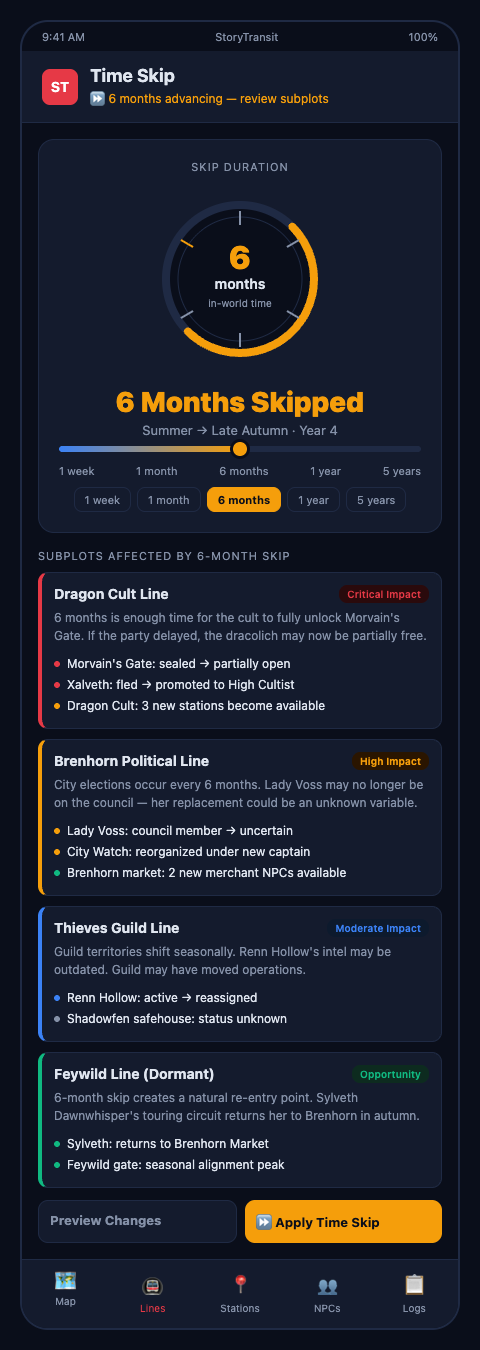
StoryTransit's gap timeline tool tracks each subplot's status before and after a time skip, automatically flagging threads that need advance calculations before the next session.
Executing the Time Skip Without Breaking Momentum
The practical problem is that time skips require more pre-session prep, not less. You're not skipping the narrative work — you're compressing it into DM prep instead of play time.
Build a time skip worksheet with five rows: one per active subplot. For each subplot, write three fields: what was happening when the skip started, what logically changed during the gap given the forces in play, and what the first scene after the skip will reveal. That worksheet is your Session 63 prep document.
The Angry GM's pacing framework advocates "burning through the negative space" — skipping moments players don't care about to sustain narrative momentum. The crucial distinction is that burning negative space requires knowing what happened in that space, even if you're choosing not to play it out.
D&D campaign pacing suffers most when time skips become continuity voids. The party returns from a three-month gap to a world that looks exactly the same as when they left, because the DM didn't advance the world state during prep. Players notice this immediately — not consciously, but as a vague feeling that their choices don't matter because the world isn't responding to their absence.
Pacing within the narrative arc requires that subplots maintain rising tension even during downtime. Dormant threads lose audience investment. If a subplot has been quiet for 47 sessions and then gets reactivated after a time skip, the reactivation needs a hook strong enough to justify the gap — not just "oh yeah that thing, it got worse."
The time skip worksheet must be completed before the session where the skip is announced, not after. DMs who announce a time skip at the table and then improvise the world state consequences on the fly are creating a continuity debt that will compound across the next five to ten sessions as players ask questions the DM hasn't thought through. Announce the skip only when the worksheet is done and you know what changed while the party wasn't watching.
StoryTransit's gap timeline feature flags every active subplot when you enter a time skip, prompting you to record each thread's advancement before the skip session begins. The result is a world that visibly responds to the party's absence — not because the DM had extraordinary memory, but because the system captured the state that needed advancing and made the calculation structured rather than improvised.
Play-by-post campaigns face an extreme version of this challenge because the two-week gap orientation problem — keeping players oriented after extended real-world gaps between posts — maps directly to in-game time skip management. The techniques transfer across formats.
Advanced Tactics for Subplot Momentum Through Time Skips
The faction clock system. Assign each active faction a clock with four to six segments. Every real-world month of play, that clock advances one segment unless the party intervenes. A time skip advances the clock proportionally. When the clock fills, the faction achieves its goal — and the party has to deal with consequences rather than preventing them. This makes time skips feel like real narrative risk rather than convenient travel montages.
Character-driven skip content. Ask each player what their character did during the skip before you reveal what the world did. This creates genuine character development moments and gives you information about character priorities you can use later. The bard spent three months searching for their missing rival — that's a new subplot development that emerged from the skip itself.
The "meanwhile" document. Prepare a brief player-facing document that covers three to five world events that happened during the skip. Frame it as rumors, news reports, or NPC letters — something that exists in-world. This distributes the exposition load off the first scene of the new session and gives players something to react to before you start running.
Anchor scenes. Plan at least one scene in the immediate aftermath of the skip that connects directly to the party's last significant choice. If they chose to evacuate Brenhorn Village before the skip, the first scene after the skip should show the consequences of that choice — good or bad. This validates the decision as meaningful and signals that the world kept moving in their absence.
DMs managing in-game time skips correctly will find that they become one of the most powerful pacing tools in their homebrew kit. The work is in the prep, not the session — but the payoff is players who feel that three months actually passed in a living, breathing world.
Time Skips Are a Prep Problem, Not a Play Problem
The momentum you've built across 62 sessions doesn't survive a careless time skip. But a carefully executed gap timeline — with faction advances, subplot status updates, and planned reveal sequences — can be the moment your campaign shifts from "good" to "unforgettable." Do the prep, advance your world, and let your players discover what three months without them actually cost.
The time skip worksheet is the concrete deliverable that makes the difference. Five rows, one per active subplot. Three columns per row: starting state when the skip begins, logical changes during the gap given active factions and unresolved tensions, and first reveal moment in Session 63. That document, completed before the skip is announced, is what separates a time skip that makes the world feel alive from one that makes it feel frozen. The faction clock system described above gives each clock-owning group a built-in advancement logic, so even subplots the party wasn't watching have moved in predictable directions — reducing the improvisation burden at the session where the gap closes.
StoryTransit's time skip tools are made for homebrew D&D dungeon masters who want to accelerate their narrative without freezing their world. Join the waitlist and bring your gap timelines under control before your next major campaign skip.