Resurrecting Dead Plot Threads: A Continuity Rescue Playbook
Threads That Died Quietly
Session 22 introduced a blood feud between two merchant families in the capital. Players showed passing interest, then pivoted toward the dungeon arc that consumed the next 18 sessions. By Session 40, no one had mentioned the feud. By Session 60, the DM had forgotten which family owed a debt to which, and whether the party had ever taken a side. The thread wasn't dead from lack of quality — it died from lack of maintenance.
DM burnout research identifies stalled narrative threads as a primary driver of campaign fatigue: DMs lose momentum when they realize they've accumulated more unresolved story promises than they can service, and the backlog starts to feel like failure rather than potential. But every dead thread is an asset. It contains established NPCs, locations, tensions, and history that took real creative effort to build. A continuity rescue playbook treats those assets as dormant infrastructure, not abandoned debris.
Research on foreshadowing in narrative comprehension confirms that foreshadowed cues remain active in readers' narrative models — meaning your players likely remember more about dormant threads than you do. The unresolved merchant feud is a cognitive placeholder in your players' mental model of the world, even if it hasn't surfaced in conversation. When you bring it back, you're not introducing something new — you're delivering on a promise they've been holding.
The tabletop games market is projected at $4.66B by 2030, with multi-year campaigns driving retention of premium players — players who are precisely the audience most invested in narrative payoffs from threads introduced long ago.
The Continuity Rescue Protocol
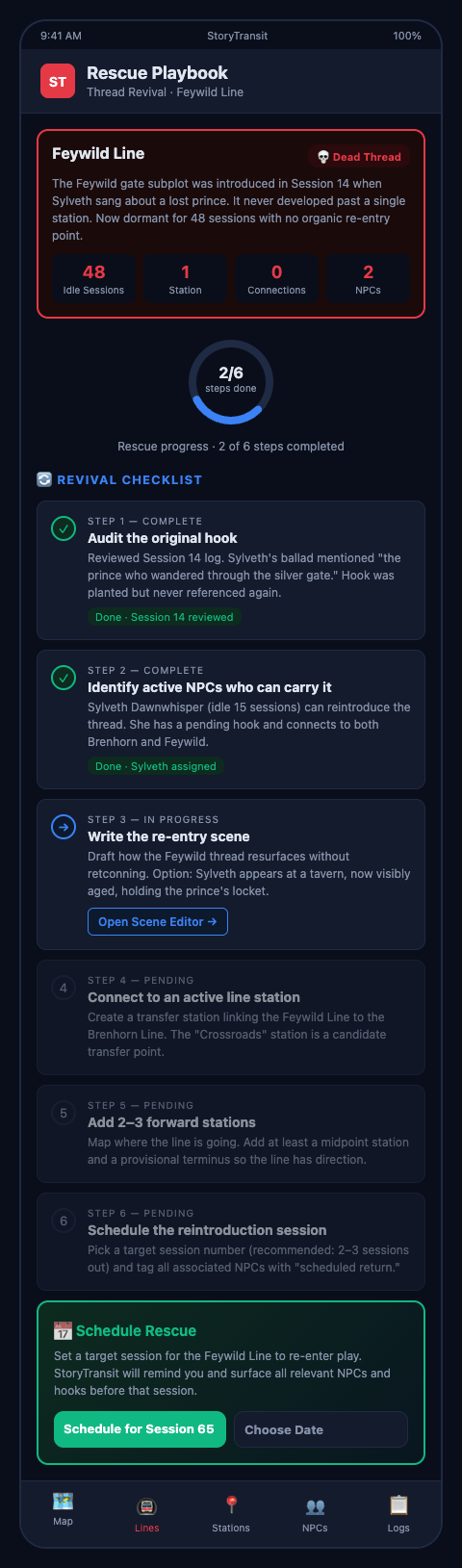
Rescuing dead plot threads follows a five-stage protocol. Each stage builds on the previous, and the total effort for a single thread recovery is typically under 30 minutes.
Stage 1: The Thread Audit. Before you can resurrect anything, you need a complete inventory. Pull every plot thread you introduced in the last 60 sessions that hasn't formally resolved. Don't evaluate them yet — just list them. A thread qualifies for the audit if it had at least one moment of player engagement (a question asked, a decision made, an NPC interaction that advanced it). Threads introduced and immediately forgotten without any player contact are candidates for quiet retirement, not resurrection.
Stage 2: Status Assessment. For each thread on your audit list, determine its current status: (a) dormant but intact — the established facts still hold, the NPCs are still alive, and the thread could resume without contradiction; (b) dormant with complications — some subsequent session events have affected the thread's premise, requiring reconciliation; (c) structurally broken — too many contradictions have accumulated for a clean return without a significant in-world explanation.
Most threads will be dormant but intact. Status (c) threads require the most care — see the section below on reconciliation tactics.
Stage 3: The Re-entry Point. A dormant thread doesn't need a dedicated session to come back. It needs a re-entry point: a moment in an upcoming session where the thread can reappear organically through an NPC encounter, a location visit, or a consequence that reaches the party. The merchant family feud can re-enter through a chance encounter with a family member at a market, a rumor that one family has hired assassins, or a player character receiving an unexpected inheritance from one side of the dispute.
The re-entry point should be low-stakes. Don't bring back a dead thread with a dramatic revelation in Session 1 of its return — bring it back with a quiet reminder that it exists, then escalate over the next three sessions. This mirrors how serialized fiction writers use structured callbacks to dead arcs: re-introduce before you escalate.
Stage 4: Bridge the Gap. Between the thread's dormancy period and its return, things should have happened in the world. The merchant feud didn't pause while the players were doing something else — it continued offscreen. Decide what happened during the gap: did one family gain advantage? Did an NPC change allegiance? Did an event you can tie to another plot line affect the feud's dynamics?
This is where the transit system metaphor earns its keep. On your campaign's story map, buried subplots tracking lets you see the dormant thread's station history alongside the active threads' recent stations. You might discover that a consequence from Session 55's active arc naturally affected the dormant thread's premise — a connection that makes the return feel earned rather than arbitrary.
Stage 5: The Payoff Schedule. Once the thread is reactivated, give it a payoff schedule: a rough target for when it should reach a climax or resolution. Three to seven sessions is a reasonable window for a mid-tier thread. A major arc thread might need 10-15 sessions. The schedule isn't a constraint — it's a planning anchor that prevents the thread from drifting back into dormancy.
Reconciliation Tactics for Broken Threads
When a thread's premise has been contradicted by subsequent events, outright resurrection isn't possible. But retirement isn't the only alternative.
The evolution retcon. Rather than pretending the thread's established facts never happened, find an in-world explanation for why the situation has changed. The merchant family feud resolved offscreen — one family won, the other has been reduced to a single bitter heir who now operates as a criminal. This evolves the thread rather than erasing it, and often produces a more interesting story than the original premise.
The consequence thread. Take the original thread's most significant established fact and generate a new thread from it. The feud itself is gone, but the debt one family incurred during it has passed to a new creditor — the thieves' guild. The original thread is closed; a new thread inherits its lore.
Time skip subplots are the cleanest structural device for reconciling broken threads: a declared in-game time skip gives you license to resolve threads offscreen with a summary, eliminating the debt without pretending it never existed.
For actual play editors managing season arcs, this same reconciliation challenge appears at production scale — dead threads from early episodes can't simply be ignored when listeners have documented them in fan wikis.
Foreshadowing research confirms that failed payoffs break immersion and engagement in ways that are disproportionate to the size of the original promise. A small thread that goes nowhere is still a crack in the world's coherence. The continuity rescue playbook exists to minimize those cracks — not to fix everything retroactively, but to give every thread a deliberate outcome.
Every Thread Deserves an Ending
Homebrew D&D dungeon masters with 50+ sessions of campaign history have a library of dead threads that represent real creative investment. StoryTransit's continuity rescue tools are designed to help you audit that library, identify the threads worth resurrecting, and build the re-entry points that bring them back without disrupting your active arcs.
A useful first pass before doing the full five-stage protocol: read through your last 30 session summaries with a single question in mind — which threads got introduced and never returned? Don't evaluate whether they're worth saving yet. Just list them. A dead thread from Session 22 that introduced a blood feud between merchant families costs nothing to list, and the list alone often reveals that three or four threads share a common NPC or location, which means a single scene can serve as a re-entry point for multiple dormant lines simultaneously. That kind of convergence — where one scene reactivates multiple dead threads at once — is the most efficient form of continuity rescue, and it's only visible once you've done the audit.
The waitlist for homebrew D&D DMs is open. If your campaign has more unresolved threads than active sessions to service them, StoryTransit's dormant stop detection and payoff scheduling will change how you prep — starting with the threads you thought were gone for good.