5 Mistakes Actual Play Editors Make With Season Arcs
Why Season Arc Editing Errors Are Different
Actual play editors operate with a constraint that scripted show editors don't face: the story wasn't written before it was recorded. The arc emerged live. Characters made choices the GM didn't anticipate. A subplot got introduced accidentally in a cold open and the cast latched onto it. A faction that was supposed to be background noise became central over six sessions.
By the time an editor sits down with episode 40 of a running season, they're working with six active plot lines, three character arcs in various stages of development, and a back catalog of story commitments the show has made without anyone formally tracking them. Structural storytelling errors in long-form serialized content include rushed arcs and unresolved threads—and actual play shows are especially vulnerable because there's no writers' room to catch these problems before they hit the feed.
The five mistakes below are the most common season arc mistakes actual play editors make. Each one is a documentation failure before it's an editing failure.
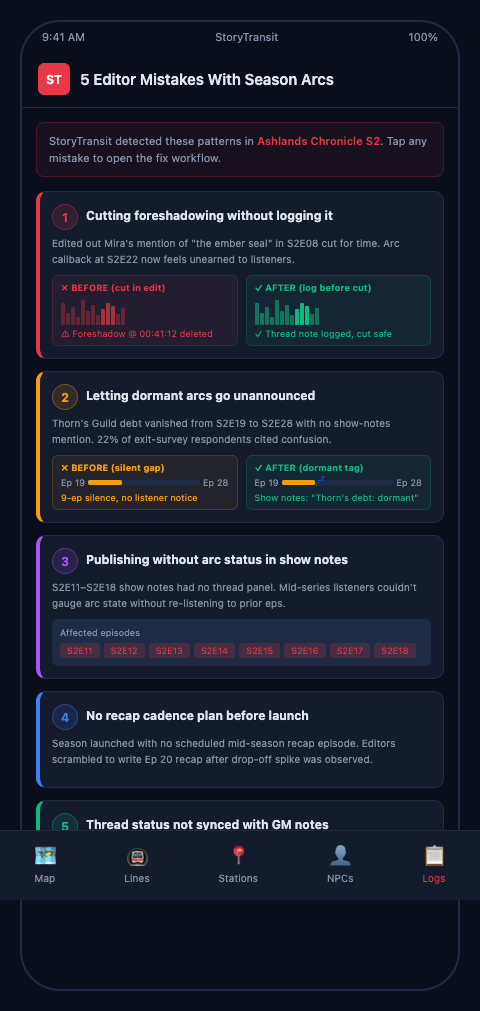
Mistake 1: Cutting a Thread Without Checking Its Arc Status
An editor removes a two-minute conversation between characters because the runtime is already long and the exchange feels digressive. What they don't know—because the thread tracker wasn't consulted—is that the conversation contains the only reference to a plot commitment made in episode 31. The thread goes cold in the listener's experience, not because the cast dropped it, but because it was edited out.
Planning the complete arc before episode one—knowing the ending and major beats—prevents downstream continuity errors. But most actual play shows can't plan that way. The practical equivalent is a pre-edit thread review: before making cuts for runtime, the editor checks the current thread map to flag content that carries narrative load. Content that can't be removed without breaking a story commitment stays in the episode, or gets bridged with a show note flag.
StoryTransit's pre-edit view surfaces thread status by episode—so an editor knows before touching the timeline which beats are load-bearing and which are safe to trim.
Mistake 2: Inconsistent Pacing Decisions Across the Season Arc
Editors who work episode-by-episode without reference to the larger arc create unintentional pacing disasters. They cut aggressively in episode 38 because the session ran long, then cut conservatively in episode 39 because the content felt thin. The result is a season that alternates between rushed and meandering without any structural logic the listener can follow.
Reducing churn is as important as acquiring new listeners; structural story errors directly feed audience attrition. Pacing inconsistency is a structural error—listeners feel it even when they can't name it. They describe the show as "uneven" or "hard to binge" without realizing the issue is at the editing level.
The fix is a pacing map: a simple document showing target runtime ranges by episode type (standard session, climax episode, setup episode, cold open-heavy episode) and how each episode in the season arc has been handled. When an editor can see the pacing arc across the full season, individual episode decisions stay coherent with the whole.
Mistake 3: Treating Recap Content as Filler
Recap segments—whether full recap episodes or "previously on" openings—get cut or compressed when editors are focused on runtime. The thinking is that regular listeners don't need them. This is wrong in two ways. First, regular listeners who miss an episode use recap content to catch up without re-listening. Second, new mid-series listeners use recap segments as their primary orientation tool. Cut the recaps and you've removed the on-ramp.
Continuity in serialized media requires consistent maintenance of characters, plot, settings, and timelines across installments. Recap content is part of that maintenance. It's not dead air—it's the orientation system for any listener who isn't perfectly current. Editors who understand this protect recap segments in every episode, treating them as structural elements rather than optional additions.
The edit unresolved threads guide covers how to make editing decisions around open threads without cutting their narrative context—which directly connects to how recap segments should be built and protected.
Mistake 4: Ignoring Thread Status During Episode Description Writing
Show notes are written after editing is done, usually quickly. Editors who write episode descriptions without consulting the thread map produce show notes that either omit active threads entirely or describe thread status inaccurately. A listener reads "Lord Thadderon reveals a secret" in the episode description, expecting a major arc beat, and finds that the reveal was a minor aside that got half the context cut for runtime.
Descript lets editors work from transcripts rather than waveforms, reducing risk of cutting story-critical dialogue—but accurate show notes still require knowing what the episode's story beats are before writing. A thread tracker that's been updated during the editing pass gives the show notes writer a current-state summary they can use directly.
Mistake 5: Not Marking Dormant Threads for Reactivation
Threads go dormant for legitimate story reasons—a PC's backstory gets backgrounded during a major arc, a faction feud goes cold while the party pursues a different objective. Dormant doesn't mean resolved. An editor who doesn't distinguish between dormant and resolved threads will eventually mark a reactivation episode as confusing or digressive and cut the moment the thread comes back.
Leaving music too loud, over-compressing audio, and poor pacing are among the most common editing errors—but for actual play editors, thread-management errors cause more lasting damage than any technical mistake. A compression artifact bothers listeners once. A cut that buries a thread reactivation loses the payoff of fifteen episodes of setup.
The dormant thread marker in your story map is the fix. When a thread is flagged dormant rather than resolved, every editor who works on subsequent episodes knows to watch for and protect its reactivation content. Narrative continuity basics covers the continuity documentation system that makes this distinction workable in a multi-editor production.
The cross-niche parallel is direct: plotlines unravel modes in live-event production show the same thread-management failures that actual play editors experience—dormant threads mistaken for resolved, reactivation moments lost to poor documentation.
Releasing raw unedited content and inconsistent publishing schedules are top mistakes that drive listener loss—but for shows that have solved those basics, season arc mistakes are where retention goes next. StoryTransit gives actual play editors the thread map they need to make arc-aware decisions at every stage of post-production.
How to Audit Your Existing Archive for These Mistakes
If your show is already 30 or 50 episodes in without a story map, an audit is more effective than wishful thinking about starting fresh. Work backward from listener feedback and your own memory of where the story stands.
Start by listing every plot thread you believe is currently active or dormant. For each one, identify the last episode where it appeared. Any thread that hasn't appeared in 20+ episodes and isn't clearly dormant-by-design is a candidate for dead thread status—introduced but effectively abandoned through editing decisions or pacing problems.
Next, pull your three lowest-performing episodes by listen-through rate or subscriber drop data. Listen to the cold opens of those episodes with a specific question in mind: did the episode begin with sufficient orientation for a listener who missed the previous two episodes? This is the cold open orientation test. If the answer is no—if the episode assumes significant prior context without establishing it—that's a podcast pacing problem at the production level, not just a story problem.
Finally, check your last five episode descriptions. Does each one include at least one sentence that would orient a new listener? If every description assumes full back-catalog knowledge, you're writing for current subscribers only, and your mid-series discovery rate is suffering for it.
Understanding podcast churn rate and how structural story errors directly feed audience attrition is the diagnostic frame for this audit. The five mistakes in this post aren't hypothetical—they show up in the listener data as patterned drop-off events that a story map and pre-edit thread review would have prevented.
The audit is also useful for identifying which mistakes are most costly in your specific show's context. A show with a small, deeply invested subscriber base loses more to thread-continuity mistakes than to pacing inconsistency—the audience is too invested to leave over pacing, but they will vocally respond to dropped threads. A show that's actively growing and onboarding new listeners loses more to the recap-as-filler mistake, because the steady stream of new arrivals needs orientation content that isn't there.
Serial storytelling podcast planning research shows that knowing your ending and major beats before episode one prevents downstream continuity errors. For actual play editors who didn't have that planning luxury, the arc audit is the retroactive version of that foresight. It tells you where the story went structurally and where the editing decisions that followed may have undermined it. That's information you can act on—by building the story map, initializing the pre-edit thread review, and writing show notes that work for both current subscribers and mid-series arrivals.
Actual play podcast producers who want their editors making arc-aware decisions from episode one should start with StoryTransit. Join the Waitlist for Actual Play Producers and get early access to the tools that turn scattered production decisions into a coherent season arc system.