The Fundamentals of Narrative Continuity in Actual Play Audio
What Continuity Means for an Actual Play Show
Narrative continuity in scripted television is managed by a writers' room and a continuity supervisor. Continuity in actual play audio is managed by whoever happens to remember what happened in episode 34. That structural gap is where most actual play story consistency problems originate.
55% of the US population listens to podcasts monthly; audience scale means continuity errors reach millions of listeners. A continuity break in a small actual play show affects hundreds of listeners. A continuity break in a mid-tier show with a dedicated fanbase affects tens of thousands. Either way, the audience notices. Long-term listeners have better memory for story details than most producers give them credit for—because they've been listening to the same show for months or years and the story is emotionally significant to them.
Serialized continuity requires consistent maintenance of characters, plot, settings, and timelines across all installments. In practice, this means four categories of detail that need to stay consistent across your episode archive: character traits and established capabilities, factional states and relationships, world-building commitments (what Kaelith's backstory actually established, what the Sunless Citadel's role in the world actually is), and plot thread status (what threads are open, what's been resolved, what commitments the narrative has made).
Listener loyalty depends on perceptions of authenticity; continuity breaks erode the trust that builds parasocial bonds. This is the real cost of continuity errors—not that a detail is wrong, but that the break signals to the listener that the show isn't paying attention to its own story. That signal damages trust in a way that good audio production or entertaining sessions can't fully repair.
The Most Common Sources of Continuity Breakdown
Continuity breaks in actual play audio cluster around predictable production moments. Knowing where they come from makes them preventable.
Editor-introduced gaps. An editor cuts a scene for runtime without knowing it contained a continuity-relevant detail. A character accepted a quest with specific terms in a scene that was cut. A location got named in a throwaway line that was trimmed. These gaps don't show up until three episodes later when the show contradicts the missing information.
Session-gap memory failures. The cast doesn't play every week. Between sessions, details blur. A character's relationship with Lord Thadderon was established one way; three weeks later, someone remembers it differently and plays it differently. Without documentation, neither version is authoritative.
Retired PC residue. A player leaves the show and their character exits the story. But the threads that PC was involved in don't necessarily resolve—they just lose their most invested steward. The cursed compass was Kaelith's discovery. When Kaelith's player retires, who tracks the compass thread?
Long-arc payoff disconnects. A thread introduced in episode 12 pays off in episode 63. Fifty episodes is a long time for any production detail to stay consistent. If the setup in episode 12 wasn't documented, the payoff in episode 63 has to be reconstructed from memory and show notes—which means it may contradict the original setup in ways neither the cast nor the producer notices until a listener points it out.
Jason Mittell's research on narrative complexity in contemporary television shows that narratively complex serialized shows demand active, attentive audience comprehension — which only works if the writers manage continuity carefully on the production side. The producer's job is to make that management systematic.
The editor arc mistakes post covers the editing-specific failure modes in detail. Edit unresolved threads goes into how editors can protect continuity in the cutting process without slowing down post-production.
Building Continuity Infrastructure Into Production
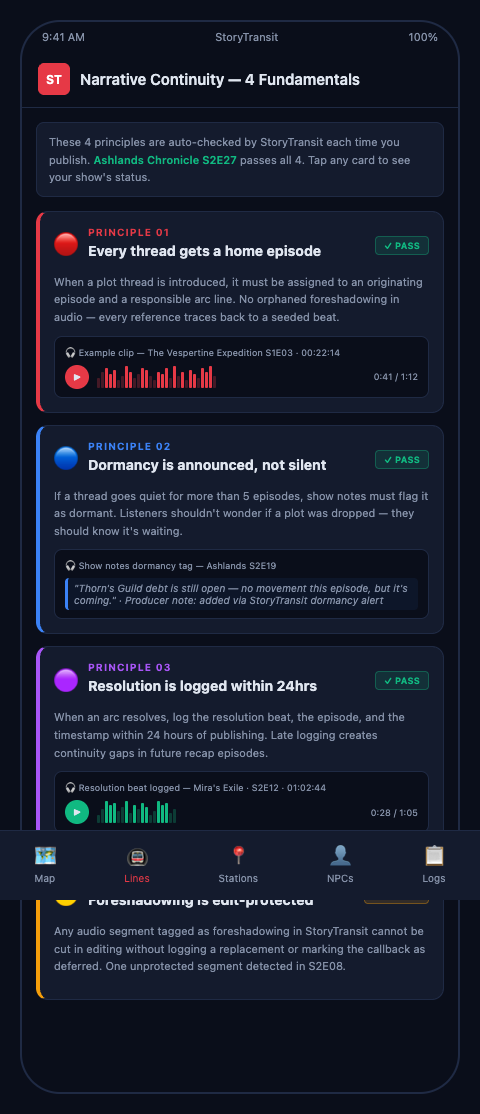
The continuity system that prevents these breaks has four components, all of which feed from a functioning story map.
The session-end continuity log. After every session records, spend ten minutes documenting: what new information was established about existing characters, what world-building commitments were made, which threads advanced or resolved, which new threads appeared. This is the raw material for every downstream continuity task. The editor who processes this log before cutting doesn't accidentally remove load-bearing content.
The character state document. For each major character—PC and significant NPC—a running record of their current state: known abilities, established relationships, active goals, and any story commitments the character has made. This document prevents session-gap memory failures. When the cast comes back after two weeks, they review character states before playing, not after.
The world-building registry. A simple record of what has been established as true about the world. What is the Sunless Citadel? What does the cursed compass do? Who is Lord Thadderon and what do we know about him for certain versus what is still mystery? This registry is the reference document that prevents "I thought we established X" contradictions.
The open thread register. Every thread that's been introduced and not resolved. Status (active or dormant), origin episode, last appearance, and current-state summary. When an editor is cutting episode 58, they check the open thread register before making cuts. When a recap episode needs to flag unresolved threads, the register provides the complete list.
Narrative continuity errors in TV productions illustrate the risks of poor documentation systems. The risk in audio is the same; the documentation solution is the same. The difference is that actual play producers don't have a dedicated continuity supervisor—so the system has to be simple enough to maintain across the full production team.
Dimension 20's narrative consistency across multiple seasons is cited as the lifeblood of Dropout's subscriber retention. Subscriber retention in actual play audio is directly tied to continuity quality—listeners who trust the show to maintain story consistency become subscribers who recommend the show and stay through slow-build arcs.
LARP documentation fails in live-event production shares the same root cause as actual play continuity breaks: real-time storytelling without adequate documentation infrastructure. The fix is identical—build the documentation habit into the production workflow rather than trying to reconstruct it after the fact.
Podcast community participation grows when listeners feel the show maintains consistent narrative standards. StoryTransit is the infrastructure layer that makes those narrative standards achievable for actual play producers working without a writers' room or continuity supervisor.
When Continuity Breaks Happen Anyway
Even with good documentation, actual play continuity breaks occur. The GM establishes something in session that contradicts an earlier detail. A player speaks as their character in a way that conflicts with established history. An editor cuts a scene that turned out to carry continuity load. These breaks will happen. The question is how producers handle them when they're discovered.
The first principle: address continuity breaks proactively rather than hoping listeners don't notice. Dedicated actual play audiences are attentive. They will notice when Lord Thadderon's faction affiliation contradicts what was established in episode 34. Acknowledging it—briefly, without extended apologies—maintains trust. Ignoring it erodes it. A quick show notes addendum or a brief in-episode acknowledgment from the cast is almost always better than silence.
The second principle: use the break as documentation intelligence. If a continuity error surfaced, it means a gap exists in your documentation. The character state document should have caught the faction affiliation detail. The world-building registry should have it. The break reveals exactly where the documentation system failed, which tells you where to add detail.
The third principle: don't let continuity break anxiety paralyze production. Some actual play shows spiral into over-documentation, trying to lock down every possible detail in advance. This works against the improvised nature of the format. The goal is enough documentation to catch the most consequential continuity errors—the ones that affect arc payoffs and listener trust—not a perfect record of every established fact. The four-document system described in the previous section covers approximately 90% of the continuity risks that actually damage audience trust. The remaining 10% are minor enough that the occasional error acknowledged gracefully costs less than trying to prevent it through comprehensive documentation.
Serialized audiences invest emotionally in continuity, and violations of established facts damage long-term engagement. For actual play audio, "manage carefully" means four documents, not twenty. The character state log, the world-building registry, the session-end continuity log, and the open thread register—maintained consistently over the season—catch the vast majority of continuity risks before they reach the feed.
StoryTransit is designed around this minimum viable continuity system. Not maximum documentation, but the documentation that actually prevents the breaks that cost you listener trust. For actual play producers running shows with 87 episodes in the feed and a community that knows the story as well as the cast does, that protection matters. The session-end continuity log alone—fifteen minutes per episode after every session—would prevent the majority of continuity errors that cost actual play shows listener trust. That's the return on a fifteen-minute habit: a story consistency record that lets the show grow without the production team having to hold every established detail in working memory.
Actual play podcast producers who want their audio storytelling to hold up across 50, 80, or 100 episodes need continuity infrastructure built for the live-play format. Join the Waitlist for Actual Play Producers and access StoryTransit's continuity tracking tools designed for the documentation realities of long-form TTRPG podcast production.