The DM's Guide to Tracking Buried Subplots Before They Resurface
The Subplot That Came Back Wrong
At Session 73 of a long-running homebrew campaign, a player announced that their character was finally going to follow through on the lead planted in Session 26 — the whispered rumor about a hidden vault beneath the city of Greyvast. The DM remembered planting the rumor. What the DM couldn't remember: whether the vault had been tied to the thieves' guild or the merchant council, what was supposed to be inside it, and whether any subsequent sessions had accidentally contradicted the premise. The session ground to a slow, improvised halt.
This is the scenario every DM guide to long-running campaigns warns about, but rarely addresses with enough operational specificity to prevent. Buried subplots don't vanish — they accumulate as campaign lore debt, collecting interest session by session until a player invokes one and the DM discovers the debt is due. Homebrew continuity failures of this type are rarely dramatic. They're quiet: a vague answer where there should have been a specific one, an improvised contradiction that nobody calls out but everyone notices. The DM who wants to prevent this moment needs more than memory. They need a tracking system that preserves the original details of every seeded subplot — not as a static archive, but as an accessible, session-linked record that surfaces the right information when a player finally pulls on the thread.
Research on information overload confirms that parallel information streams cause confusion, poor judgment, and degraded ability to track simultaneous threads. A homebrew campaign with 30+ active plot lines is an extreme version of this problem — and DMs manage it across dozens of sessions with no institutional support structure, unlike, say, a TV writers' room that maintains a show bible to prevent exactly these failures.
The Ebbinghaus forgetting curve applies to context-rich episodic content at the same rate as factual data. The subplot details you carefully crafted in your session prep for Session 26 have largely decayed by Session 73. What remains is a vague impression of intent, which is worse than having forgotten entirely — because you'll try to reconstruct from that impression and get it wrong.
The TTRPG market continues growing, with a rising player base that increasingly demands long-running, multi-arc homebrew experiences. That demand creates DMs who are running more complex campaigns than ever, with more buried subplots to track. The tools haven't kept pace.
A System for Tracking Dormant Subplots
Television writers have handled this problem for decades through what's called a show bible — a living document that tracks every established character detail and story fact to prevent continuity breaks across episodes and seasons. The DM running a multi-year homebrew campaign is operating under similar constraints, without the writers' room.
The transit system metaphor applies directly here. Every subplot is a line on your campaign's story map. When a subplot is active — when it's generating events and player engagement — it's a line with trains running. When it's been dormant for 15+ sessions, it's a line that's been suspended. The stations are still there, labeled on the map. But no trains have stopped.
The problem with buried subplots isn't that they're gone — it's that they're invisible. You can't see the suspended line unless you've mapped it. And you can't honor the promise of a story seed unless you can find the record of what that seed was.
Here's a tracking protocol that adds minimal prep overhead:
The subplot register. Maintain a running list of every plot seed you've introduced, sorted by session number. Each entry needs: the session it was planted, a one-sentence description of the seed, the intended payoff category (revelation, confrontation, reward, consequence), and current status (active, dormant, or resolved). This is your buried subplot inventory.
The dormant threshold. Any subplot that hasn't advanced in 12 sessions gets flagged as dormant. This isn't a deadline — it's a visibility trigger. When a subplot crosses the threshold, you review it and make a deliberate decision: schedule a reactivation, close the thread with a background resolution, or formally retire it. The worst outcome is neither — a subplot that sits in an undecided state indefinitely.
The reactivation window. When you're prepping an upcoming session, scan your dormant list for threads that could naturally intersect with the session's planned events. If the party is visiting a merchant district, check whether any dormant commercial or faction subplots have station stops there. A dormant subplot doesn't need its own dedicated session — it needs a single moment of acknowledgment that puts it back on the players' radar.
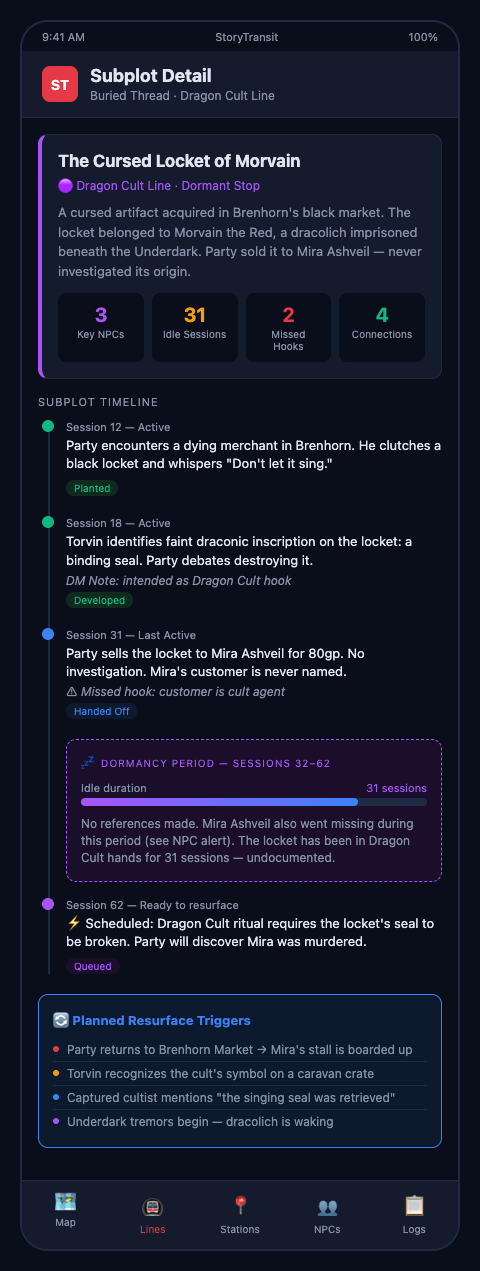
StoryTransit structures this as a transit map with a separate view for dormant stops — plot stations that have been visited at least once but have had no train arrive in the configured threshold period. This view is the single most valuable feature for DMs with 200 hours of campaign history: it surfaces the promises you've made without surfacing everything at once.
When you need to resurrect dead plot threads, the first step is the same one described here — you have to find the thread before you can bring it back. A register that doesn't exist can't be consulted.
Avoiding the Most Common Tracking Mistakes
Mistaking plot notes for a subplot tracker. Session notes record what happened. A subplot tracker records what was promised. These are different documents with different purposes. A session note for Session 26 might record "party heard rumors of vault beneath Greyvast." A subplot tracker entry records "Vault beneath Greyvast — introduced S26, tied to merchant council, contains the ledgers, payoff category: revelation, status: dormant." The tracker is forward-looking.
Letting the register grow without auditing it. A subplot register that never gets audited becomes another source of overwhelm. Schedule a brief audit at every tenth session — 10 minutes to scan the full register, update statuses, and flag anything that needs attention. Ten minutes every ten sessions is one minute per session on average. The overhead is trivial relative to the continuity benefit.
Planting subplots without payoff targets. Foreshadowing arcs work best when you have a rough target session range for the payoff — not a precise session number, but a window. "This subplot should pay off within 20 sessions of introduction" is enough. Without a target, the subplot joins a backlog with no retrieval trigger.
Over-tracking minor flavor details. Not every throwaway NPC comment needs to be a tracked subplot. The distinction between a flavor detail and a tracked subplot is player investment: if at least one player asked a follow-up question about it, track it. If it passed without comment, it's probably not load-bearing.
Failing to date your entries. Every subplot register entry needs a session number attached to the moment it was planted and, separately, to each subsequent advancement. Without session-number anchoring, your register becomes a list of intentions with no temporal structure — useful as a reminder that a subplot exists, useless as a DM guide to reconstructing its history. Session 26: planted. Session 41: party received indirect clue. Session 73: player invoked it. That three-line history tells you everything you need to know before improvising a response.
Treating the register as a write-once document. The subplot register has to be a living document, updated every time a thread advances, receives an indirect reference, or gets a status change. A register that captures the plant but not the subsequent developments is recording the beginning of a story without any of its middle — and the middle is precisely what you need when a player arrives at Session 73 having remembered Session 26's promise more clearly than you have.
The stale subplot problem in asynchronous play environments is even more acute than in live tabletop — threads can sit for weeks of real time between player posts, compounding the dormancy issue. But the same register-and-threshold framework applies.
Undocumented knowledge disappears without retrieval systems — organizational research on knowledge management confirms this at institutional scale. A single dungeon master running a homebrew campaign is operating a personal knowledge institution. The same retrieval principles apply.
Before the Next Subplot Surfaces Uninvited
Homebrew D&D dungeon masters with years of campaign history carry a growing inventory of buried subplots they've promised but haven't yet delivered. The question isn't whether they'll resurface — it's whether you'll be ready when they do. StoryTransit's subplot tracking view is built specifically for DMs managing 50+ sessions of accumulated story seeds, giving you a live map of what's dormant, what's approaching payoff, and what needs a decision before Session 87 arrives.
The first concrete step for any DM who hasn't yet built a subplot register is a 20-minute archaeology pass through their most recent ten sessions of notes. List every thread that was referenced but not resolved. Flag anything that a player asked a follow-up question about — those are the seeds that have already taken root in your players' mental model of the world, which means they're the ones most likely to surface without warning. A register built from ten sessions takes less than half an hour to create and immediately surfaces two or three dormant stops that you've been carrying without realizing it. From there, the register grows forward naturally — one new entry per session for any seed planted or any thread that advances. The overhead is low; the protection is immediate.
If you're already past the point where you can hold all your subplots in your head, join the waitlist for homebrew D&D DMs at StoryTransit — and get early access to dormant stop detection and the full campaign transit map before your next session.