Keeping PbP Players Oriented After a Two-Week Posting Gap
What a Two-Week Gap Actually Does to Your Players
The forgetting curve is blunt: humans forget roughly 56% of new information within an hour and up to 79% within a month without review. For a forum game running at one-post-per-day pace, a two-week posting gap falls squarely in the high-decay window. Players returning after fourteen days remember the broad strokes of their character's situation but have lost precision on NPC names, unresolved story threads, the mechanical stakes of the current scene, and the specific promises your plot made that they're supposed to care about.
This matters because PbP player retention depends on players posting with confidence. A returning player who can't remember where they left off posts shorter, hedges their character decisions, and often posts something that's inconsistent with the recent IC thread — forcing you to either correct it publicly or absorb the inconsistency into the story. For longer narratives, people summarize rather than recall precise details, which means their mental model of your campaign is already a compression artifact by the time they return.
Story information within a single scene is bound together in memory, but details that cross scene boundaries — the merchant's debt mentioned in scene three and payable in scene seven — are precisely the kind of cross-event information most vulnerable to forgetting. Those are usually your most important plot threads.
The two-week forum gap is also when players decide whether to keep investing in a campaign. A confusing return experience is a reliable dropout trigger. The post recaps discipline addresses this at the campaign level — a well-structured recap posted every two weeks is the macro-level version of what the scene opening post does at the scene level.
Building the Orientation Station
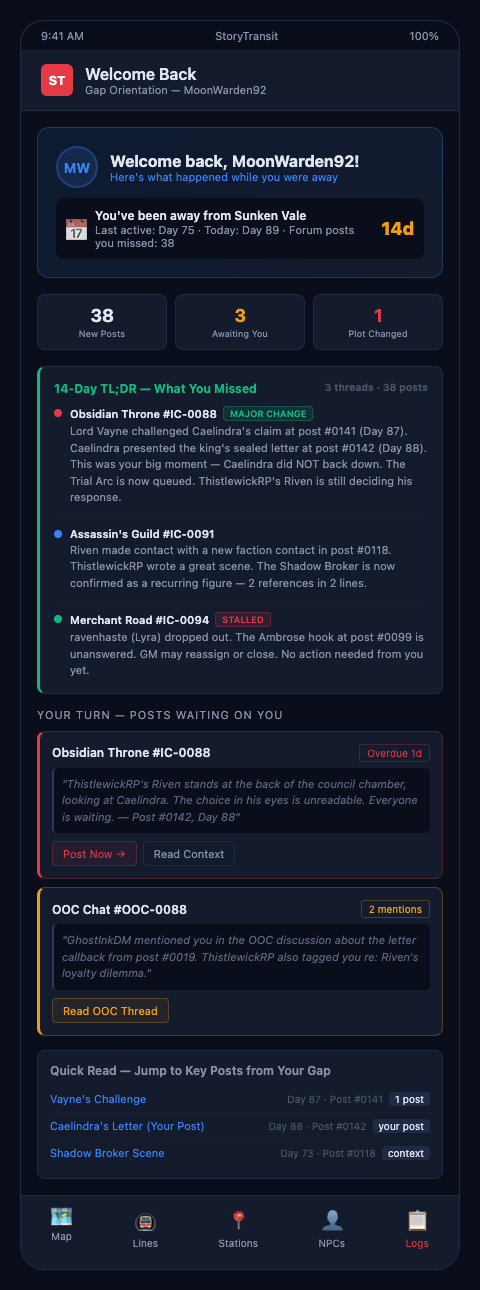
StoryTransit treats each re-orientation moment as a named station: a fixed stop on the route where players can board the story without having to trace the entire route from the beginning.
The core structure is a scene opening post — a brief IC or OOC post that appears at the start of each new scene, formatted specifically for returning players. It's not a summary of everything that happened. It's a boarding card: the minimum context needed to post with confidence.
A scene opening post contains four elements:
Active characters. Who's present in this scene. One line per character, with their current stated goal or concern. This anchors pbp NPC recall — players who forgot which NPCs are involved can reorient without rereading previous threads.
Carried stakes. The one or two story threads from previous scenes that are actively in play here. Not a full recap — just the specific unresolved promise: "The Council still owes the party for the Ember Gate affair." Players remember emotional stakes faster than narrative detail.
Scene opening state. Where are we, what's happening right now, and what's the immediate dramatic question. This is the station platform — the place players step onto the route.
Unresolved prior threads. A single line listing plot threads that are still open but not directly relevant to this scene. These are the dormant stops — still on the map, not currently in service. Players don't need to act on them now, but knowing they exist prevents players from posting as though those threads were resolved.
StoryTransit's transit metaphor applies directly: the scene opening post is the current stop announcement. Players know which line they're on, where it's been, and where it's going next.
Dedicated recap posts in IC threads are the veteran PbP GM's primary tool for re-orienting returning players, and research on spaced repetition confirms why: review intervals aligned with actual forgetting rates dramatically reduce memory decay. Posting the orientation at the start of each scene — rather than only when someone asks — creates a natural review cadence.
Advanced Tactics for Persistent Disorientation
Some players will still get lost even with good scene opening posts. They missed the gap AND the previous two scenes. They're not just two weeks behind — they're six weeks behind on a subplot that's now critical.
For these cases, build a thread catch-up index in your OOC channel. One post, updated monthly, that lists every active plot thread by name, its current status (active, dormant, resolved), the last post where it was meaningfully advanced, and a one-sentence summary of its current state. Players who need deep catch-up have a single navigation point rather than a pagination archaeology problem.
The companion tactic is structuring recap posts in a way that players actually read rather than scroll past. The scene opening post described above is a short-form version of that; the full recap system is the long-form version for deeper disorientation.
For campaigns where time skip subplots are a structural feature — where in-game time advances faster than real-world posting frequency — the orientation challenge compounds. A player absent for two real weeks might be returning to a campaign that's advanced two in-game months. Your scene opening post needs to address both the real-world gap and the in-game elapsed time.
One specific tactic for long-running gaps: the character status update. When a player returns after more than ten days, prompt them to post a brief IC internal monologue for their character — what they've been thinking about, what they remember, what they're worried about. This isn't just flavor; it forces the player to re-engage with their character's emotional state and signals to you which plot details they've retained. Gaps in their recall tell you exactly which threads need reinforcement in your next scene opening post.
Why thread catch-up index design matters. A catch-up index that's accurate on week one but never updated becomes a reliability liability — players who check it in week eight and find stale information stop trusting it entirely. The index needs two disciplines to stay useful: a clear update trigger (update when any thread's status changes, not on a fixed calendar schedule) and a versioning convention (each update gets a date stamp at the top, so players know when it was last current). A dated index that's three weeks old is still useful. An undated index of unknown freshness is ignored.
Graduated re-entry for long absences. A player returning after more than three weeks is in a different situation than one returning after two. They need more than a scene opening post — they need a personal catch-up brief delivered as a direct OOC message rather than a thread post. The same four-element structure applies: active characters (specifically which ones the returning player was closest to), carried stakes (which threads they were personally invested in, not all active threads), scene opening state, and one explicit "your first post should do this" suggestion.
The explicit suggestion is the most important element. A returning player with two weeks of pbp posting gap and no clear first move will write a vague, hedged post that doesn't advance anything. A player with a concrete prompt — "Kael needs to decide whether to tell the party what he recognized about the poison" — produces a post that moves the story.
The forgetting curve applied to IC posts. Different types of in-character information decay at different rates. Emotional moments — a character's betrayal, a confrontation, a sacrifice — are remembered far longer than factual details (NPC names, faction allegiances, specific locations). This asymmetry has practical implications for your scene opening post: lead with emotional stakes, not facts. "The party is still processing the loss of Mira" retrieves more player context than "Session recap: Mira died in thread 14, page 3." The emotional anchor reactivates the factual memory that hangs on it. Once players feel the emotional state, the details follow. Play-by-post player retention depends on players posting from a place of felt investment — and felt investment is retrieved through emotion, not through plot summaries.
Stop Making Players Do Archive Archaeology
Every time a player has to scroll backward through thread pagination to figure out what they missed, you're asking them to work for the privilege of playing in your game. That friction accumulates, and eventually some percentage of your players decide the effort isn't worth it.
The scene opening post and thread catch-up index are low-overhead structures that shift the orientation burden from players to the GM — where it belongs. Both can be implemented for an existing campaign in a single work session: write your first scene opening post for the current active scene (four elements, ten minutes), then build the thread catch-up index in OOC with a current status entry for every active, dormant, and recently resolved thread (30 to 45 minutes for a campaign with six to eight active plot threads). From that point forward, the scene opening post costs five minutes per new scene, and the catch-up index costs five minutes per status change. The ongoing overhead is negligible. The payoff is measurable: returning players post within 24 hours instead of asking recap questions that stall scene momentum.
StoryTransit gives play-by-post forum GMs a system for tagging story beats, tracking dormant threads, and generating orientation materials so returning players can board the story at the current station rather than tracing the route from the beginning. Join the waitlist for play-by-post GMs to see how the orientation station model works in practice.