How to Write Post Recaps That Players Actually Read
Why Players Skip Your Recap
You wrote the recap. It's in the OOC thread. You covered the last three weeks of IC posts, named the NPCs involved, summarized the outcome of the confrontation in the Merchant Quarter subforum, and flagged the two subplots that are still unresolved. Two players replied. The other three didn't acknowledge it at all. A week later, someone asked a question in the IC thread that your recap answered directly.
This is not a player engagement problem. It's a recap structure problem.
The root cause is that most pbp post recaps are written for the GM, not the player. They document what happened in the order it happened — IC chronology retold as OOC summary. Players reading this face the same cognitive overhead as re-reading the IC thread, just at lower resolution. The information is there, but the format doesn't reduce the work required to extract it.
Players who skip recaps aren't disengaged with the campaign. They're making a rational decision: if the recap requires the same mental effort as just reading the last few IC posts, they'd rather read the IC posts and get the full texture of the scene. The recap only wins if it delivers something the IC posts don't — which is current-state structure, not historical narrative.
Replication and Analysis of Ebbinghaus' Forgetting Curve – PMC shows that people forget roughly 70% of information within 24 hours without re-exposure. In a one-post-per-day pbp campaign, your players are operating at partial recall of everything that happened more than three days ago. A recap is your best tool for counteracting this — but only if it's structured in a way that matches how players actually need the information. A chronological event list does not match how players need the information.
Narrative Structure in Reading Engagement – ResearchGate shows that structured narrative summaries significantly improve comprehension recall. "Structured" is the key word — not longer, not more detailed. Structured to connect past events causally to present ones.
Why Player Recaps Matter in PbP — Nerdist confirms the practical dimension: forum GMs who provide regular plot recaps keep players oriented and reduce dropout in slow-paced games. The issue is not whether to write recaps but how to write ones that actually get read.
The Transit Line Recap Structure
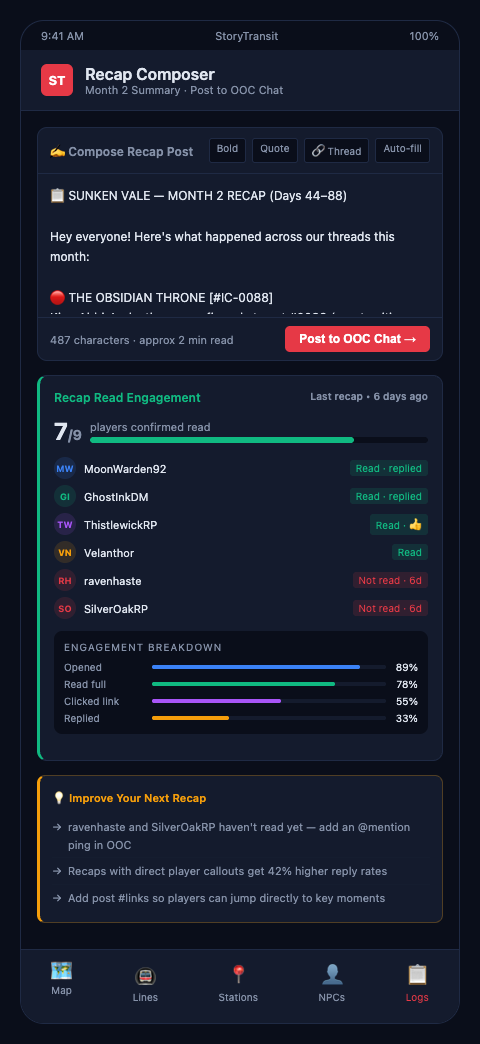
The most effective pbp post recap is built around active lines and dormant stops, not chronology. StoryTransit's transit-line model is what makes this structure concrete: each plot thread has a named line, a current station, and a defined next stop.
Instead of writing "Three weeks ago, the party discovered the merchant was poisoned. Then the guild representative appeared. Then the characters split up to investigate different leads," write with line logic:
Red Line (Poisoning Arc) — Active. Last station: the apothecary confirmed the poison was non-standard. Current status: the party has two leads unresolved. Next logical IC move: someone needs to visit the herbalist's district.
Blue Line (Guild Succession) — Dormant. Last station: the guild representative mentioned a competitor. Dormant since: eleven days. Revival trigger: the herbalist's district visit will likely surface a guild connection.
Green Line (Character Backstory: Kael) — Active. Last station: Kael recognized the poison formula from his military service. Current status: he hasn't told the party. Next logical IC move: the player controlling Kael needs to decide whether to disclose.
This structure tells each player exactly which thread concerns them, what state it's in, and what action would logically advance it. It respects their time. It doesn't require re-reading the archive.
Spacing Repetitions Over Long Timescales: A Review – PMC shows that spaced review at session boundaries is more effective for retention than a single comprehensive review. A weekly transit-style recap functions as that spaced review — it's not redundant with the IC posts, it's the reinforcement layer that makes the IC posts stick.
What to Cut and What to Keep
A pbp post recap should be readable in under three minutes. If yours is longer than that, it's carrying information that belongs in the archive, not the recap.
Cut: Chronological narrative of what happened. Players who were there remember it well enough. Players who weren't are better served by the current-state summary than a sequence of events.
Cut: NPCs who appeared but don't have active roles in any current transit line. If they're dormant, they belong in the dormant stops section, not the narrative body.
Cut: Rules clarifications and logistics. Those belong in the OOC thread proper, not the recap.
Keep: The current status of every active line, stated in one sentence each. Keep: The dormant stops list — name, last station, days since last activity, revival trigger. Keep: Player-specific action pointers: "The next IC advance on the Red Line logically belongs to Kael's player." Keep: A link to the most recent IC post that advanced each active line. Not the thread — the specific post. Forum pagination means a thread link is almost useless without the page number.
An Analysis of Reader Engagement in Literary Fiction – ACL Anthology found that engagement correlates with narrative tension and character relevance. Your recap maximizes both when it connects current thread status to the specific character each player controls. A generic summary is low on both; a player-specific action pointer is high on both.
For the slow-burn arcs that define the pbp format, the recap is the primary mechanism for maintaining narrative tension across weeks of asynchronous posting. The recap that refers back to a month-old station on the Red Line — "eleven real-world weeks since the apothecary's warning, and the party is now facing the consequence" — activates that dormant thread in a way a new IC post alone cannot.
The player-specific action pointer is not optional. A recap that lists active line statuses without assigning agency leaves every player waiting for another player to act first. The pointer changes this: "The next IC advance on the Red Line belongs to Kael's player — the apothecary's question is directed specifically at him." That single line transforms a passive reader into an active participant. It costs you thirty seconds per active line to write and is the most reliable tool available to a forum GM for preventing the "everyone waiting for someone else to post first" stall that derails IC threads.
Keep the format consistent between recaps. Players learn a consistent format quickly; they start scanning for the section that covers their character's line rather than reading the whole document. That's a feature, not a flaw. A recap that players skim efficiently is better than one they read thoroughly once and then stop opening.
Recap Cadence and the Two-Week Gap
Comparing Comprehension of Long Text in Print vs Kindle – PMC shows long-form text comprehension improves with structural markers and periodic summaries. For forum campaigns, the practical implementation is a recap posted every two weeks — timed not to calendar dates but to IC activity volume.
A good rule of thumb: post a recap when the IC thread has accumulated more than fifteen new posts since the last recap, or when two or more active transit lines have advanced their station count, whichever comes first.
The two-week gap orientation post covers what happens to player engagement after a two-week absence — the recap is the primary re-entry tool for returning players. Make it findable: pin it or link it from the OOC thread header so a player who's been away for ten days doesn't have to scroll to find where they left off.
The dormant stop section is the most important part of the recap. Active line summaries are useful. But the dormant stops list is what separates a recap that maintains campaign continuity from one that merely catches players up on recent events. When you include the dormant stops list in every recap — name, last station, days dormant, revival trigger — you accomplish two things simultaneously. You remind players that these threads still exist and still matter. And you give yourself a public accountability mechanism: a subplot listed as dormant in five consecutive recaps is a signal that you need to make a revival decision.
Recap as narrative architecture. The Impact of Paging vs. Scrolling on Reading Online Text – Semantic Scholar shows paged formats outperform scrolled documents in reading speed. Your recap is effectively the "paged" version of the campaign's archive — it extracts the structural essentials from a scroll of posts into a format players can read in three minutes. The formatting matters: headers for each active line, a clear dormant stops section, and a specific player-action pointer at the end. The player who opens the OOC thread and sees that structure immediately knows whether this recap is relevant to their character without reading every line.
Link from every recap to the last. A chain of linked recaps creates a navigable history of the campaign's state at two-week intervals. When a player returns after a six-week absence, they can read three recaps and be fully current — without touching the IC archive at all. This is the most underused feature of the OOC thread in long-running pbp campaigns.
For actual play producers who track narrative across episodes, the structural challenge of the recap episodes guide maps closely to the pbp post recap — same cognitive problem, different medium.
StoryTransit generates transit-style recap templates for play-by-post forum GMs, pulling the current status of each active line and dormant stop directly from your campaign map. Join the Waitlist for Play-by-Post GMs to access structured recap generation that cuts your prep time and produces recaps players actually read.