Slow-Burn Storytelling: The Beginner's Guide to Month-Long Arcs
Why Month-Long Arcs Are PbP's Greatest Strength and Most Common Failure
The play-by-post format has one structural advantage that no other tabletop format can match: time. A slow-burn arc that would take ten minutes to resolve at a weekly table can be stretched across three months of IC posts, with each new post adding texture, advancing a clue, or deepening a character's investment in the outcome. The poisoning arc from April becomes something players are still thinking about in July — because they've been living inside it, one post at a time, for eleven real-world weeks.
That's the upside. The downside is identical: eleven real-world weeks. At one post per day, that's seventy-seven posts, spread across multiple threads, accumulated in a forum archive that grows deeper every week. If you don't build explicit pacing structure into a month-long arc from day one, the slow burn becomes a slow fade — and players who invested in week one have no reason to care in week twelve. Slow-burn pbp storytelling is not passive; it requires active station scheduling and deliberate play-by-post session cadence choices to survive contact with the format's memory-decay realities. Forum narrative that spans twelve weeks without structural milestones doesn't feel epic — it feels aimless.
Slow Burn Storytelling – Author's Pathway describes the core requirement: slow burn needs deliberate pacing milestones to maintain tension without losing audience investment. In a pbp campaign, "audience" is your players, and "milestones" are the scheduled story beats you commit to hitting regardless of how slowly the IC posts accumulate.
Establishing and Satisfying Plot Threads – Mythcreants makes the cost explicit: threads left unresolved erode reader trust. In a forum campaign, that trust erosion shows up as declining post frequency. A player who invested in a subplot that's been dormant for six weeks isn't just waiting — they're quietly recalibrating how much the campaign is worth their time.
The Three-Phase Structure of a Month-Long Arc
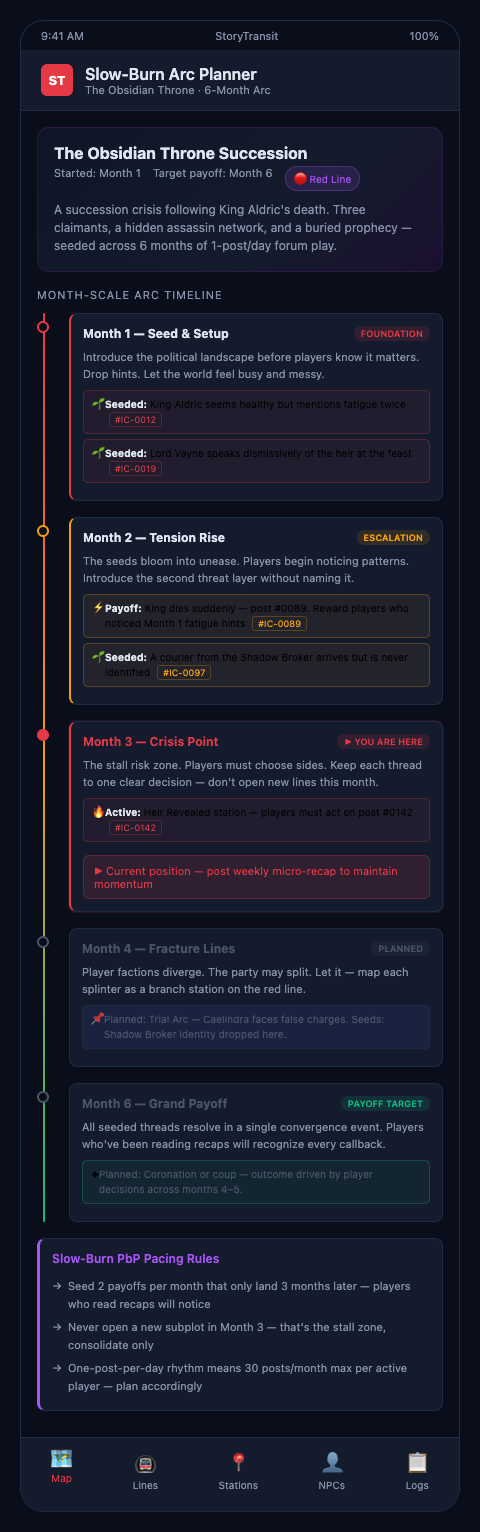
A month-long arc in a pbp campaign needs three explicit phases, each with at least one station logged on your transit line.
Phase One: The Seed (Weeks 1-2). Plant the arc visibly but without urgency. A suspicious detail, a character revelation, a background event that players can notice if they're paying attention but that doesn't demand immediate IC action. This is the station where the line opens. Log it: thread, page, post number, date, one-sentence description. Mark it active.
Phase Two: The Escalation (Weeks 3-7). This is where most slow-burn arcs die. Nothing dramatic enough to demand attention, but enough happening that players who forgot the seed feel the gap. The fix is a scheduled mid-arc advancement: one IC post every two to three weeks that moves the arc forward without resolving it. Not a callback to the seed — an independent development that makes the seed retroactively more significant. The apothecary wasn't just making a routine delivery; the poison was ordered by someone with guild connections. That's a mid-arc escalation. Log it as a new station.
Phase Three: The Convergence (Weeks 8-12). This is where the slow burn pays off — but only if players remember the seed. Mastering Narrative Threads – Freelance Writing Canada confirms that threads must be revisited at intervals to reward long-term engagement. The convergence works when players can feel the callback to something they experienced weeks ago. If they've forgotten the seed, the payoff lands flat.
The transit model tracks this structure automatically: an arc with three stations (seed, escalation, convergence) has a clear visible shape on the map. A GM looking at the map can see that the Red Line has had no new station in five weeks and is in danger of arriving at the convergence phase with a disengaged audience.
Building Station Schedules Before You Start
The Right Time to Learn: Mechanisms of Spaced Learning – PMC shows that spaced reinforcement over long intervals deepens processing. The practical application for a month-long arc: before you post the seed, write a rough station schedule. Not detailed scenes — just target dates for each station and a one-sentence description of what that station will establish.
Seed (April 3): Apothecary delivers non-standard compound to Merchant Quarter. Escalation 1 (April 21): A second delivery is refused — the buyer has gone silent. Escalation 2 (May 10): The compound appears in a different district under a different name. Convergence (May 30): The buyer is identified; the arc connects to the guild succession conflict.
That schedule is a four-line document. It takes five minutes to write. It's the difference between an arc that maintains tension for eight weeks and one that dissipates after week two.
For the one-post-per-day documentation requirements that come with this posting cadence, the station schedule is the planning layer that makes daily posts sustainable. Each day's post doesn't need to advance every arc — it needs to advance at least one station on some line. The schedule shows you which line is due.
Sustaining Player Investment Across Weeks
Jim's Blog: How To Run A Play-By-Post – Knights of the Braille identifies the practical problem: month-long arc pacing in pbp requires explicit signposting. Players disengage when momentum stalls. The signposting doesn't need to be heavy-handed — it needs to be present.
Three techniques keep players invested across a long arc:
Personal stakes assignment. When you post the seed, identify which player character has the strongest reason to care about this arc. Their backstory, their current goals, their IC relationships. Make the escalation developments land through that character first. Players who feel personally implicated in an arc stay engaged with it.
Dormant stop announcements. When you deliberately pause an arc between stations — during a focused push on a different transit line — post a brief OOC note: "The Red Line is dormant this week while we advance the guild succession conflict. Expect a new station next week." This acknowledges the pause as intentional rather than accidental. Players who know the arc is coming back stay oriented; players who don't know assume the arc is dead.
Transfer station callbacks. When two arcs converge at a transfer point, give players a moment to feel the connection. "The compound you found in the Merchant Quarter — you've seen it before. Station 2 of Kael's backstory." An explicit callback rewards players who remembered the earlier station. It also functions as a recap for those who didn't.
Managing plot drift prevention across a slow-burn arc requires these same techniques applied consistently — not just at the convergence phase but at every escalation. The 48-hour plot beats framework that LARP organizers use compresses the same three-phase structure into a weekend; the challenges of timing and player investment are structurally identical.
When the Slow Burn Goes Cold
Every slow-burn arc reaches a point where it's been dormant long enough that revival requires active work rather than a single IC post callback. The test is simple: if you wrote a new IC post that referenced the arc's last station, would players recognize the reference without re-reading the archived thread? If yes, the arc is recoverable. If no, you need a more deliberate revival approach.
The deliberate revival approach for a cold slow-burn arc has three steps. First, post a brief OOC note acknowledging the thread's status: "The poisoning arc has been dormant for eight weeks. I'm planning to bring it back this month through the herbalist district visit." This primes player memory before you make the IC move. Second, write an IC post that doesn't require players to remember the specific detail — it re-introduces the arc element as something the characters are encountering fresh. Third, follow with a recap that includes the arc's transit line status and explicitly connects the new IC development to the original seed for players who do remember it.
Global Online Gaming Market Report (Grand View Research) reports the online gaming market reached $282B in 2024; forum-based narrative games represent a growing niche, which means more GMs are attempting slow-burn arcs across extended campaign timelines. The structural challenge of sustaining those arcs doesn't change at scale — it gets harder.
Running multiple slow-burn arcs in parallel. A single slow-burn arc is manageable with good station scheduling. Two or three in parallel — which is typical for a campaign that's been running for four months or more — requires explicit priority management. Not every arc can advance every week. Use your transit map to maintain a rotation: if the Red Line advanced this week, the Blue Line should advance next week regardless of what's happening narratively. The arc that's "always about to advance" but never does is the one that players stop investing in.
The station log in StoryTransit makes rotation visible: you can see at a glance which line's last station is oldest and schedule its advancement before players have consciously noticed the gap. That's the difference between a slow-burn arc that rewards patience and one that tests it past the breaking point.
StoryTransit is built for play-by-post forum GMs running slow-burn arcs across months of thread pagination. The transit line view shows you every arc's current phase, next scheduled station, and days since last activity — at a glance, before every IC post. Join the Waitlist for Play-by-Post GMs and get early access to the arc management tools designed for the forum GM's one-post-per-day session cadence.