Preventing Plot Drift in Play-by-Post Games Over Six Months
How Plot Drift Actually Happens
Ask a forum GM whose six-month campaign has drifted and they'll usually say the same thing: they noticed it too late. The faction that was supposed to be a slow-burn antagonist became a neutral party around month three because a player's IC post reframed them sympathetically and the GM went along with it. The poisoning arc from April still has an open thread but no one's touched it in eight weeks. The political marriage subplot resolved in a way that contradicts a promise made in the campaign's second week — but that post is on page fourteen of an archived subforum and nobody remembers it except you.
For a six-month forum game, plot drift prevention requires active systems, not good intentions. Slow-burn RPG campaigns that lack structural anchors drift into plot incoherence within two or three months. This isn't a failure of creativity. It's a predictable structural outcome of long-form collaborative storytelling without explicit drift-prevention systems. Promise logging needs a place to live, and without that tracking discipline most drift-prevention strategies collapse before they take hold.
The research confirms the pattern. Collaborative storytelling drifts specifically at plot branch points — moments where a player decision could take the story in multiple directions. Without a tracking mechanism, each branch point creates a small gap between the GM's intended story logic and the story the players are experiencing. Over six months of one-post-per-day pacing across dozens of IC threads, those gaps compound into pbp plot drift.
Even AI narrative systems show systematic factual and temporal drift in stories beyond a certain length. The challenge isn't unique to PbP or to human GMs — it's a fundamental property of long-form storytelling without structural anchors.
The Story Transit Anchor System
StoryTransit approaches drift prevention the way a transit authority approaches route maintenance: with scheduled audits, defined endpoints, and an explicit record of where each line has been.
Promise logging. Every time your story makes a narrative promise — a villain announces a plan, a faction makes a threat, a character learns something that implies a future revelation — log it as a station on the relevant plot line. Story promises are debt: they generate player expectations that the narrative eventually has to pay. Unlogged promises become forgotten debt, and forgotten debt is the primary driver of forum story consistency failures over long campaigns. A structured audit of unresolved plot threads is how most GMs catch accumulated promise debt before it compounds into full drift.
In StoryTransit terms, a promise is a scheduled station. The line is supposed to stop there. If the train runs past without stopping, players feel the omission even if they can't articulate why the story feels off.
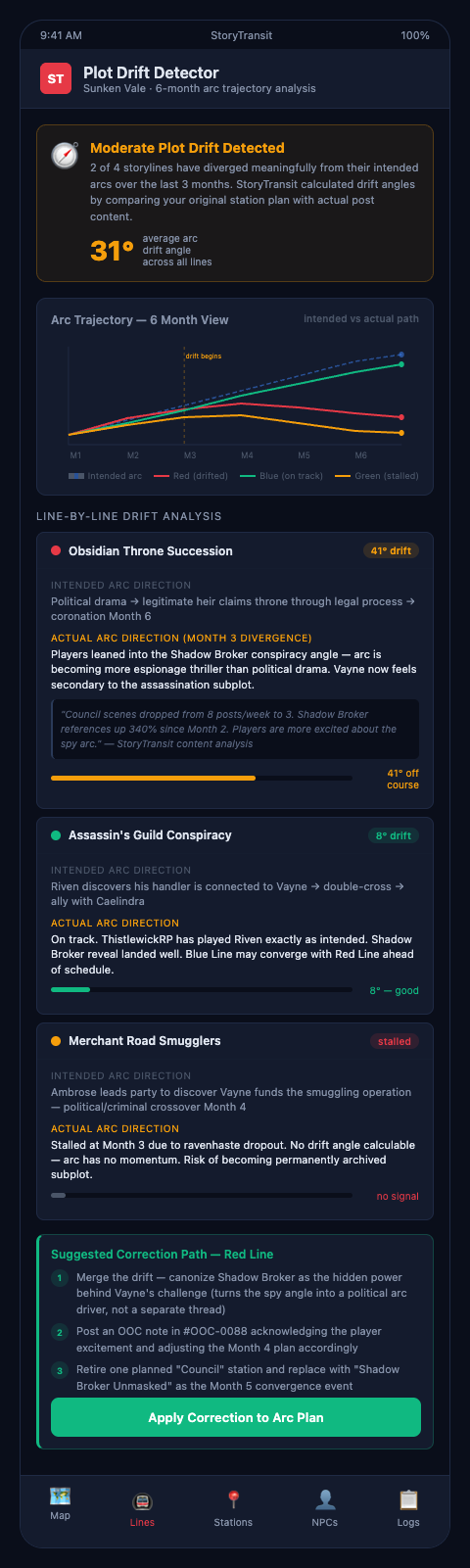
Quarterly route reviews. Every twelve to sixteen weeks — roughly every quarter of a six-month campaign — audit every active plot line against its original destination. Which lines have drifted from their intended route? Which stations have been skipped? Which lines have been running so long that their original destination no longer makes narrative sense given how the story has developed?
The quarterly review isn't about forcing the story back onto its original track. It's about making the drift visible so you can manage it deliberately rather than accidentally. Sometimes the drift is an improvement. Maintaining a detailed outline that tracks promises and character arcs is the most effective drift-prevention technique — but the outline serves navigation, not constraint.
Dormant stop alerts. Any plot thread that hasn't been advanced in more than three weeks gets flagged as a dormant stop. This isn't necessarily a problem — some threads are slow-burn by design. But dormant stops that the players don't know are dormant create confusion. Flag them explicitly in your OOC thread: "The Ember Gate investigation is on hold pending the Council vote." Players know the thread is alive; they're not waiting for a signal that will never come.
Convergence checkpoints. When two plot lines are scheduled to converge — when the slow-burn poisoning arc and the political marriage subplot are supposed to intersect — build a checkpoint post into your planning. One week before the convergence, review both lines for consistency. Do they still connect the way you intended? Has one drifted in a way that makes the convergence incoherent?
Advanced Tactics for Long-Form Play-by-Post Narrative Cohesion
The six-month threshold is when most forum game GMs encounter a specific failure: the story has accumulated so many open threads that closing them all feels overwhelming, so they stop tracking and start improvising. Improvised closure generates new inconsistencies, and the drift accelerates.
The antidote is deliberate thread pruning. Not every open thread needs to be resolved. Some can be closed as dormant stops with a brief IC acknowledgment that the thread reached a natural resting point. The goal isn't resolution — it's accounting. Your story map should accurately reflect which threads are active, which are dormant, and which are permanently closed.
For campaigns that have already drifted, a structured recovery process is a different problem than prevention — you're working backward from a drifted state rather than forward from clean architecture — but the underlying tools are similar. Closing dormant arcs, reconstructing promise history from the archive, and re-anchoring the current state all rely on the same formal audit methodology described above, run against a larger backlog.
If drift has already damaged player engagement, the related failure mode of a pbp game stalled after month three is a pacing problem rather than a coherence problem, though the two co-occur often enough that the same recovery playbook applies to both.
For live-event parallels, plot reconciliation debrief in LARP settings addresses the same underlying challenge: how do you identify and reconcile narrative inconsistencies after the fact? The LARP approach is structured for post-event reconciliation; the PbP approach described here is preventive.
One practical tactic that consistently works: a campaign bible update at the six-week mark. Not a full wiki — just a running document that tracks the current state of every active faction, NPC, and plot thread in a single paragraph each. Takes thirty minutes to update. Prevents three hours of forum archaeology when a player asks "wait, what happened with the Guild?"
Why the six-month threshold specifically. A two-month campaign has too little accumulated history for drift to compound into incoherence. A three-month campaign has enough threads to drift but can still be navigated from memory. Six months is the threshold because it's when two separate drift dynamics converge simultaneously: the plot archive is deep enough that players can no longer hold the early campaign in working memory, AND the GM has made enough responsive adjustments that the story logic has genuinely diverged from the original design. Both conditions are required for serious forum story consistency failure. Preventing either one keeps the drift manageable.
Identifying drift before players do. Players notice narrative incoherence before they can articulate it. The signal is usually behavioral rather than explicit — they start posting more cautiously, hedging character decisions, referencing recent events rather than drawing on the full arc history. A player who was enthusiastically building on month-one subplots in month two but stops referencing them in month five is experiencing the feeling of drift even if they haven't named it. The quarterly route review is in part a tool for catching this before it becomes a player complaint: if a promised arc hasn't been touched in eight weeks and a player's posting style has become more cautious in the same period, those two data points are likely connected.
Keep Your Story Honest Across Six Months
The challenge in long-form play-by-post isn't sustaining creativity — it's maintaining the narrative honesty to acknowledge when the story has drifted and respond deliberately rather than reactively. A promise logged is a promise visible. A visible promise is one you can honor, negotiate, or consciously close.
The forum story consistency problem compounds because drift doesn't feel like failure while it's happening. Each small divergence from the original story logic feels like responsive GM-ing — adapting to player choices, honoring IC moments, letting the story breathe. Individually, each of those choices is correct. Cumulatively, they produce a six-month campaign that has lost its through-line without any single decision being the cause. This is why the structural anchors described above — promise logging, quarterly reviews, dormant stop alerts — need to be built in from month one, not introduced after the drift is already visible.
A practical test: once per month, read your campaign's first OOC thread post and your most recent IC post back to back. If the world those two posts describe feels like the same campaign with a coherent through-line, your play-by-post narrative cohesion is intact. If they feel like different stories, you have drift — and now you have the tools to locate where it started. Quarterly route reviews are most effective when the GM can compare where each plot line was supposed to be at this stage versus where it actually is. That comparison requires the original destination to be documented, which is the argument for promise logging from day one rather than retroactively.
StoryTransit gives play-by-post forum GMs a structured story map that logs promises, flags dormant stops, and schedules convergence checkpoints so drift becomes visible before it becomes collapse. If you're running a six-month forum game or planning one, join the waitlist for play-by-post GMs to see how the route-audit system applies to your specific campaign.