5 Reasons Your Play-by-Post Game Stalled After Month Three
Month Three Is Where PbP Campaigns Break
The first eight weeks of a play-by-post campaign tend to run well. Players are energized, post frequency is high, and the world feels new. Then, somewhere around week ten or twelve, something shifts. Post frequency drops. An IC thread goes two weeks without a reply. A player posts an OOC apology and then disappears. The forum campaign that felt like it had momentum is now a collection of half-finished threads and a GM wondering what went wrong.
Guide to PBP/PBEM – Roleplaying Tips describes this cycle as one of the most predictable failure modes in the format: PbP games frequently grind to a halt, and GMs who don't post consistently see player interest collapse. But knowing the pattern doesn't explain it. Here are the five specific structural reasons month three is where play-by-post campaigns stall.
Reason One: The Archive Has Swallowed the Plot
By month three, your forum archive has grown. The exciting early threads that established the world and the characters are now on pages three and four of their subforums. Players joining late can't find the context. Veterans remember things happened but can't easily locate where. The slow-burn poisoning arc from the first month is now buried deep enough that bringing it back requires excavation rather than a simple reference.
The fix is pbp pacing fundamentals: building a narrative map before the archive swallows your plot threads. A transit-style map where each plot thread is a line and each story beat is a station means you can always see the current state of every arc, regardless of how deep it's buried in pagination. Without this, month three is when the archive starts winning.
Reason Two: A Single Player Is Blocking Multiple Threads
In a one-post-per-day pbp campaign, a single combat round takes a month. If one player's response is required to advance a scene and they go silent for two weeks, that thread stalls — and any subplot that depends on it stalls with it. Jim's Blog: How To Run A Play-By-Post – Knights of the Braille confirms this directly: players ghost without warning, and games reliant on a single player's action stall for weeks.
The structural fix is to design threads so that no single player's absence blocks more than one storyline. Keep your transit lines parallel rather than sequential: if the Red Line stalls because a player went silent, the Blue Line and Green Line should still be running. The GM's job at month three is to ensure there are always at least two active threads so that a ghost doesn't take the whole campaign with them.
Reason Three: Plot Drift Has Replaced Your Original Vision
Persistence and Dropout in Higher Online Education – Frontiers in Psychology shows that dropout spikes at "chapter transitions" in long-running online engagements. Month three is often a natural chapter transition in a pbp campaign — the initial arc is wrapping up, and the next arc hasn't fully begun. During this gap, the campaign drifts: IC posts start addressing minor threads rather than major ones, and the overall narrative momentum dissipates.
plot drift prevention requires a documented through-line. If you can't articulate in one sentence what the campaign's central conflict is right now, that's the gap drift is filling. Map your transit lines and identify which one is the main line — the one that, if it stalled, would signal to everyone that the campaign had lost direction.
Reason Four: The OOC Thread Has Become a Graveyard
At month one, the OOC thread is alive with player discussion, questions, and coordination. By month three, it's often a scroll of increasingly spaced apology posts. This matters because the OOC thread is where the social fabric of the forum campaign lives. When players stop engaging there, they stop feeling accountable to each other for posting frequency.
A Review of Online Course Dropout Research – Springer identifies lack of peer interaction as a top dropout driver in asynchronous online communities. The OOC thread is your primary peer interaction channel. A weekly structured prompt in the OOC — even something as simple as "which thread do you want to advance this week?" — keeps the social connection alive during slow IC periods.
Reason Five: The GM Has Run Out of Visible Hooks
By month three, a forum GM has planted subplots, introduced NPCs, and seeded background lore across dozens of IC posts. The problem is that much of that material is now invisible — buried in archived threads, referenced in posts nobody has re-read in two months, or simply forgotten by the GM themselves.
Forgetting Curve in Adult Learners — Mind Tools shows that without reinforcement, people lose roughly 70% of plot context within 24 hours of reading. The GM who seeded eleven clues in month one may remember perhaps three of them by month three. Without a systematic record, the hooks that were supposed to pay off never get called back.
StoryTransit addresses this directly by tracking every dormant stop — every subplot that's been introduced but hasn't advanced recently. When you sit down to write your next IC post and feel like you've run out of material, opening the map shows you a list of dormant stops that are candidates for revival.
This is the paradox of month three: the campaign that feels empty of ideas is usually the campaign that has the most dormant material available. The slow-burn poisoning arc seeded in week two, the guild contact who dropped a cryptic warning in week four, the location mentioned in passing in week six — all of these are potential sources of new IC content. The GM who can't access them believes the campaign has exhausted its material. The GM with a dormant stop registry knows they have a backlog.
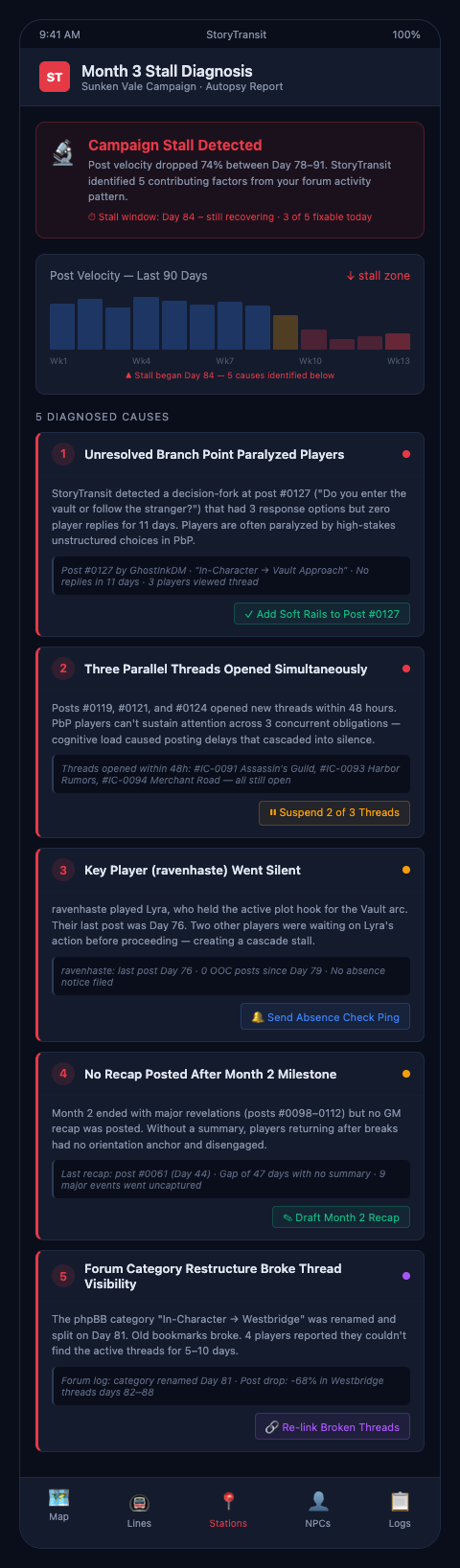
The Month Three Audit
If your campaign is at or past month three and showing signs of stall, run this audit:
Check how many threads have had no IC post activity in more than three weeks. If the number is more than two, your archive has already started swallowing plot. Check whether any single player's absence is blocking three or more active threads. If yes, redesign those threads to allow GM-controlled advancement. Check whether you can articulate your campaign's current central conflict in one sentence. If no, that's the drift point. Check the OOC thread's last five posts — are any of them substantive discussion, or all apologies and absence notices? Check your list of planted subplots and mark which ones have had no activity in more than six weeks.
The results of this audit are your repair priority list. Address the highest-traffic stall point first.
A Long-Term Study of a Popular MMORPG – ResearchGate shows that social cohesion challenges in online gaming communities worsen over time without active engagement loops. The audit isn't a one-time fix — it's a monthly check that keeps small stalls from becoming campaign-ending collapses.
GMs managing mid-series listener loss in actual play podcasts face the same structural problem in a different medium — the same chapter-transition dropout pattern appears wherever long-form async storytelling is involved.
The Repair Sequence
If your campaign is already stalled — not slowing, but genuinely stopped — the repair sequence is different from the preventive audit.
First, post in the OOC thread. Not an apology and not a schedule promise — a direct statement of intent: "I'm restarting the campaign. Here's what we're doing next." A concrete next move creates a posting target. Players who have been waiting for a signal that the campaign is actually continuing will respond to a concrete IC prompt more readily than to a statement of good intentions.
Second, restart with one active line, not all of them. Pick the thread with the most recent IC activity and the highest player investment. Start posting there. Leave the other threads dormant. A campaign that has one active line is running; a campaign trying to revive four stalled threads simultaneously often fails to revive any of them because the effort is spread too thin.
Third, don't recap the hiatus. A detailed account of what happened during the stall — apologies, explanations, timeline of what went wrong — focuses attention on the absence rather than the return. One sentence in the OOC acknowledging the break, then an IC post that moves the active line forward. The campaign's momentum restores faster when you post toward the future rather than processing the past.
Examining asynchronous communication platform vs existing methods – PMC shows that asynchronous formats boost productivity but require clear structure to prevent disengagement. The restart provides that clear structure: one active line, one direction of travel, one explicit next posting target. From there, dormant stops can be reactivated gradually as the campaign's baseline rhythm re-establishes.
Month three is where pbp campaigns break. It doesn't have to be. Play-by-post momentum is recoverable when the stall conditions are identified early — and GM pacing is the lever with the most control. A GM who posts consistently and uses dormant stop revival to surface new material at the right moment can restore campaign rhythm even after a three-week quiet period. StoryTransit gives play-by-post forum GMs the structural visibility to catch stall conditions before they compound. Join the Waitlist for Play-by-Post GMs and get notified when StoryTransit opens — built for the specific overhead of running a forum campaign across months of thread pagination.