Why Actual Play Podcasts Lose Mid-Series Listeners
The Drop-Off Isn't Gradual—It's a Cliff
Actual play producers often think of audience loss as a slow bleed. In practice, it clusters. A subscriber joins, binge-listens through ten or fifteen episodes, and then stops. That episode fifteen dropoff is one of the most documented patterns in serialized podcast audiences, and it has a specific cause: the honeymoon period ends exactly when the narrative complexity starts to compound.
40% of podcast listeners decide within 15 minutes whether they're in or out, and 17% leave before the five-minute mark. But mid-series drop-off is different. These are listeners who already committed—they made it past episode five, they've been following the story. When they leave at episode 15 or episode 30, it's not because the cold open failed. It's because the show lost them structurally. Too many live threads running simultaneously with no clear hierarchy. Too much assumed context from sessions they haven't processed yet. A recap episode that dropped three months ago that they've already scrolled past.
96% of one-time listeners leave within six months; listener churn is the quiet killer of podcast growth. For actual play shows with long season arcs, the window between episode one and meaningful arc payoff can stretch to 40 or 50 episodes. That's a long runway for structural problems to compound.
The question for any actual play producer isn't whether some listeners will drop mid-series—some will. The question is whether you've built anything that makes staying easier than leaving.
Pacing, Complexity, and the Transit System Breakdown
Apply the transit metaphor here: subscriber drop-off happens when the system map becomes unreadable. Your season arc has six major storylines running simultaneously. Lord Thadderon's conspiracy line, Kaelith's personal arc, the cursed compass subplot from episode 63, the faction war that's been simmering since episode 40. For a listener who subscribed on episode 47 and has been following weekly since then, those threads are mostly trackable. For a listener who fell behind for three weeks and missed four episodes, they've lost the thread map entirely. They don't know which station they're at. They don't know which lines are still running.
Content misalignment and marketing misalignment are the two primary drivers of listener churn. For actual play podcasts, narrative complexity is a specific form of content misalignment: the show is delivering more story signal than the listener's context can receive. The solution isn't to simplify the story—it's to rebuild the map.
StoryTransit addresses mid-series drop-off by giving producers a way to maintain a current-state narrative document that surfaces in every episode's show notes. Listeners who fall behind for a few weeks don't have to re-listen to four hours of content. They read a 150-word "story so far" block and pick up the current transit map before hitting play.
The pacing problem is related but distinct. Actual play shows that run slow-burn arcs—where the payoff for a thread introduced in episode 20 doesn't land until episode 50—create a natural churn window. Listeners who are invested in the arc will stay. Listeners whose investment hasn't fully formed yet are at risk. While total listeners decline over time, those who stay listen more intently with higher retention rates. Your job as a producer is to accelerate investment formation through structural tools: thread flags in show notes, character arc summaries at season midpoints, and explicit "why this moment matters" context in episode descriptions.
What Actually Retains Mid-Series Listeners
Structural retention tools outperform content quality alone. Many AP series lean heavily on listeners for income; direct financial contributions signal fan ownership in narratives. The listeners who become financial supporters are the ones who feel oriented enough to invest emotionally in the outcome. Disoriented listeners don't become Patreon subscribers.
Three tools that demonstrably reduce mid-series drop-off in actual play podcasts:
Thread flag show notes. Every episode description includes a one-line flag for each active story thread touched in that episode. "Lord Thadderon arc: new information about the conspiracy surfaces." "Cursed compass: first appearance since episode 63." Listeners who missed episodes use these flags to quickly assess which gaps matter before re-listening.
Mid-season narrative anchors. At the season midpoint, produce a dedicated "where we are" document—not a recap episode, just a structured summary. Active transit lines with current status. Character positions and open questions. Dormant threads flagged for reactivation. This document becomes the onboarding artifact for any listener who joins or catches up in the second half of the season.
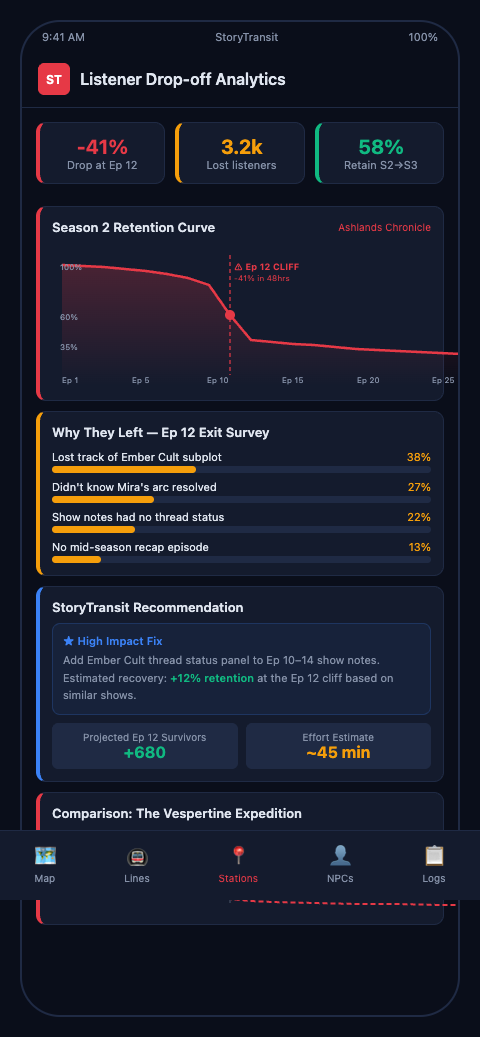
Exit-point analysis. Pull your listener drop data and look for episode-level clustering. If you're losing listeners consistently around specific episodes, check what's happening narratively at those points. Complex multi-thread reveals, slow travel sequences, and episodes dominated by side content are common culprits. Understanding where the narrative continuity basics break down tells you where to add structural support.
Relatedly, the problems serialized shows face in retaining audiences through long arcs show up in written formats too. PbP stall month three describes an almost identical drop-off dynamic—readers and listeners both disengage when narrative complexity outpaces orientation infrastructure.
Weekly listeners consume roughly eight episodes per week across all their shows. Your actual play is competing for attention within that listening budget. Structural clarity doesn't just help new listeners—it helps existing subscribers stay engaged during the sessions when the story slows down. A listener who can see where the transit lines are heading doesn't drop off during the slow-build arc. They're invested in the destination.
Building the Retention Case Into Your Production Workflow
Mid-series retention infrastructure can't be retrofitted at scale without significant effort. The time to build it is before your feed passes 30 episodes. After that, the work multiplies.
StoryTransit is designed so the documentation happens alongside production, not after. The editor pulls up the map pre-edit and tags story beats as they process each session. Show notes pull from that living thread map. By the time episode 87 is in the feed, the orientation system was built in real time, episode by episode—not reconstructed from scratch when a listener says they're confused.
Understanding Drop-Off Versus Churn
Two categories of listener loss behave differently and require different interventions. Churn is the listener who subscribes, samples a few episodes, and disengages before forming any arc investment—this is primarily a discovery and first-impression problem. Mid-series drop-off is the listener who was invested and lost the thread—this is an orientation and continuity problem.
Most podcast retention advice conflates these two categories. Fixing the first episode's cold open helps churn. Fixing the show notes and thread tracking helps mid-series drop-off. Actual play producers who focus on audio quality and release consistency may reduce churn without touching mid-series drop-off at all, because those interventions don't address the structural disorientation that drives mid-arc abandonment.
Still Listening? research into listener habits examines why audiences disengage from shows they once followed. The pattern in serialized shows is consistent: listeners who fall behind by three or more episodes have a significantly higher probability of abandoning the show entirely. The gap between current and caught-up becomes a barrier that feels too expensive to bridge—especially when the episode archive has grown past 50 entries.
The three-episode rule is a useful internal benchmark: if a listener can fall three episodes behind your feed and still return without feeling completely lost, your orientation infrastructure is working. If falling three episodes behind feels irrecoverable, the transit map isn't surface-level enough in your show notes and episode descriptions.
Shows that map their own listener drop data against the story arc timeline often find that drop spikes align with specific narrative conditions: major cast changes, significant time skips, and slow-burn arcs without visible progress markers. Knowing this pattern lets producers add structural support—a mid-arc "here's where we are" show note, a "previously on" cold open, an explicit thread flag—at exactly the moments when listener orientation is most at risk.
For actual play podcast producers watching mid-series subscriber drop-off climb, the retention lever is structural, not creative. Join the Waitlist for Actual Play Producers and get early access to StoryTransit's pacing and thread-management tools built specifically for long-running AP seasons.