The Fundamentals of Pacing a Play-by-Post Campaign
Why Pacing Kills More PbP Campaigns Than Player Drama
Ask any veteran forum GM what ended their last campaign, and most will describe some version of the same thing: the game slowed down, momentum dissipated, and eventually the posts just stopped coming. Not a conflict between players, not a plot dead end — a gradual loss of rhythm that nobody intervened in until it was too late.
Pacing Failures in Asynchronous Play — The Alexandrian puts it directly: PbP campaigns take years and hundreds of posts to complete, and pacing failures drive most mid-campaign collapse. The format's asynchronous nature — the thing that makes play-by-post attractive — is also what makes pacing failures easy to miss. A live session where nobody's engaged is immediately visible. A forum campaign where engagement is declining shows up in post frequency data, not in any single IC post.
Discover the Narrative Worlds of Play-by-Post – Nerdist captures the fundamental difference: PbP's asynchronous format gives players reflection time that live play doesn't. Pacing expectations differ sharply from live play as a result. What feels slow at a weekly table can feel appropriate in a forum campaign — but only up to a specific threshold, and most GMs don't know where that threshold is until they've crossed it.
Paizo Forum: DH's Guide to Play By Post Gaming distills community consensus: consistent GM post cadence is the single biggest factor in PbP campaign survival. Not player engagement, not plot quality — GM cadence. If the forum GM is posting regularly, players post regularly. If the GM's cadence slips, the campaign's rhythm collapses within weeks.
The Three Pacing Variables
Play-by-post campaign pacing is controlled by three variables, and most forum GMs only consciously manage one of them.
Post cadence is how often the GM posts new IC content — advancing scenes, introducing developments, moving dormant threads back into activity. This is the variable most GMs think about. One post per day is the standard benchmark; some campaigns run slower, a few run faster. What matters is consistency. An irregular GM cadence — three posts one week, none the next — teaches players that their own post frequency doesn't matter, because the GM's doesn't.
Thread rhythm is the pacing within individual threads: how many IC posts each scene requires before it advances, how long combat rounds take to resolve, how quickly NPCs respond. A campaign with a healthy overall post cadence can still have thread rhythm problems — a single combat thread that has been running for six weeks without resolution drags on the whole campaign's pacing, even if other threads are moving well.
Arc tempo is the pace at which the campaign's transit lines advance through their station sequences. A slow-burn arc has a different appropriate tempo than a crisis arc. The problem for most forum GMs is that arc tempo becomes invisible over time: the arc that was supposed to build to a convergence in six weeks is now at week twelve, and nobody has explicitly noted that it's running at half the intended pace. The pbp stall month three analysis is in large part an arc tempo failure — arcs drifting past their intended convergence points without correction until the whole campaign loses momentum.
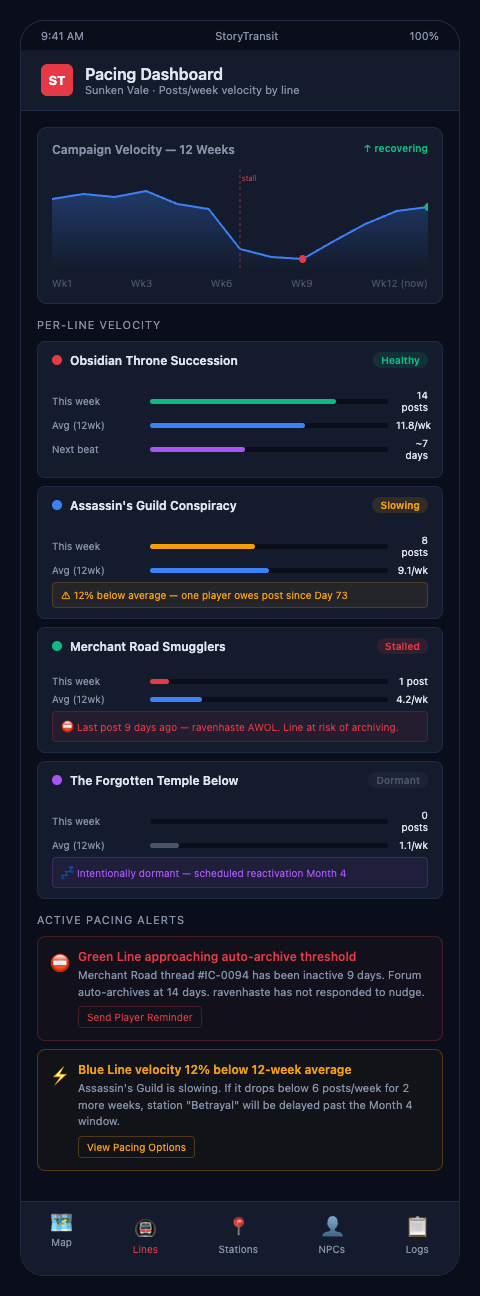
Managing all three variables requires knowing their current state at a glance. This is where StoryTransit's transit map view changes how a forum GM works — instead of inferring pacing from memory, you can see which transit lines have advanced recently, which haven't, and which are approaching stall conditions by any measurable definition.
Setting the Right Post Cadence for Your Campaign
Examining Asynchronous Communication Platform – PMC found that structured async communication reduced task completion time by 58.8% — structure is essential at low post frequency. For pbp campaigns, "structure" means explicit cadence commitments that players can plan around.
The right cadence is not the fastest you can post — it's the cadence you can sustain for the life of the campaign. A forum GM who starts at one post per day and drops to three posts per week by month two has already established a pacing failure. Players recalibrated their expectations to daily and now perceive every missed day as a delay.
The sustainable cadence benchmark for a forum campaign is a GM post (IC or OOC substantive) every two to three days, with explicit notice when a gap will exceed three days. This is conservative enough to sustain across months without burnout, and frequent enough to maintain narrative momentum.
Set this expectation explicitly in your OOC thread on day one. Not aspirationally — as a stated commitment. "I will post IC content at least three times per week. If I need to pause for more than three days, I'll post an OOC note." That commitment makes your cadence accountable and gives players a reference point when the rhythm slips.
Sustaining Rhythm When Players Go Silent
Persistence and Dropout in Higher Online Education – Frontiers in Psychology shows cliff-effect dropout spikes at content transitions in long-running async engagement — the arc boundaries in a pbp campaign are exactly these transition points. When a player goes silent during a transition, the risk of permanent dropout is highest.
The GM response to player silence is the most important pacing lever available. Waiting for a silent player to return before advancing a scene is the single most common cause of campaign stall. Instead:
Allow GM advancement on a three-day timer. If a player's IC post is required to advance a scene and three days pass without one, the GM advances the scene on their behalf — a minor action consistent with the character, enough to keep the thread moving. This policy should be established in your OOC thread before it's ever needed.
Maintain parallel active threads. At minimum two threads should be active at any point so that a silent player in one thread doesn't stall the whole campaign. The transit model makes this explicit: if one line is stopped at a station waiting for a player, at least one other line should be running service.
Use dormant stops productively. When player silence is causing thread stall, activate a dormant stop in a thread that doesn't require that player. The campaign keeps moving, and returning players re-enter a world that has continued without them — which is more engaging than re-entering a world that has been waiting.
The pacing fundamentals here are the preventive layer — the practices that keep a campaign from reaching the stall conditions in the first place. The forum combat rounds problem is a thread rhythm issue that compounds quickly when post cadence is already stressed.
The Right Time to Learn: Mechanisms of Spaced Learning – PMC shows that expanding intervals between reinforcement sessions produce deeper long-term retention. Applied to pbp pacing: the right question is not "how do I post more frequently" but "how do I space IC developments to maximize player engagement and retention across the intervals between posts." A campaign with three strong IC posts per week and clear inter-post structure will sustain better than a campaign posting daily with no structural rhythm.
Podcast producers who track episode fifteen dropoff are navigating the same pacing dynamic in a different medium — engagement drops at predictable transition points in both formats, and the structural responses are closely parallel.
Reading Pacing Signals From the Forum
Player behavior in the forum is the most reliable indicator of pacing problems — more reliable than a GM's subjective sense of how the campaign is going. Three signals are worth monitoring explicitly.
Declining post frequency. Track how many IC posts are generated per week across the whole campaign, not just the main thread. A decline of 30% or more over two consecutive weeks is an early pacing warning. It's not proof of a problem — players have lives, and a two-week dip is noise. But a consistent downward trend over a month is a signal to investigate the three pacing variables.
Increasing post length variance. When pacing is healthy, IC posts tend to be roughly similar in length across players — everyone is engaged at approximately the same level. When one or two players start writing very short posts ("Kael nods and waits to see what happens"), those players have disengaged from the current scene. The scene isn't giving them enough to work with, or the thread rhythm is too slow for them to maintain investment between responses.
OOC thread silence. The OOC thread is the social layer of the campaign. When it goes quiet — no questions, no banter, no off-topic discussion — the community cohesion that sustains long-term campaigns is weakening. A silent OOC thread often precedes post frequency decline by one to two weeks. If you catch it early, a simple OOC prompt ("What do your characters want to accomplish before the end of this arc?") can re-engage the social layer before it translates into IC disengagement.
These signals are only visible if you're looking for them. The forum GM who checks their OOC thread daily for social activity — not just IC thread updates — has earlier warning of pacing problems than one who only monitors IC post frequency.
Pacing as Active Management
The forum GM who treats pbp campaign pacing as something that happens automatically — a natural result of posting regularly — is the GM whose campaign stalls at month three. Pacing is active management: checking post cadence weekly, noting which transit lines haven't advanced in two or more weeks, identifying thread rhythm problems before they become stall conditions, and adjusting arc tempo when a slow-burn arc is running at half its intended speed. Story rhythm engagement — the felt sense players have that the campaign is moving, building, and paying off — is the downstream product of all three pacing variables managed together. Understanding play-by-post fundamentals means recognizing that engagement is an output, not an input: you can't sustain it by asking players to care harder. You sustain it by managing the structural conditions that produce it.
A Study on Efficacy of D&D for Improving Mental Health – Mary Ann Liebert shows that tabletop RPG participation supports sustained community engagement when sessions have clear social rhythm. The pbp forum campaign that maintains a visible, consistent rhythm — known post cadence, regular arc advancement, explicit dormant stop management — is the one players stay in.
StoryTransit gives play-by-post forum GMs a pacing dashboard that makes all three variables visible: post cadence history, transit line advance rates, and arc tempo across the full campaign timeline. Join the Waitlist for Play-by-Post GMs to access the pacing tools designed for the slow rhythms of forum storytelling — built for the GM who runs campaigns in months, not hours.