Auditing a PbP Campaign for Unresolved Plot Threads
The Unresolved Thread Problem in Long-Running Campaigns
Unresolved plot threads are the silent debt of every long-running forum game. They accumulate quietly: a mysterious NPC introduced in a side thread who never reappeared, a faction's ambiguous move that implied future consequences but never got followed up, a character arc that stopped developing after its player's posting frequency dropped. None of these feel like failures in the moment—they feel like things that will get addressed later. Later eventually becomes two years of archive.
Script analysis of unresolved threads identifies three root causes: continuity errors (the GM forgot the detail), out-of-character behavior (an NPC acted inconsistently, creating an unresolvable contradiction), and writer oversight (the thread was seeded intentionally but never followed through). All three occur in PbP, and all three undermine the campaign's narrative coherence over time.
Forum RPG archival research from First Monday documents how forum RPG rules and accumulated practices shape which narrative threads persist or get buried across archived pages. A thread's survival in the archive doesn't indicate its resolution—threads can sit in a subforum for years without their narrative obligations being fulfilled.
Forum software link rot research adds an urgency layer: phpBB and vBulletin forums lose significant content to hosting changes over time. Unresolved threads in aging archives become literally unauditable—the source material for the original plot hook disappears, making resolution impossible even if the GM wants to pursue it.
The cumulative effect of unresolved threads on player engagement is significant and underappreciated. Players who invest in a subplot and watch it quietly disappear receive a clear signal: their contributions don't have lasting consequences. This erodes the sense of narrative permanence that sustains long-form collaboration. A pbp campaign audit conducted with the methodology below doesn't just find plot holes—it recovers the conditions for sustained player investment.
The Audit Framework
A PbP campaign audit runs in four phases, each building on the previous:
Phase 1: Thread inventory. The plot drift prevention practices that prevent unresolved thread accumulation use the same inventory logic on a quarterly basis — the audit described here is the recovery version of the same process. Starting from the oldest active subforum and working forward, log every IC thread with three fields: title/subject, date of last IC post, and current narrative state (active, paused, apparently abandoned). Don't make resolution judgments yet—this phase is purely inventory. For large campaigns, this can take several sessions of work; spread it across a week if needed. A simple spreadsheet with one row per thread is sufficient; the goal at this phase is completeness, not organization.
Phase 2: Thread classification. Apply a four-category classification to each thread in the inventory:
- Active: received an IC post in the past 30 days, no resolution needed
- Paused with intent: the GM knows why this is on hold and has a planned reactivation timeline
- Dormant: no IC activity in 30+ days and no documented reactivation plan
- Abandoned: the original narrative obligation is no longer feasible to fulfill (player has left, context has been superseded by events, or source material is inaccessible due to archive loss)
The classification is the most cognitively demanding phase. The distinction between "paused with intent" and "dormant" requires the GM to examine their own mental state: is there actually a plan for this thread, or is there just a vague intention to return to it? Honest classification here is the difference between a useful audit and one that produces false comfort.
Phase 3: Resolution mapping. For every dormant thread, determine the minimum viable resolution: what would it take to close this thread satisfactorily? Sometimes the answer is a single GM IC post that provides a definitive conclusion. Sometimes it's a three-post exchange that resolves the faction conflict. For abandoned threads, determine whether a retroactive closure is needed (a brief IC or OOC acknowledgment that the arc is over) or whether the thread can simply be archived without fanfare.
Phase 4: Resolution scheduling. Convert the resolution map into a concrete schedule: which threads get addressed in the next 30 days, which in the next 90, and which are deferred to next chapter? Prioritize threads with active player investment and threads whose unresolved state is creating downstream plot inconsistencies. A resolution schedule is only useful if it's realistic: 15 dormant threads cannot all be resolved in 30 days alongside maintaining an active campaign. The schedule must reflect actual available bandwidth.
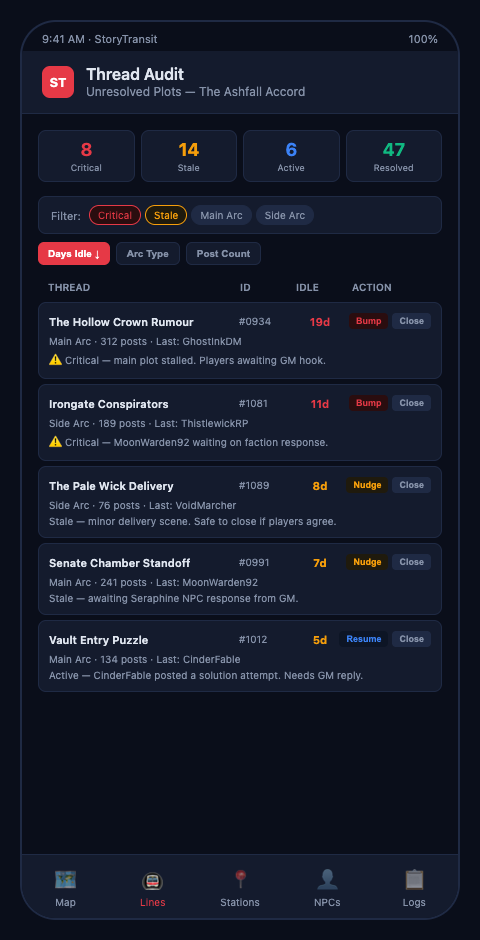
StoryTransit makes Phase 1 and Phase 2 automatic: the transit map already tracks every active line's dormancy state, so the inventory and classification work is embedded in the platform's ongoing tracking rather than a separate manual audit. When you launch the audit process in the platform, the inventory and classification are pre-populated from your existing transit map—leaving Phase 3 and Phase 4 as the primary human-judgment work.
Narrative Continuity as the Audit Standard
Narrative continuity research defines narrative continuity as logical story progression where each element connects coherently to what came before. Unresolved threads don't just leave questions unanswered—they actively disrupt continuity by implying events or consequences that the story never delivers. Players who invested in those threads notice the gap, even if they don't articulate it as an unresolved thread.
AI research on plot-hole detection confirms that unresolved threads are measurable narrative failures—not subjective aesthetic preferences but structural deficiencies with identifiable markers. The audit framework above operationalizes the same logic: each thread's resolution state is a measurable fact, not an interpretation.
Plot drift prevention and unresolved thread accumulation are related problems—the same forum GM disciplines that prevent plot drift also prevent the thread inventory from growing unmanageably. Running the audit described here alongside regular drift prevention reviews keeps the unresolved debt manageable over time.
The five-year pbp case demonstrates what consistent audit practice looks like in action: quarterly reviews that prevent the accumulation of unresolved threads by addressing dormant content before it becomes abandoned content.
Continuity debt audit methods from homebrew DnD GM contexts share the same structural methodology: inventory, classification, resolution mapping, and scheduling. The PbP context adds the archive depth and pagination challenges, but the core audit logic is directly transferable.
Advanced Audit Tactics
The player investment survey. Before finalizing the resolution map, run a brief OOC player survey: "Which open arcs matter most to you? Which would you be comfortable seeing closed?" Players often have strong preferences about which dormant threads deserve resolution resources, and their input prevents the GM from spending energy closing threads that players have already mentally released. A simple ranked-choice format—"list your top three arcs you most want to see continue"—produces actionable prioritization in ten minutes.
The minimum viable closure post. Many dormant threads can be closed with a single well-crafted GM IC post. Rather than leaving abandoned arcs in the archive as open questions, write brief IC closures: an NPC makes a final decision, a faction consolidates its position, a mystery resolves off-screen with a news-from-afar IC post. These minimum viable closures satisfy narrative continuity without requiring major plot investment. A 300-word IC post that definitively closes a two-year-old dormant subplot is worth more for narrative coherence than that subplot remaining open as an invisible obligation.
The audit OOC transparency post. Organizational memory knowledge retrieval research shows that making retrieval structures visible to users improves engagement with the underlying knowledge. For PbP, this means posting a brief OOC summary of your audit findings: "I've reviewed our open threads and here's what I'm prioritizing for resolution over the next two months." This signals to players that the GM is actively maintaining narrative coherence, which sustains engagement in the campaign's long-term health. Transparency about the audit process also invites players to flag threads they remember but that the GM may have missed.
Recurring micro-audits vs. annual deep audits. The comprehensive four-phase audit described above is appropriate for a campaign that hasn't been systematically reviewed before, or one coming off a months-long silence. For ongoing maintenance, a monthly micro-audit is more sustainable: a 30-minute review of the dormancy flags on active storyline lines, with any lines exceeding the dormancy threshold getting a resolution decision within the week. Combining a monthly micro-audit with an annual comprehensive audit prevents the accumulation that makes the deep audit so daunting.
World Anvil's session notes and timeline tracking support systematic plot thread tracking for 100+ RPG systems—useful as a complementary tool for GMs who want to track audit progress within an existing world documentation setup.
Forum GMs who run systematic pbp campaign audits find their campaigns more navigable, their players more invested, and their own workload more predictable. StoryTransit's dormancy tracking and line classification features make the audit methodology continuous rather than periodic—so the unresolved thread debt never accumulates to the point of requiring a major excavation. Play-by-post forum GMs who join the waitlist now get direct input on the audit and resolution-scheduling features being prioritized for early release.