Case Study: A Five-Year PbP Campaign With Zero Lost Threads
The Problem With Five-Year Forum Games
The average PbP campaign opens more story threads than it closes. After twelve months of one-post-per-day pacing, a single subforum can accumulate 400+ IC posts. After five years, that same game might span five or six subforums, a dozen OOC threads for reference material, and a pagination trail that no single player can realistically read. Research on digital preservation of online communities confirms that online communities routinely lose 40% or more of their archived content within a decade, even without active deletions—pruned threads, server migrations, and expired hosting contracts claim the rest.
For the forum GM running a long-running forum game, this creates a specific failure mode: dormant subplots become genuinely invisible. The merchant guild intrigue seeded in Year One gets buried thirty pages deep in the Merchant Quarter subforum. The NPC whose loyalty was left ambiguous stopped appearing in posts by Year Two. Nobody remembers the prophecy delivered in a thread that got moved to the archive. These aren't dramatic failures—they're quiet ones, and they compound.
Web archiving research adds another layer to the problem: dynamic forum content—including JavaScript-rendered pagination, user-submitted images, and interactive reply trees—is genuinely harder to preserve than static web pages. Even when the hosting stays stable, the structural accessibility of the archive degrades over time. A thread from Year One isn't lost in the legal sense; it's just buried six pages into a subforum that nobody visits anymore.
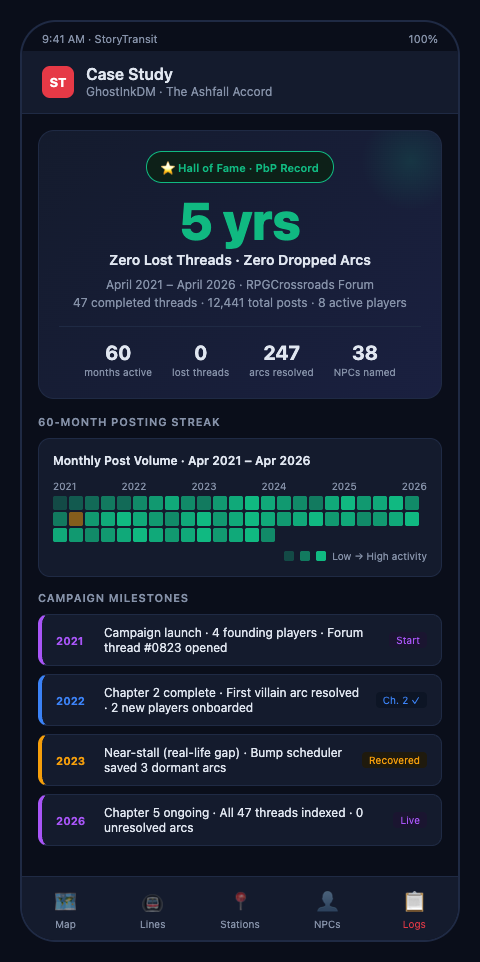
The five-year campaign this case study draws from was run on a mid-size RPG forum with a rotating cast of 6–12 active posters. At the end of Year Five, the GM could produce a complete list of every subplot seeded, its current status, and its resolution state. Zero threads were lost. Here's what made that possible.
The Transit Map Discipline
The GM's core method was treating the campaign like a city transit system. Every plot thread functioned as a transit line with defined stations (story beats), and every character arc was a named route that ran through those stations. The Merchant Quarter intrigue wasn't just "a thing that happened"—it was Line 4, currently stopped at Station 7 (the warehouse confrontation), with three downstream stations still unvisited.
This framing—which StoryTransit formalizes with visual tooling—does something that plain spreadsheet tracking doesn't: it makes dormant stops visible as gaps in the route. When a transit line stops running, you see the gap. When a subplot gets dropped for four months, a spreadsheet row just sits there quietly. A transit map shows the line ending mid-route, which prompts the question: is this intentional (a slow-burn arc) or an accidental dropout?
The GM applied four structural disciplines over the five years:
1. Thread Intake Logging. Every new IC plot development—a faction making a move, a mystery introduced, a PC commitment made—was logged as a new stop on the relevant line within 24 hours of posting. This prevented the "I'll remember to track that later" failure mode. Organizational memory research shows that structured documentation at intake is the single most reliable way to prevent knowledge loss over time.
2. Dormancy Thresholds. Any transit line that hadn't had a new station posted in six real-world weeks was flagged as dormant. The GM didn't necessarily act on every flagged line immediately—some slow-burn arcs are intentional—but the flag forced a conscious decision. Dormant didn't mean abandoned; it meant acknowledged.
3. Quarterly Line Reviews. Every three months, the GM ran a full review of all active and dormant lines. This wasn't a player-facing activity—it was an internal audit. The review produced a single document: which lines were active, which were paused with intent, and which needed a reactivation post or explicit closure.
4. Resolution Tagging. When a plot thread reached its intended conclusion, it was tagged as Resolved in the transit map with a timestamp and a link to the closing IC post. This created an audit trail that worked both for the GM's own reference and for onboarding new players who needed to understand which arcs were history versus ongoing.
Why Zero Lost Threads Is Actually Achievable
Academic frameworks for forum-based role-playing games document how PbP produces emergent narrative through collaborative contribution over time—meaning no single participant controls the full story arc. That's precisely what makes thread loss so common and why the transit map approach works: it provides a GM-side map of a story that players are actively co-creating in real time.
The Play-by-post Wikipedia entry documents PbP's origins on 1980s BBSs, and the underlying archival challenge hasn't changed: forum software was built for discussion, not narrative continuity. The GM has to impose that structure. The five-year campaign succeeded not because it used unusually powerful tools, but because the GM applied consistent intake logging and dormancy tracking from Year One rather than trying to reconstruct the map retroactively.
Research on dormant social ties shows that more than 50% of dormant connections can be restored once reactivated—but only when the reactivation is targeted and personal. The same principle holds for dormant subplots: a GM who knows exactly which threads are sleeping and why can reintroduce them with surgical precision rather than hoping players remember.
It's worth drawing a distinction between the three ways a forum thread "disappears" in a long-running campaign. The first is physical loss—a pruned thread, a deleted subforum, a hosting migration that doesn't carry archives over. The second is navigational loss—the thread exists but lives 40 pages into a subforum nobody has bumped in eight months. The third, and most common, is attentional loss—the thread exists, it's findable, but neither the GM nor any active player is holding it in working memory. The transit map addresses all three: physical loss is mitigated by intake logging at post time, navigational loss is mitigated by the map itself, and attentional loss is mitigated by dormancy thresholds that force periodic review.
For GMs preparing to audit unresolved threads in a running campaign, the transit map framework provides both the vocabulary and the visual structure to make that audit tractable. The forum storytelling psychology of why players stay invested across years also matters here: continuity signals to players that their contributions are permanent, which sustains engagement better than any single dramatic plot beat.
Advanced Tactics for the Long Haul
Archive pagination management. Five-year campaigns generate deep pagination. The GM maintained a "Greatest Hits" OOC thread updated quarterly—not a summary, but a curated list of links to the ten most narratively significant IC posts from the previous three months. New players and returning ones could orient themselves without reading 300 pages of archives. This document was publicly pinned in the campaign's main OOC subforum and updated within a week of each quarterly review.
NPC status boards. Every named NPC with ongoing relevance had a status entry in a master OOC thread: last appearance (linked), current known location or state, and any outstanding plot hooks associated with them. This prevented the common failure where an NPC the GM intended to reintroduce had been forgotten by all active players. The status board used a simple three-column format: NPC name, last IC post appearance (with link), and current narrative status. Updating it took under ten minutes per quarterly review cycle.
Cross-arc dependency tracking. The most sophisticated element of the transit map was noting when two lines intersected—when resolving the Merchant Quarter intrigue would affect the political arc running in the Capitol subforum. These intersections were logged explicitly so the GM could sequence story beats to honor both arcs without one accidentally undermining the other. A dependency note attached to each intersection specified which line needed to reach a certain station before the other could proceed—a simple conditional that prevented the chaos of two major arcs resolving on contradictory assumptions.
The Year Zero lesson. The GM's single most important decision was applying the transit map discipline from the campaign's first month. GMs who try to retrofit this structure onto a two-year-old campaign face a significant documentation backlog; those who start from the beginning find the ongoing maintenance lightweight. If you're starting a new long-running forum game today, the transit map discipline costs almost nothing to implement early and almost everything to implement retroactively.
Obsidian Portal functions as one of the longer-running campaign documentation tools in the PbP space, with adventure logs and character trackers—but it still requires the GM to maintain the narrative map structure manually. StoryTransit's transit line model makes that structure the default rather than a bolt-on.
The seven-year case study from the homebrew DnD GM space applies parallel structural lessons to tabletop sessions, and many of the intake and review disciplines translate directly to PbP contexts.
StoryTransit builds this transit map discipline into the tool itself—every thread you open becomes a line, every post a station, and every dormancy threshold triggers an automatic flag in your dashboard. If you're running a long-running forum game and want to reach Year Five with every arc accounted for, the waitlist is the place to start. Play-by-post forum GMs get early access and direct input on the feature roadmap—join the waitlist and tell us which part of your archive is hardest to navigate.