Case Study: The Seven-Year Homebrew That Never Dropped a Subplot
The Campaign That Refused to Forget
By Session 87, most seven-year homebrew campaigns have a graveyard of abandoned subplots. The half-elf bard who witnessed the burning of Brenhorn Village and swore revenge against the Merchant Council — forgotten. The dragon egg hidden under the old mill — never hatched. The prophecy delivered in Session 3 — quietly buried.
One DM ran a continuous homebrew for seven years and 200+ hours of campaign history without letting a single subplot die unresolved. Not because they had a photographic memory. Because they built a system.
Dungeon Master Survey Results from SlyFlourish found that 69% of DMs prep under three hours per week. That constraint makes subplot retention feel impossible across years of play. The DM in this case study worked within the same time budget — the difference was architecture, not effort.
The specific challenge of a seven-year homebrew is the compounding weight of its own history. In year one, tracking ten active subplots is manageable. By year four, those ten have branched into thirty. Each one carries the accumulated promises made across dozens of sessions, each one connected to NPCs who have their own histories, each one seeding future beats that the DM has to remember to pay off. The system that worked in year one has long since failed — what replaces it determines whether the campaign survives the transition to years five, six, and seven with its narrative integrity intact.
The DM in this case study recognized that collapse point early. Rather than trying to hold everything in memory or in disconnected notes, they built a structured visual record of the campaign's entire narrative state — not a summary, but a map. And that map is what kept the seven-year homebrew from dropping a single subplot.
The Transit Map System That Made It Work
The core method treated the campaign like a city transit network. Each subplot became a named line. Plot stations marked the beats within each line. Character arcs became named routes that crossed multiple lines. Dormant stops — subplots temporarily parked — stayed visible on the map rather than disappearing into forgotten notes.
This is exactly the logic behind StoryTransit's campaign visualization approach: when subplots are plotted as transit lines, a DM can see at a glance which lines are active, which have been dormant for 47 sessions, and which routes a given NPC is currently traveling.
The seven-year DM maintained what they called "foreshadowing payoff receipts" — one-line summaries of every foreshadowing moment, filed by session number and linked to the subplot line it seeded. When Session 72 called back to a promise made in Session 14, the DM had the receipt. Research on narrative knowledge graphs confirms this approach: event-centric temporal structures compress complex storylines into navigable form without losing threads.
Understanding how to weave many NPCs into a coherent system was inseparable from subplot retention in this campaign — every NPC was associated with at least one subplot line, making NPC continuity and subplot continuity the same discipline.
Three structural habits drove the retention record:
Dead line protocol: No subplot was ever deleted, only suspended. A dormant line retained its stations and could be reactivated by any NPC already associated with it.
Session-end status sweep: The final ten minutes of every session included a spoken audit — which lines moved forward, which stalled, which new seeds were planted.
NPC continuity sheets: Every named NPC carried a one-page record: current motivation, last known position, outstanding obligations to PCs, and active subplot lines they touched.
The NPC sheets alone resolved dozens of potential continuity errors. When the Merchant Council reappeared in Session 94, the DM knew exactly what they had promised, broken, and threatened across three years of play.
What the Numbers Actually Show
How Many People Play D&D in 2024? estimates roughly 13.7 million active players worldwide. A significant fraction run multi-year homebrew campaigns. Yet the overwhelming experience of long-campaign DMs is subplot attrition — not because they stop caring, but because the cognitive load of tracking 20+ active threads exceeds what unassisted memory can handle.
The seven-year case study DM was not exceptional as a storyteller. They were exceptional as a system builder.
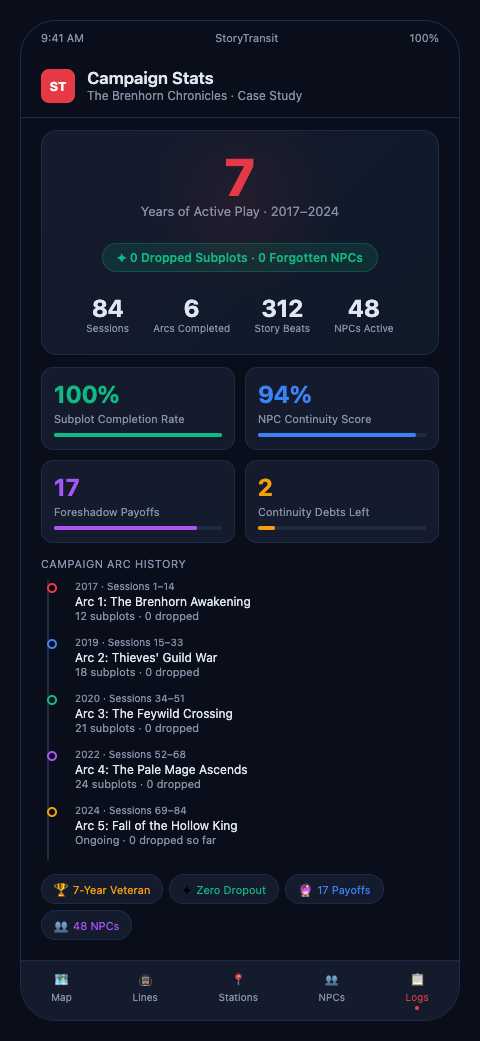
Their subplot retention rate across the full campaign was tracked retroactively by going through session notes and counting: how many subplots introduced in years one and two were still present, in some form, by year seven? The answer was over 90%. Most were resolved. A handful were dormant and explicitly acknowledged as such. None had simply vanished.
Running Epic Stories In Long-term D&D Campaigns notes that long campaigns require dedicated subplot tracking architecture. This DM had built that architecture from scratch, then iterated on it across seven years.
The 90% retention rate is notable because it includes subplots that went dormant for years before resolution. A faction conflict seeded in Session 8 did not resolve until Session 140 — over five years of real time. It stayed visible on the transit map the entire time, marked as dormant, associated with the NPCs who had been its drivers. When the world's political conditions finally brought it back into relevance, the DM could reactivate it without reconstruction, because all of its context had been preserved in the map.
This is what the transit model enables that flat notes cannot: dormant subplots remain part of the network. They do not expire or disappear. They wait at their station until the right train arrives. The DM who enters Session 150 with a transit map of the entire campaign's narrative state has a fundamentally different relationship to the campaign's history than the DM working from a folder of session summaries that nobody has fully read since year two.
Advanced Tactics for Sustained D&D Campaign Longevity
Nesting short arcs inside long ones: The campaign maintained three temporal scales simultaneously — session-scale arcs (one to three sessions), mid-scale arcs (three to twelve sessions), and long-scale arcs spanning the full campaign. Subplots at each scale were tracked separately, so a dropped session-scale thread did not corrupt the longer arc it nested within. A session-scale conflict that went unresolved could be parked as a dormant stop without affecting the multi-year arc it nested inside.
Player-owned subplot stewardship: Each player was designated as the informal steward of two or three subplots connected to their character. They were asked periodically to flag when those subplots felt stale or when they were ready for resolution. This distributed the cognitive load and gave players genuine investment in continuity. Players who feel responsible for their subplot lines notice drift much faster than DMs reviewing notes alone.
The cross-reference rule: Every time an NPC was introduced, they were immediately assigned to at least one existing transit line. An NPC who connected to nothing was a liability — a loose node waiting to create a continuity gap. This rule had a secondary benefit: it prevented the character bloat that plagues long campaigns. Before introducing a new NPC, the DM had to identify which subplot line they served. If no existing line needed them, the NPC was deferred or merged with an existing character.
The annual arc review: Once per real-world year, the DM conducted a full review of all active and dormant subplot lines against the campaign's long-arc trajectory. This review identified which dormant subplots were approaching their natural reactivation window, which active subplots had been running too long without movement, and which new lines had been seeded organically by player actions that needed to be formally added to the map. The annual review was not prep work — it was the map maintenance that kept the transit system navigable across a seven-year span.
NPC continuity and subplot retention were inseparable in this campaign. Every NPC was associated with at least one subplot line. When an NPC re-entered play, their line automatically re-activated.
The veteran self-documenting practices this DM used evolved organically over seven years, but they converge on a single principle: the world should document itself as play happens, not require retroactive reconstruction.
This logic also applies in asynchronous formats — a five-year pbp case demonstrates how the same transit-line approach translates to written forum play where thread management becomes even more critical.
Build the System Before You Need It
The seven-year case study DM would tell you that the hardest part of the system was not building it — it was trusting it. The first time they leaned on a dormant subplot they had not thought about in two years and found it fully intact, waiting to be reactivated with all its context preserved, was when the investment paid off viscerally. A subplot seeded in Session 11 that closed in Session 143 with all of its original promise fulfilled is what a transit map makes possible. Without the map, that subplot would have been one of the 30–40% that most long campaigns quietly abandon.
StoryTransit was designed for exactly this kind of campaign — not the two-shot adventure, but the multi-year homebrew that accumulates real narrative weight. If your campaign is already outlasting your original notes system, the waitlist is open now.
Homebrew D&D DMs who join early get access to the subplot transit map, NPC continuity sheets, and foreshadowing payoff receipts that made the seven-year case study work. The goal is not to prep more — it is to prep in a structure that compounds over time. Join the Waitlist for Homebrew D&D DMs and stop letting subplot debt grow one session at a time.