The Psychology of Long-Form Collaborative Forum Storytelling
What Makes Players Stay in a Long-Running PbP
The question of pbp player motivation isn't answered by "they love the story." Every player who drops from a forum game after six months loved the story too. The relevant question is what structural and social conditions sustain that love across years of asynchronous, text-based, one-post-per-day interaction.
Research on creative writing psychology identifies three primary motivators for sustained creative writing practice: fulfillment (the sense that the work matters), persistence through resistance (the capacity to continue when the work is difficult), and emotional exploration (using the work to process experience). All three are present in long-running PbP, but they require specific conditions to activate.
Fulfillment in collaborative narrative requires visibility: players need to see that their contributions have consequences in the world. When a subplot they invested in gets quietly dropped, or when an NPC relationship they developed stops being referenced, the signal they receive is that their work didn't matter. Collaborative writing research shows that 70% of co-written fiction never reaches completion—coordination failure is the primary cause, but the perception that contributions aren't valued accelerates dropout significantly.
Fan fiction community research confirms that communities providing consistent feedback loops and social learning sustain long-form writing better than isolated writers. In PbP, the feedback loop is structural: an IC post that gets responded to within 48 hours by both the GM and another player signals investment. An IC post that gets one brief response two weeks later signals the opposite.
A framework for vicarious and collective memory from cognitive science research shows that collective memory and narrative identity are co-constructed in groups—participants literally form their sense of who they are within the collaborative narrative through shared storytelling. This makes long-running PbP archives something more than documentation: they're the community's identity record. Losing them, through pruning or platform migration, severs not just historical content but the psychological foundation of why participants feel connected to the campaign. GMs who understand this relationship treat archive preservation as a community care practice, not just a technical one.
The Transit Map as Psychological Infrastructure
Forum storytelling psychology isn't separate from the structural tools GMs use—it's embedded in them. The transit map metaphor makes this concrete: players need to be able to see their character's route in the story, know which stations they've passed and which are ahead, and trust that the GM is maintaining the track system.
The five-year pbp case demonstrates this directly: sustained player engagement across half a decade came from structural visibility, not exceptional narrative talent. A player who can see that their character's arc (Route B on the transit map) currently occupies Station 6 of 10, with three more stations ahead, experiences their participation as progress toward something. A player whose character arc is an untitled subplot buried in a subforum they haven't visited since last month experiences their participation as noise in an overwhelming archive. The map converts ambiguity into direction.
Csikszentmihalyi's flow theory applied to narrative shows that deep immersive engagement in long-form storytelling requires a balance between challenge and clarity. Too much uncertainty about where the story is going breaks flow; too much rigidity removes the collaborative element that makes PbP distinct from reading a novel. The transit map manages this balance: it provides enough structural visibility to sustain momentum without predetermining the story's outcomes.
Academic research on forum-based role-playing as collaborative improvisation frames PbP as emergent narrative—the story co-created by participants over time. The GM's structural role is maintaining the improvisational frame: clear enough that players know what they're improvising within, open enough that their contributions genuinely shape outcomes.
Three psychological conditions that sustain long-form collaboration:
Consequence visibility. Players need to see that their IC posts matter beyond the immediate response. Story beats that reference a player's earlier contribution (even indirectly) are the strongest signal. Maintaining a practice of explicit callback—"Kira remembered the promise made in the harbor"—costs the GM minimal effort and provides disproportionate psychological return for the player whose post created that promise.
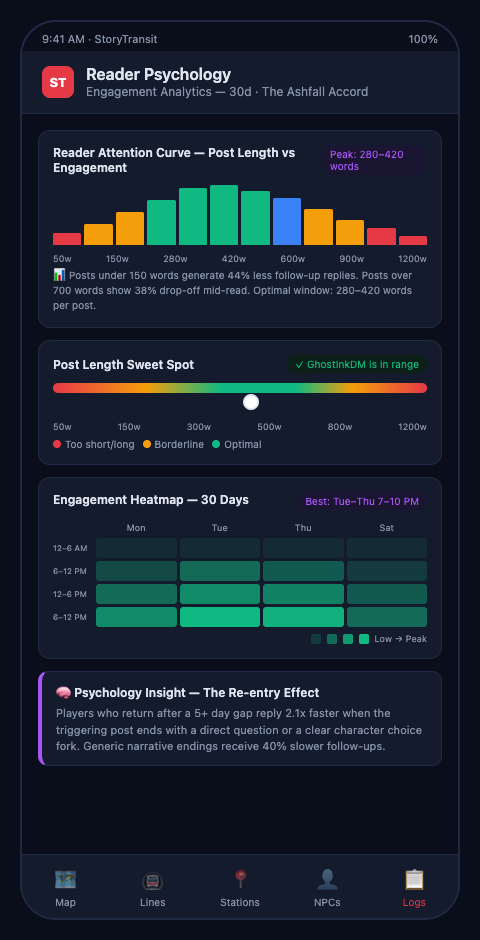
Progress markers. The absence of visible progress is a primary driver of PbP dropout. Players who have been posting to a slow-burn arc for four months with no apparent forward movement lose confidence that the arc is going anywhere. StoryTransit's station structure makes progress visible at the line level: players can see that their arc has moved from Station 3 to Station 5 even if individual posts felt incremental.
Social reciprocity. Collective memory research identifies shared narrative memory as central to group identity in collaborative communities. When a long-running PbP archive gets pruned, migrated without documentation, or becomes inaccessible through pagination depth, it severs the community's shared narrative history—and with it, a significant portion of what holds the group together.
How Structural Tools Serve Psychological Needs
The connection between structural GM tools and player psychology is direct: the tools that prevent narrative loss are also the tools that preserve the psychological conditions for sustained participation. A GM who runs quarterly thread audits isn't just managing narrative continuity—they're maintaining the consequence visibility that keeps players convinced their contributions matter. A GM who documents chapter close isn't just archiving—they're preserving the shared narrative memory that constitutes group identity.
That campaign sustained player engagement across half a decade not through exceptional narrative talent but through consistent structural discipline. The transit map, the dormancy thresholds, the quarterly reviews—all of these served the psychological needs described above even if the GM didn't frame them that way.
Future pbp tools that integrate these structural and psychological insights will look fundamentally different from discussion-forum-based PbP infrastructure. The platforms that will sustain decade-long collaborative narratives are the ones that treat psychological sustainability—not just thread organization—as a design requirement.
Campaign economics in long DnD campaigns engages similar questions about what players are actually investing—time, creative energy, social capital—and what structural conditions make that investment sustainable over years. The psychological logic transfers directly to PbP.
Advanced Tactics for Psychological Sustainability
The contribution acknowledgment protocol. After any significant IC post that establishes a world fact or advances a character arc meaningfully, the GM sends a brief OOC message to the player: "That post established X—I've logged it and it's going to matter in the next three sessions." This closes the feedback loop that fulfillment requires. Two sentences, sent within 24 hours of the post, is sufficient. The practice costs minimal time and produces outsized retention benefits—because fulfillment requires not just that contributions matter, but that the player knows they matter.
Player arc visibility sessions. Every 60–90 days, share with each player a brief one-paragraph summary of where their character arc currently stands in the transit map: current station, most recent consequence registered from their posts, and the next two stations ahead. This is not a plot reveal—it's an arc status update that confirms the player's contribution is being tracked. Players who receive these arc updates consistently stay engaged during slow-burn periods because they can see the arc is progressing even when individual post sessions feel uneventful.
Community narrative archive as social capital. The shared IC post history of a long-running PbP is the group's cultural memory. Research on collective memory and group identity shows that vicarious memory—access to events you didn't directly experience—is essential to group cohesion. A new player who can read the campaign's narrative history through a well-organized archive develops group identity faster than one who has to infer it from current posts alone. This is why archive maintenance isn't just a documentation practice—it's an ongoing investment in the social fabric of the community.
The emotional arc mapping practice. Beyond plotting story beats, experienced forum GMs who understand collaborative narrative psychology also track emotional arc progression: where is each player's character in their emotional journey? Fulfillment requires not just narrative consequence but emotional resonance. A character arc that advances in plot without advancing in emotional complexity provides diminishing returns for the player's motivation. Mapping emotional beats alongside story beats—and explicitly advancing both—produces the sustained engagement that keeps players posting for years.
Graduated responsibility structures. As veteran players accumulate campaign history, giving them structured responsibilities—mentoring new players, maintaining specific subforum reference threads, running minor NPC interactions—converts their knowledge investment into social capital that deepens their own commitment to the campaign's continuity. Obsidian's graph view and backlinks offer one model for how this externalized knowledge can be structured and navigated, even outside a dedicated PbP platform.
The GM who understands forum storytelling psychology runs campaigns differently: with more attention to feedback loops, more explicit consequence acknowledgment, and more structural visibility for player arc progress. StoryTransit operationalizes these psychological insights into the platform's core mechanics—so the tools that serve narrative continuity automatically serve player motivation too. Play-by-post forum GMs who join the waitlist now are helping shape how those tools get built. Add your name and tell us which part of the player psychology challenge is hardest to manage in your current campaign.