Time, Memory, and Story: The Economics of Long D&D Campaigns
The Accounting Most DMs Have Never Done
69% of DMs prep under three hours per week. Multiply that by 52 weeks and five years, and a modest long-running homebrew represents 780 or more hours of DM prep time. Add session time — three hours per week, same period — and you reach 1,560 hours of actual play. A campaign that has produced 200 hours of documented history was the output of two to three times that much investment.
That accounting matters because it reframes the cost of a dropped subplot. When the half-elf bard's revenge arc — set up in Session 22, forgotten by Session 87 — never pays off, it is not just a loose thread. It is a piece of a real investment that produced no return. The seven-year case study demonstrates what a 90% subplot retention rate looks like in practice — the economic model of D&D campaign economics where every seeded promise has a documented payoff, and homebrew sustainability is built on that record of kept commitments rather than on player goodwill alone.
A Scoping Review of TTRPG as Psychological Intervention confirms what long-time DMs already know: sustained TTRPG play builds genuine social bonds and reduces anxiety. The return on a long campaign is not abstract — it is measurable in the relationships it creates and sustains. That social ROI is the reason players keep showing up after 200 hours, and the reason a campaign's collapse is experienced as a real loss.
The Three Currencies of Long Campaigns
Long D&D campaigns operate in three distinct currencies, all of which depreciate differently and require different management strategies.
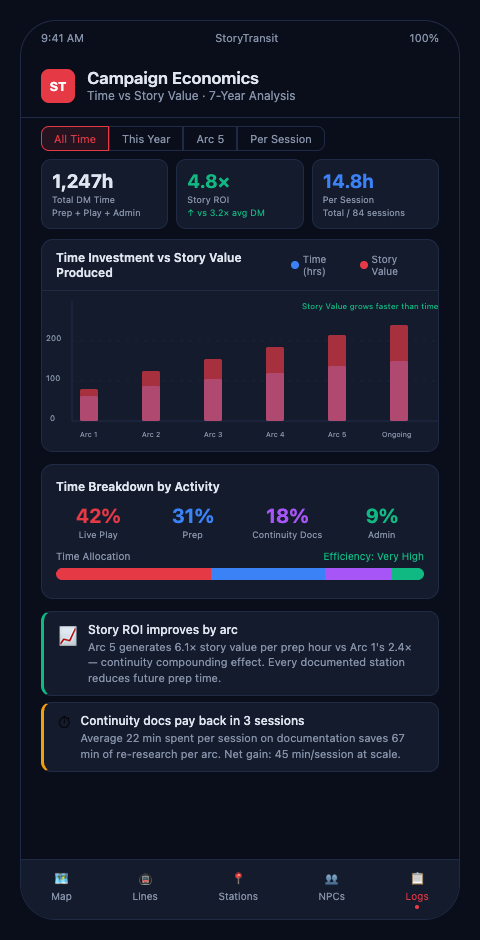
Time currency: The hours invested in prep, sessions, and documentation. Time currency is the input — it is spent before any return is realized, and it cannot be recovered if the campaign ends prematurely. The economics of time currency favor front-loading structure: a continuity system built in session one costs less time per session than an improvised one built reactively at session 50.
Memory currency: The accumulated shared knowledge of the campaign's events, characters, and world. Memory currency is the most volatile of the three — it depreciates continuously and exponentially, following the forgetting curve regardless of how much time currency was invested. The Forgetting Curve from The Decision Lab quantifies this: without reinforcement, 70–80% of information is lost within 24 hours. Across the weeks between sessions, campaign memory takes ongoing losses unless it is externalized.
Narrative capital: The accumulated story value — established characters, seeded subplots, promised payoffs, earned relationships between the party and the world. Narrative capital is the return on the investment. It grows with every kept promise, every paid-off foreshadowing thread, every NPC who behaves consistently across 47 sessions. It erodes with every dropped subplot, every inconsistency the players notice before the DM does, every momentum-killing session that requires reconstruction instead of forward movement.
StoryTransit is fundamentally a narrative capital management tool. The transit map preserves the value of seeded subplots, foreshadowing payoff receipts, and NPC continuity sheets so that narrative capital grows over the campaign's lifespan rather than leaking away.
In transit terms: the time currency bought the train network. The memory currency is the fuel. The narrative capital is the value delivered when trains run on schedule to destinations that were promised.
Where Long Campaigns Fail Economically
The most common economic failure in long D&D campaigns is the memory currency collapse: the DM's accumulated world knowledge becomes so large, and so poorly externalized, that session prep time is consumed by reconstruction rather than creation. Instead of advancing plot threads, the DM spends prep time trying to remember what was established 47 sessions ago.
Cognitive Load Theory explains the mechanism: working memory limits are fixed. When the cognitive load of tracking active subplots, NPC motivations, faction states, and foreshadowing threads exceeds working memory capacity, prep quality degrades and session quality follows. External scaffolding — the transit map, the continuity sheet, the foreshadowing log — offloads that cognitive load so working memory can focus on creative work.
The second failure mode is narrative capital erosion: the campaign continues but players gradually disengage because the payoffs they were promised stop arriving. Subplots that were seeded in year one have not resolved by year three. NPCs who made memorable promises have been quietly forgotten. The half-elf bard's revenge arc has been dormant for 47 sessions with no acknowledgment. Players experience this as a diffuse loss of investment — they are still present but no longer fully engaged.
TTRPG market valued at 11.88% CAGR confirms the commercial validation: players are spending more on the hobby, not less. The economic case for long campaigns is strong. The risk is not that players stop valuing the investment — it is that the campaign's infrastructure fails to deliver the narrative return that justifies their continued investment of time and memory.
The Sustainability Economics of Homebrew Campaigns
Critical Role and Dimension 20 at Madison Square Garden proved that D&D's long-term storytelling holds mass audience value at scale. For homebrew DMs, the equivalent proof is simpler: players who have been in the same campaign for three years and are still excited about what happens next. That sustained engagement is the campaign's proof of economic viability.
What makes that sustained engagement possible? At the economic level, three things:
Memory externalization: The campaign's shared history lives in a system that any participant can access, not just in the DM's head. When players can reference past events, the memory currency depreciates less. A shared world record — a transit map, an NPC wiki, a foreshadowing log — is the mechanism by which a group's long campaign investment in the campaign's history is preserved and made accessible.
Narrative promise fulfillment: A consistent track record of seeded subplots reaching payoff, foreshadowing threads resolving, and NPC obligations being honored. Each kept promise is a return on the narrative capital investment. The half-elf bard's revenge arc that was set up in Session 22 and pays off in Session 87 has generated narrative capital across 65 sessions of play. That is the economic argument for long-arc story design — the return on investment grows with the duration of the setup.
Session momentum: Sessions that advance the story rather than reconstruct it. A DM who enters every session knowing exactly which plot stations are next, which dormant subplots are approaching activation, and which NPC obligations are due creates sessions that feel forward-moving. That forward momentum is what sustains player investment across years.
The DM who has built the right infrastructure is also better positioned to survive the disruptions that every long campaign faces: player changes, hiatus periods, real-world scheduling constraints. When the campaign's narrative capital is stored in a system rather than in individual memories, it survives the disruptions that would otherwise cause it to depreciate irreversibly. A campaign that can recover from a six-month hiatus without losing its accumulated story value is a campaign that can sustain itself across the full arc that the DM originally intended. That recovery capacity is the ultimate economic test of whether a long-campaign infrastructure was built correctly.
Advanced Dungeon Master Strategy for Long-Campaign Sustainability
The narrative ROI review: Once per real-world quarter, evaluate the campaign's narrative capital balance. Which subplots have been active for more than ten sessions without movement? Which foreshadowing threads are past their intended payoff window? Which NPC promises are unresolved? This review is the economic audit that prevents compounding narrative debt.
The prep efficiency ratio: Track how much of your prep time is spent on creation versus reconstruction. If more than 25% of your prep time is spent reviewing what was previously established rather than advancing what comes next, the campaign's documentation infrastructure needs investment.
The player engagement indicator: One reliable signal of narrative capital health is player-initiated subplot engagement — players who bring up dormant threads themselves, ask about NPCs unprompted, or arrive at sessions having thought about the story since the last session. High player engagement is the clearest indicator that narrative capital is being generated, not just spent.
The dungeon master strategy for long-campaign sustainability is fundamentally an economics problem: time and memory are inputs, narrative capital is the output, and the ratio between them is what determines whether a campaign thrives or slowly dissolves into inconsistency. Future continuity tools covers where campaign management technology is heading and why the economic case for specialized DM tooling is stronger now than it has ever been.
The economics of long-form audience investment in collaborative storytelling extend beyond the homebrew table. Listener lifetime value examines how actual play podcast producers manage the audience relationship economics across multi-year productions — a commercial expression of the same underlying investment dynamics.
Protect the Investment You Have Already Made
A five-year homebrew campaign is not just a hobby. It is a genuine investment in shared memory, narrative momentum, and social connection. StoryTransit is built to protect that investment — to make sure the time and memory currency you have already spent continues to generate narrative capital rather than leaking away into forgotten subplots and inconsistent continuity.
Homebrew D&D DMs who have built something worth protecting can join the waitlist now and get early access to the transit map, NPC continuity sheets, and foreshadowing payoff receipts that turn long-campaign economics from a drain into a compound return. Join the Waitlist for Homebrew D&D DMs and start managing your campaign's narrative capital like the investment it is.