Auditing Your Long Campaign for Hidden Continuity Debt
What Continuity Debt Actually Looks Like
Session 47 of a long homebrew. A player asks: "Whatever happened with the curse the temple put on Aldric in Session 11?" The DM pauses. They vaguely remember Aldric. They do not remember the curse. Somewhere in their notes, that thread exists. But they have not touched it in 36 sessions, and the world has moved significantly since then.
That moment of pause is continuity debt surfacing. It accumulated silently, one forgotten foreshadowing thread at a time, until a player noticed the gap before the DM did. The subplot triage revive process covers what to do when that debt has accumulated across a full hiatus — a condensed version of the same dungeon master retrospective described here. A D&D consistency check run quarterly catches Aldric's curse at Session 20 rather than having a player surface it at Session 47, and homebrew quality is directly proportional to how proactively that check gets done.
Continuity Audits in Serialized Fiction documents how 125+ years of comics publishing forced editors to create formal tracking and correction systems precisely because continuity debt, left unmanaged, compounds into continuity crises that require full-series retcons to resolve. The patterns in long-form comics publishing map directly to long-form D&D campaigns.
From Technical Debt to Cognitive Debt establishes the formal analogy: cognitive debt — accumulated mental overhead in complex systems — describes exactly what happens when a DM allows narrative promises to accumulate without resolution. The debt does not disappear. It grows.
The most common form of continuity debt in homebrew campaigns is the unfulfilled foreshadowing promise. A DM seeds a cryptic warning in Session 8. They seed another in Session 19. They seed a third in Session 34. Each of those seeds was intended to build toward a revelation in the campaign's second half. But without a foreshadowing log that links each seed to its intended payoff, the seeds are invisible at Session 47. The revelation never comes. The players never hear the theme click into place. The investment in those three foreshadowing moments produced no narrative return because the debt was never collected.
The audit process makes that debt visible before it expires. A foreshadowing log checked quarterly reveals seeds that are past their payoff window. A subplot line status review flags lines that have been dormant for 20+ sessions without acknowledgment. An NPC motivation audit surfaces characters whose behavior has quietly drifted from their last documented state. Each of these is a category of continuity debt that, once surfaced, can be addressed at far lower cost than it would require after a player notices it.
The Continuity Debt Audit Framework
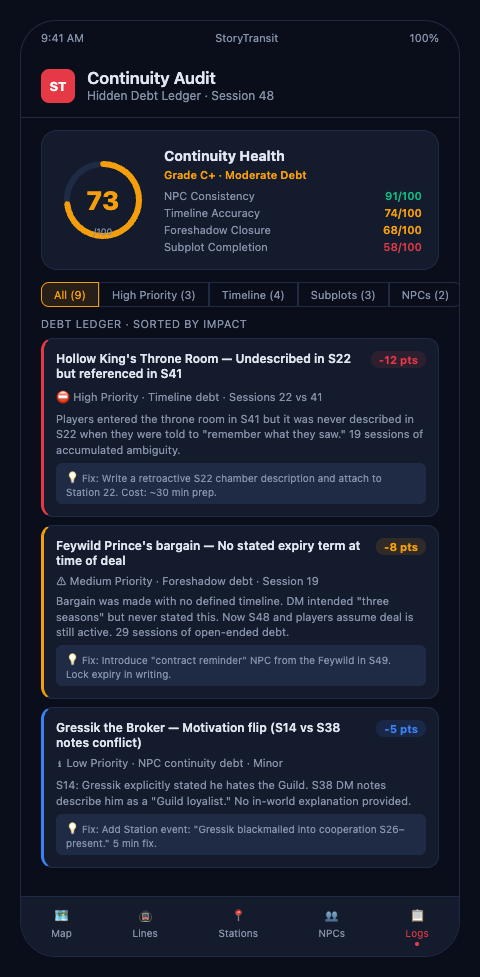
A continuity debt audit for a long campaign review is a structured review of all outstanding narrative obligations. The goal is not to resolve everything — some debt is intentional, representing deliberate long-arc foreshadowing that is right on schedule. The goal is to make the debt visible, categorize it, and address the portions that have become liability rather than asset.
The transit system metaphor makes the audit navigable. Every subplot line on the map has a current status. The audit reviews each line: Is this line on schedule? Has it gone dormant longer than intended? Does its current state contradict any established world fact? Are its associated NPCs still behaving consistently with their last documented motivation?
StoryTransit's transit map provides the audit surface — every line is visible, every dormant stop is flagged, every NPC connection is queryable. A DM who can see their entire subplot network at once can conduct a meaningful audit in one prep session rather than several hours of note archaeology.
The Rolling Retcon from Campaign Mastery identifies the core risk: retroactive continuity in RPGs is hardest to manage when not caught early. A contradiction between Session 12 and Session 47 that the DM notices at Session 48 is correctable with minimal social capital. The same contradiction noticed at Session 80 requires a more disruptive correction.
Prevalence, common causes and effects of technical debt found that on average 25% of development effort in software projects addresses technical debt — a proportion that should give pause to any DM who believes their campaign's narrative backlog is under control.
The four-part continuity audit:
Subplot status review: Every subplot line assessed for current status — active, dormant, approaching resolution, overdue. "Overdue" means the subplot was seeded more than a defined number of sessions ago and has had no movement. Flag every overdue line.
NPC motivation check: Every Tier 1 and Tier 2 NPC's current stated motivation checked against their recent behavior. Any divergence between motivation and behavior is a continuity error candidate.
Foreshadowing payoff inventory: Every foreshadowing seed in the campaign's foreshadowing log checked against its associated subplot line. Seeds whose lines have been resolved without a payoff, or whose payoff window has passed, are continuity debt.
Promise log review: Every explicit promise made to players — by NPCs, by the world's established rules, by the DM as narrator — reviewed for fulfillment status. Unfulfilled promises are the most player-visible form of continuity debt.
Correcting Without Breaking
It's Retcon Time! at Gnome Stew makes the practical point that DMs who surface and address continuity errors early spend less social capital than those who let them compound. A retcon at Session 50 that clarifies a confusion from Session 20 is a minor course correction. A retcon at Session 100 that rewrites a character's history is a narrative disruption.
The Art of the Retcon identifies proximity as the single biggest factor in correction cost: the closer to the original inconsistency, the lower the cost of fixing it. The audit's primary value is finding inconsistencies while they are still close enough to correct cheaply.
When an audit surfaces a genuine continuity error — not just a dormant thread, but an actual contradiction — the correction strategy depends on the error type:
Additive correction: Add information that explains the inconsistency without changing any established fact. An NPC who behaved inconsistently was secretly under magical influence. This is the lowest-cost correction and should be the default when possible.
Selective retcon: Acknowledge to the players that a specific element has changed, provide an in-world explanation, and move forward. Brief, explicit, and limited in scope.
Full retcon: Reserved for errors so significant that ignoring them would undermine player trust in the world's coherence. Rare, costly, and requiring full table discussion.
Advanced Audit Practices
Quarterly audit cadence: Long campaigns benefit from a full continuity audit every real-world quarter. This cadence catches drift early and prevents the accumulation of compounded errors. The quarterly audit takes roughly two to three hours for a campaign with 50+ active sessions of history — a modest investment relative to the cost of a continuity crisis at Session 80.
AI-assisted audit: AI-assisted prep that reviews prior session notes and flags unresolved threads functions as an automated continuity audit assistant. Running session notes through an AI with a specific "find continuity inconsistencies" prompt can surface gaps the DM has become blind to through familiarity. The blind spots are particularly valuable to surface — a DM who has been running the same campaign for three years has often stopped seeing the gaps that feel normal because they have been present for so long.
Player-side continuity reporting: Create a lightweight mechanism for players to flag continuity questions between sessions. Players often notice inconsistencies the DM misses — a formal channel for those observations is more useful than hoping they mention it at the table. A simple shared document where players can add "hey, didn't this character say X back in Session 32?" creates a collaborative audit that catches far more than any single DM can manage alone.
Debt prioritization: Not all continuity debt requires the same urgency of response. Debt that is directly relevant to an upcoming story arc requires immediate resolution. Debt in dormant subplot lines can wait until those lines are reactivated. Debt in fully resolved arcs — where the inconsistency exists in a closed chapter of the story — may not require correction at all. Prioritizing debt by its current relevance prevents the audit from becoming an overwhelming retrospective project and keeps the focus on narrative health going forward.
The audit process is intimately connected to the revival process. A campaign returning from a hiatus faces a condensed version of this same audit framework under time pressure — the triage categories map directly to the four-part continuity audit above.
A completed continuity audit often reveals structural decisions that were made for a previous ruleset and may not survive an edition change. Edition transition migration covers how to handle the mechanical layer of that transition without disrupting the lore continuity the audit just cleaned up.
LARP event organizers face a parallel challenge with physically enacted plot beats that were designed but never staged. Audit unreached beats examines how organizers review and resolve unplayed plot content — a structural analogue to the DM's subplot debt review.
Audit Before the Debt Audits You
StoryTransit's transit map makes continuity audits tractable for long-running homebrew DMs because the audit surface is always current — dormant lines are flagged automatically, NPC states are queryable at any session point, and foreshadowing threads are linked to their subplot lines by design.
The first audit is almost always the most revealing, because it surfaces debt that accumulated before the DM knew they needed to track it. A DM running their first quarterly audit on a 50-session campaign will typically find three or four subplot lines with no status update in 20+ sessions, one or two NPCs whose recent behavior doesn't match their last documented motivation, and at least one foreshadowing seed with no reinforcement since it was planted. Each of those is a fixable problem at the time of discovery. The same problems discovered at Session 100 because a player asked about them cost more to correct and carry a higher risk of damaging narrative trust. Quarterly audits at Sessions 25, 50, and 75 catch everything early.
Homebrew D&D DMs who want to run their retrospective before their players notice the gaps can join the waitlist now and get access to the audit tools that surface continuity debt systematically rather than accidentally. Join the Waitlist for Homebrew D&D DMs and turn your retrospective into a competitive advantage for your campaign's next phase.