Transitioning a Homebrew Campaign Between Edition Rulesets
The Edition Transition No One Warned You About
When D&D's 2024 ruleset arrived, the conversation among homebrew DMs focused almost entirely on mechanics: which classes changed, which spells were modified, whether existing characters needed to be rebuilt from scratch. That conversation was necessary. It was also incomplete. The decade timeline techniques post covers the chronology architecture that makes any lore preservation audit tractable — knowing exactly what was established when is the prerequisite for a successful edition ruleset transition and D&D edition change that protects your campaign's narrative history.
D&D's 2024 ruleset split the product line into "legacy" and current, forcing homebrew DMs to make a compatibility decision. Dungeons & Dragons Explains How New Rules Work With Old 5E Characters makes the constraint explicit: the 2024 rules override the 2014 rules and cannot be freely mixed. That override creates a migration decision, not just a conversion exercise.
A campaign running since 2017 with 200 hours of history has established world facts that were built on the assumptions of the 2014 ruleset. A half-elf bard's skill proficiencies, a villain's legendary actions, a magic item's economy — all of these have lore implications that ripple into narrative decisions. When the rules change, the lore implications change too. Without explicit attention to those ripples, the migration introduces retroactive inconsistencies into the campaign's established history.
D&D 2024 launch was an unqualified success with underestimated demand, making edition migration an immediately relevant concern for a large fraction of the active homebrew DM community.
The lore layer problem is invisible until it surfaces. A DM who converts their characters to 2024 rules and runs the next session without a lore audit will likely encounter the first inconsistency by Session 5 of the new ruleset: a player who remembers that their character's backstory included a specific class ability that no longer exists, an NPC whose power level was calibrated to 2014 monster math that no longer applies, a magic item whose scarcity was balanced against a crafting economy that has changed. Each of these is a minor disruption individually. Accumulated across a campaign with 200 hours of established precedent, they become a significant continuity burden.
The edition transition, handled well, is also an opportunity — the lore audit it requires forces a comprehensive review of the campaign's established history that a DM who never transitions may never otherwise conduct. The DM who uses the transition as a prompt for a full continuity review will emerge from the process with a cleaner, better-documented campaign than they had before the transition began.
The Two-Layer Migration Framework
The transit system metaphor maps the migration problem precisely. The mechanical layer is the rolling stock — the rules by which trains operate on the lines. The lore layer is the network itself — the lines, stations, and established routes that the world's history has laid down. You can change the rolling stock without changing the network. But if the new rolling stock requires different track gauges, some stations may no longer be reachable.
In practice, a successful homebrew campaign migration between rulesets requires two separate processes run in parallel:
Mechanical migration: Convert existing characters, NPCs, and mechanics to the new ruleset. This is the work most DMs do. Subclass level-gating and class rebuilds in 2024 are the main mechanical obstacles — identify every character affected and make explicit decisions about how each converts.
Lore audit: Review every established world fact that was mechanically grounded. An NPC whose power level was tied to old monster stat blocks, a magic item whose scarcity was based on old crafting rules, a faction whose capabilities were assumed from old spell lists — each of these is a potential continuity inconsistency after the transition.
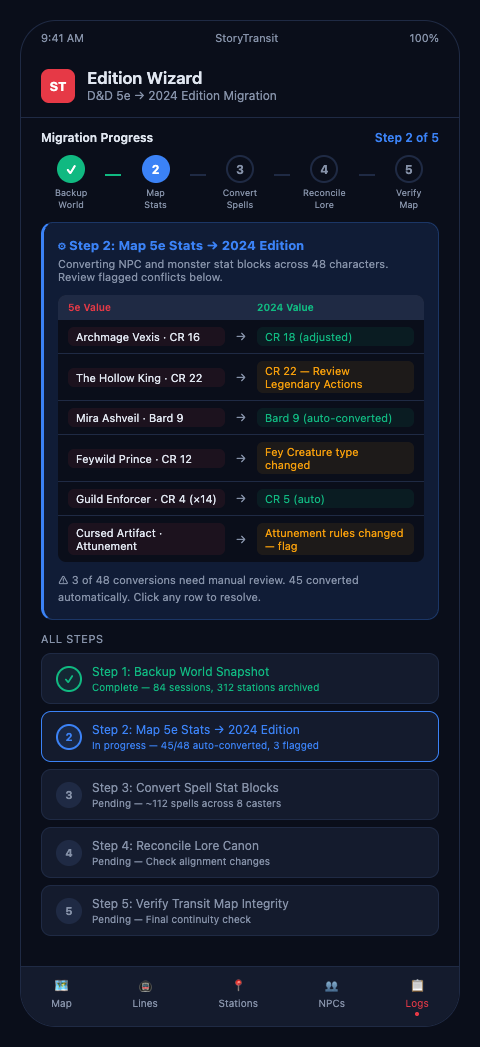
StoryTransit's transit map supports the lore audit by surfacing every NPC, faction, and subplot that has a mechanical dependency. The map does not track rules — it tracks the world's narrative state, which is exactly what the lore audit needs to review.
The lore migration decision tree:
Additive: The new rules expand what was previously established, making the existing lore more detailed. Accept and integrate.
Neutral: The mechanical change has no narrative implication for this specific element. No lore action required.
Contradictory: The new rules conflict with an established world fact. Choose: retcon the lore with an in-world explanation, or rule the legacy lore as a campaign-specific exception.
Retroactive continuity in long-running fiction shows how Tolkien, Lucas, and Marvel all navigated medium and edition transitions by treating established lore as the fixed point and the new ruleset as the adaptation layer — not the reverse. The story precedes the mechanics.
Additive retcons are the safest strategy when migrating established lore to new rulesets. Add, don't delete. When the 2024 rules change how a druid's wildshape works, the narrative answer is: "This is how it has always worked in this world, and here is the in-world explanation for why."
Managing Player Expectations During the Transition
Edition transitions are visible to players. A character rebuild is not invisible. The DM who handles this well communicates early, provides rationale, and frames the transition as a world event rather than an administrative correction.
Options for in-world framing of a mechanical transition:
The Awakening: Something changed in the world's fundamental magical structure. All practitioners of arcane and divine arts have adapted, their abilities evolving in response to a shift in the weave. This framing works particularly well for class ability changes.
The Discovered Knowledge: Adventurers have learned new techniques, found ancient texts, or received training that expanded their capabilities. New class features represent earned advancement, not retroactive revision.
The World Record Update: Certain factual elements of the world — which items exist, which creatures' capabilities — are simply updated as accurate world knowledge. The old information was incomplete.
The DM's job is to choose the framing that creates the least discontinuity with the campaign's established tone and narrative.
Advanced Transition Tactics for Lore Preservation
Pre-transition lore freeze: Before beginning the mechanical conversion, create a snapshot of the world's current lore state. Every active NPC, every faction position, every subplot status. This snapshot is the baseline — the mechanical migration should not alter anything in this snapshot unless a specific lore decision is made. The snapshot also provides a reference point for the lore audit: every mechanically grounded world fact needs to be checked against the new ruleset's equivalent mechanics.
Player character rebuild sessions: Rather than converting characters administratively, run individual sessions with each player to rebuild their character together. This preserves player agency and creates opportunities to integrate the mechanical changes into the character's in-world narrative arc. A class feature that no longer exists in 2024 is an opportunity to develop an in-world explanation for why the character's abilities have evolved. These rebuild sessions often produce richer character moments than the original character creation did.
Legacy rules exceptions list: Some campaign-specific mechanics may be better served by maintaining the legacy rules as explicit exceptions. A magic item the party has been carrying since Session 3 may be more narratively valuable under the old rules. A specific monster's legendary actions may have been so integral to an established story arc that changing them would require significant retconning. Document each exception with a brief rationale — the list creates a transparent record of where the campaign has intentionally diverged from the new ruleset, preventing confusion in future sessions when players or new players encounter the exceptions.
Narrative coherence test: After the mechanical migration is complete, run the next three planned sessions as a mental simulation. Would any of the upcoming story beats produce a contradiction with the established lore now that the rules have changed? Catching those contradictions before play is far less costly than catching them at the table. The simulation can be as simple as reviewing the next session's prep with the question: does anything here require an NPC or world element to behave differently than it did under the previous ruleset, and if so, does the lore support that change?
The edition transition decision is easier when the campaign's historical timeline is already well-documented. Knowing exactly what was established when is the prerequisite for knowing what needs to be reviewed in the lore audit — a well-maintained timeline makes the mechanical migration's lore implications visible rather than hidden.
The scale of the campaign also affects the transition complexity significantly. A multi-table scaling scenario introduces additional coordination requirements — all tables must migrate simultaneously, and the shared world's mechanical dependencies must be addressed centrally.
The edition transition challenge in tabletop campaigns has an interesting analogue in LARP scaling. Tabletop-to-LARP transition covers how campaigns that move from tabletop to live-action format manage the same two-layer migration problem — mechanics must change, but lore continuity must survive.
Migrate the Rules, Preserve the Story
Edition transitions are a mechanical event, but their real risk is to the lore layer. StoryTransit helps homebrew DMs track every narrative element that has mechanical dependencies, so the lore audit runs in parallel with the character conversions rather than being discovered after the fact.
The pre-transition lore freeze is the single most important practical step, and it costs almost nothing to do. Before any character sheet touches the new ruleset, take one session to document the current state of every active NPC, every faction position, and every subplot status. This snapshot takes 45 minutes to an hour for a mid-size campaign with 30 to 40 sessions of history. It becomes the baseline that the lore audit checks against. Every mechanical change in the new ruleset that might affect an element in that snapshot gets flagged for a decision: additive, neutral, or contradictory. Without the snapshot, the lore audit has no fixed reference point, and the migration proceeds on memory rather than record — which is how campaigns with 200 hours of history quietly accumulate a new category of continuity debt during the transition itself.
Homebrew D&D DMs navigating the 2024 ruleset migration, or planning for future edition changes, can join the waitlist now and get the transit map tools that make lore-layer auditing systematic. Join the Waitlist for Homebrew D&D DMs and protect the 200 hours of campaign history you have built from the mechanical layer's ripple effects.