Transitioning a Tabletop Campaign Setting Into a Live LARP
The Conversion Problem
A well-built tabletop campaign setting is rich, layered, and internally consistent. The GM has spent years developing factions, histories, geography, and NPC relationships. Players are deeply invested in the world. When that group or a successor community decides to bring the setting to life as a LARP, the richness feels like an asset. Often, it becomes a liability.
Tabletop worldbuilding in LARP runs into a fundamental format mismatch. At the table, the GM mediates every player encounter with the world. Information reaches players when the GM decides to deliver it. NPCs say exactly what they're supposed to say because the GM is voicing them with full knowledge of the plot. Story beats fire on the GM's cue because the GM controls when and how they're introduced. In live format, none of this is true.
Players navigate the world physically, encounter only what's actually present in the venue space, and interact with NPCs who are human costumed volunteers with limited briefing time and variable improvisation skills. A NPC who needs to deliver three paragraphs of critical lore at exactly the right moment in a conversation will fail at least thirty percent of the time—not because they're bad volunteers, but because live improvisation under those conditions is a different skill set than the GM narrating that information at a table.
Research on tabletop-to-LARP conversion failures documents that 68% of homebrew TTRPG campaigns fail to convert to LARP due to scale mismatch between narrative design and physical staging requirements. The most common failure mode isn't inadequate creativity—it's organizers porting their plot bible directly into the LARP format without rebuilding the delivery mechanisms. The story beats exist. The world is designed. The problem is that no one has answered the fundamental question: how does this information reach a player in a live environment?
RPG Research's format taxonomy defines the core design constraints separating tabletop, live-action, and hybrid formats. Understanding those constraints explicitly—rather than assuming the formats are similar enough to transfer directly—is the first step in any campaign setting conversion.
The Eight Infrastructure Layers
Franchise larp research from ResearchGate identifies eight world-building infrastructures that transfer from source material to LARP: space, character, mythology, staff structure, prop ecosystem, timeline, social contract, and participant culture. A successful tabletop to LARP transition requires explicit attention to each layer.
Space is the most immediately obvious conversion challenge. Tabletop campaign geography is abstract—the GM describes the locations, players imagine them. Live-action adaptation requires physical space assignments for every significant location in the campaign world. The merchant quarter, the nobility council chambers, the forest shrine—each needs a real venue location, a physical boundary, and a visual identity that players can recognize without narration.
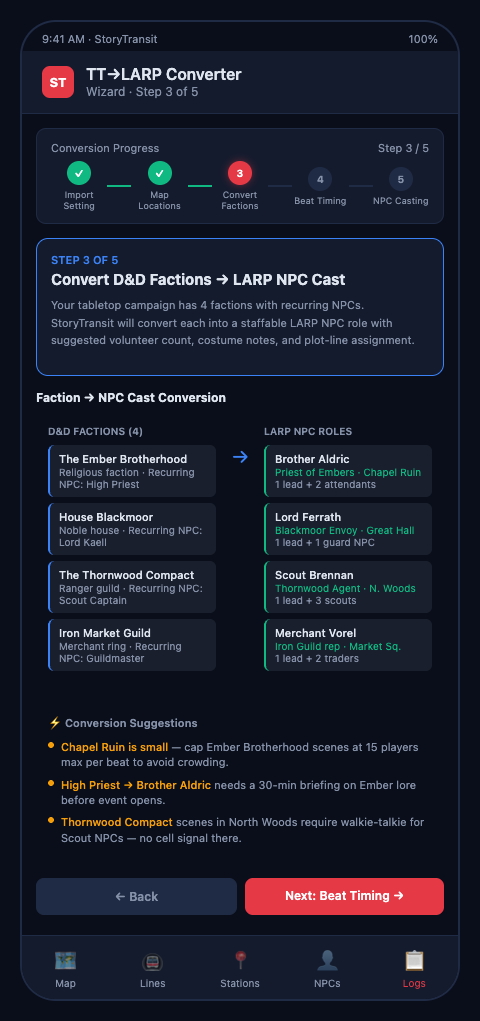
Character conversion means transforming statted tabletop characters into live-action characters with physical costumes, physicalized skills, and interaction-based resolution. A character's tabletop ability scores don't translate directly to LARP mechanics. The character conversion process requires rewriting every significant NPC and PC template for live play.
Mythology and lore are among the most transferable layers—but the delivery mechanism changes entirely. Lore that players learned through GM narration at the table needs to be converted into discoverable artifacts: written documents, NPC monologues, physical props, and environmental storytelling that players encounter through active exploration rather than passive listening.
Staff structure requires the biggest organizational rebuild. A single GM running a tabletop campaign becomes a head organizer, several plot runners, a radio dispatcher, and a pool of costumed volunteers. Each of those roles needs explicit definition, clear protocols, and communication systems that didn't exist at the table.
The transit metaphor is particularly useful for the format migration as a whole. Think of the tabletop campaign setting as a route map that exists only as a drawing. The LARP conversion is the project of building actual tracks, stations, and vehicles on the physical terrain of a real venue. StoryTransit supports this migration by maintaining the same plot structure across format contexts—the parallel plotlines that ran as GM-narrated arcs become transit lines with defined stations and zone assignments.
LegendKeeper's multi-format worldbuilding modules offer a technical approach to the conversion: mapping tabletop locations, factions, and NPCs onto live-event plot structures using the same underlying data model, so the transition preserves relational connections between world elements rather than requiring a complete rebuild from scratch.
The Practical Migration Protocol
Audit your plot bible for delivery dependencies. Read every story beat in your tabletop campaign notes and ask: how does this information reach a player in live format? If the answer is "the GM describes it," that beat needs a live-format delivery mechanism before migration. Identify the NPC, the physical location, and the trigger condition for each beat. This audit will reveal which beats transfer easily (those with clear physical triggers and simple information delivery) and which require significant redesign (those that relied heavily on GM narration or information the players couldn't verify independently).
Rebuild your NPC roster as volunteers, not characters. Tabletop NPCs are GM-controlled and perfectly consistent. LARP NPCs are costumed volunteers with thirty-minute briefings. Every NPC from your campaign setting who needs to deliver critical plot information needs a brief so simple that a volunteer can deliver it accurately after one read-through. Compress your rich tabletop NPC histories into one-paragraph volunteer briefs. The rich backstory and personality details go in the supplementary document for NPCs who want to read more—but the operational brief stays short.
Test your setting's geography at scale. A tabletop campaign's world map doesn't have dimensions. A LARP venue does. Walk the physical space before finalizing the event layout and assign each of your campaign's major locations to a specific area of the venue. Then calculate travel time between locations. A tabletop scene that moves between the palace and the docks in a single session might require players to walk twenty minutes across a sixty-acre venue in live format—meaning the sequence either needs to be redesigned or the venue assignments need to be reconsidered.
Build a format migration schedule. Don't attempt to convert the entire tabletop setting in a single event. Identify the three to five storylines most central to your current player base and convert those first. Leave secondary storylines as dormant stops for future events once the core format migration has been tested and the mechanics are stable.
Run a conversion rehearsal. Before the first live event, run a tabletop session using the LARP-format mechanics to test whether the converted plot still works as intended. The constraints that LARP mechanics introduce—physicalized conflict resolution, time-bounded NPC encounters, geographic separation of information delivery—change how stories unfold in ways that aren't always visible until someone is actually playing through them.
What the Campaign Setting Needs to Survive the Jump
Larp Design by Tampere University provides the academic framework for what makes a setting suitable for live-action adaptation: tools and principles for converting narrative concepts into physically playable design. The core insight is that live-action adaptation isn't about simplifying the narrative—it's about converting narrative delivery mechanisms from GM-mediated to environment-mediated.
Campaign settings that survive the format migration successfully share three characteristics: they have clear geographic structure that maps to physical spaces, they have active factional conflicts that players can engage with through direct interaction, and they have story beats that can be triggered by player behavior rather than requiring specific narrative setup by a GM.
Settings that struggle in migration tend to have intricate lore that's beautiful on paper but requires extensive explanation to access, narrative beats that depend on precise timing and information sequencing, and dramatic tension that emerges from GM-curated revelations rather than from emergent player interaction.
Understanding the difference between these two setting types before committing to the migration saves significant time and creative energy. A setting that's heavy on GM-narrated backstory and light on player-driven faction conflict can still be converted—but it requires a heavier prop and document layer to make the lore accessible without narration, and a more structured NPC briefing system to ensure information delivery is consistent across a full volunteer cast. Building that infrastructure explicitly into the conversion plan prevents the most common late-stage discovery: that the setting's lore is beautiful but no one can find it during the weekend.
Campaign settings as defined world-building frameworks that migrate across game formats have a long history—tabletop supplements like the Forgotten Realms and Planescape both started as setting documents before becoming playable systems across multiple formats. The conversion challenge has always been the same: what's implicit in the written setting document needs to become explicit in the play experience.
The LARP market is growing at 13.8% CAGR, with tabletop-to-live conversions driving 15% of new event launches. The demand for successful format migration is real, and the communities built around converted settings tend to have unusually deep world investment from the player base—a significant competitive advantage for organizers who get the conversion right.
The transition from tabletop to LARP involves scaling challenges at multiple levels—the chamber to convention post covers the operational inflection points that typically arise as a converted setting attracts more players beyond the original tabletop community. When the converted setting grows into a full multi-line event, the multi-plot logistics post covers staffing and spatial planning for the operational layer. The analogous challenge of transitioning between different rule systems while preserving narrative continuity is documented in edition transition migration, which surfaces parallel infrastructure challenges that arise whenever a campaign crosses a format boundary.
StoryTransit gives LARP event organizers a structured framework for managing the tabletop-to-LARP transition. The same transit map that tracks your campaign setting's narrative layers during pre-production becomes the operational plot dashboard for your live event's runtime coverage. Join the Waitlist for LARP Organizers and bring your campaign setting into the live format with the infrastructure to support it at scale.