The Logistics of Multi-Plot LARPs: Staffing, Space, and Story
The Three-System Failure Pattern
Multi-plot LARPs fail in one of three ways—and often in combination. Staffing failure looks like zone coverage gaps: entire areas of the venue running without active NPCs while the GOD tent has five costumed volunteers waiting for deployment orders that never come. Space planning failure looks like player clustering: ninety percent of attendees concentrated in twenty percent of the venue while peripheral plot stations sit empty. Story coordination failure looks like parallel plotlines going dark: a plot runner discovers on Sunday morning that an entire narrative arc they were responsible for ran zero story beats since Friday evening.
Each failure mode has its own fix. But all three are downstream of the same root problem: multi-plot logistical coordination requires three separate operational systems running simultaneously, and most events only have explicit infrastructure for one of them—usually character management or registration administration, neither of which helps when Zone 7 has been without an NPC for three hours.
ConQuest of Mythodea runs 10,000 participants across 100+ hectares with defined roles—healers, engineers, commanders, logistics coordinators—across every operational category. Their model isn't directly replicable at 200-player scale without significant adaptation, but the organizing principle transfers exactly: every operational function needs a defined owner, a communication channel, and a success metric. The failure modes at Mythodea scale and at 200-player scale are the same three; the systems required to prevent them are structurally identical.
Alliance LARP's 1:3 NPC-to-PC ratio requirement illustrates the staffing density floor for multi-plot coverage: you need dedicated staff density per player, not per event. At 200 players, that's roughly sixty-five NPC shifts minimum—enough to sustain coverage across multiple parallel plotlines across a full weekend runtime. Most organizers underestimate this number until their first event under 1:3 ratio reveals exactly how thin the coverage becomes.
The Transit Model for Multi-Plot Coordination
The most operationally useful frame for multi-plot LARP logistics is the city transit system. The venue is the network. Plot zones are districts. Each parallel plotline is a transit line running through specific zones. Story beats are scheduled station stops with defined times, locations, and NPC assignments. The plot dashboard is the live departure board showing which lines are on schedule and which have stalled.
This framing makes the three logistical systems legible and explicitly interdependent. Staffing is the vehicle assignment problem: which costumed volunteers are assigned to which line, when do they rotate, and who covers gaps when a volunteer goes offline? Space planning is the route design problem: are the station locations spaced to encourage natural player flow along the transit lines, or do route gaps leave large areas of the venue without accessible stops? Story coordination is the dispatch problem: who is monitoring all lines simultaneously and responding when a line goes dark before that darkness becomes a permanent coverage failure?
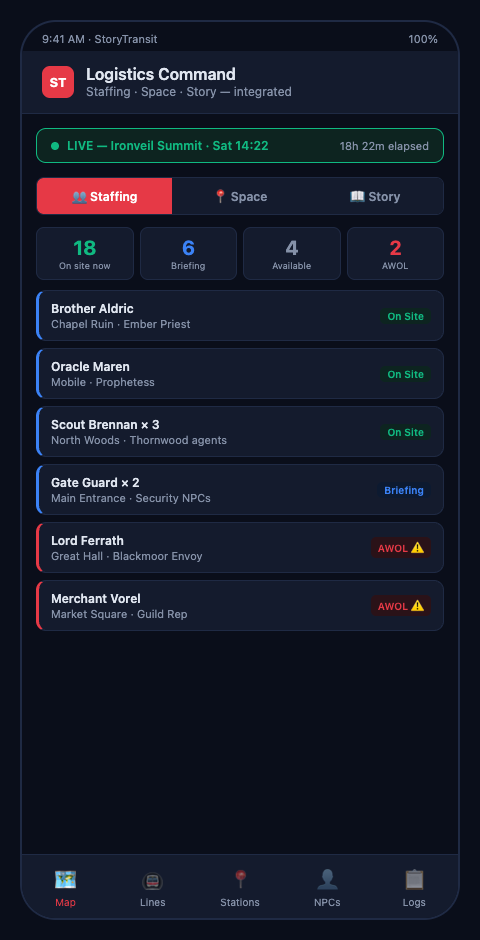
StoryTransit's plot dashboard addresses the dispatch function directly. The radio dispatcher at the GOD tent has a live view of every parallel plotline's status, every story beat's completion state, and every dormant stop that hasn't had player contact within the configured threshold. When a line goes dark, the dispatcher has the information needed to redirect a costumed volunteer from the pool within minutes rather than discovering the gap during the post-event debrief.
Immersive Storytelling Experiences research introduces the drama manager concept—a coordinating role that guides narrative beats across simultaneous story threads in location-based events. The drama manager function is precisely what the radio dispatcher performs in a well-structured multi-plot LARP. It's also the role most often left implicit in events that scale their player count without rebuilding their coordination layer.
Designing the Staffing System
The GoPassage LARP planning guide recommends one storyteller per eight to ten players and one NPC per ten players as minimum staffing ratios for effective event coverage. For a 200-player event with eight parallel plotlines, that translates to twenty storytellers and twenty NPC volunteers minimum per session block—plus a dispatcher function, a head plot coordinator, and a pool of unassigned NPCs for reactive coverage.
Structure NPC assignments in three tiers. Line conductors are assigned to a specific parallel plotline for the full event—they know their storyline thoroughly and are responsible for ensuring every story beat in their line reaches its intended players. Zone NPCs are assigned to a geographic area and are available to service any plotline passing through their zone during their shift. Pool NPCs are unassigned to any specific line or zone and are available for dispatcher deployment wherever coverage is needed. Keep at least fifteen percent of your NPC roster in the pool at all times—this is your dropout buffer and your overflow coverage for unexpectedly high-traffic zones.
EPIC EMPIRES' eleven-camp four-day structure with Round Table governance and per-camp budget grants distributes spatial ownership and staffing responsibility across camp organizers. At smaller scale, the equivalent is zone warden assignments: each zone warden is responsible for monitoring NPC coverage in their zone and escalating gaps to the dispatcher before they become coverage failures.
The NPC shift system needs explicit overlap scheduling. When costumed volunteers rotate out of a zone, there should be a fifteen-minute overlap period where the outgoing and incoming NPCs share a physical handoff—the outgoing NPC walks the incoming one through current beat statuses, player group locations, and any continuity notes. Without the overlap, the incoming NPC loses the context needed to continue ongoing storylines seamlessly.
Designing the Space Plan
Before finalizing the venue layout, build a plot station map showing every story beat's physical location and the natural player movement paths between them. The goal is to ensure that players moving between high-traffic areas pass through at least one active plot station every thirty minutes without having to actively seek out story content. Beats that require deliberate player navigation to find will be systematically under-encountered because most players are engaged in other things and won't interrupt active roleplay to go exploring.
LARP space planning requires thinking in player movement patterns, not just venue geography. Where do players congregate naturally—near food, near the main event building, near faction camps? Where do they avoid—distant edges of the venue, areas without shelter, locations far from toilets? Plot stations placed in naturally low-traffic areas need stronger directional hooks to pull players toward them than stations placed along existing movement corridors.
The zone boundary system affects how players understand the event's geography. Clear zone boundaries—physical markers, visual distinctions, NPC presence—help players navigate a large venue without a map. Ambiguous zone boundaries mean players don't know when they've entered a new plot area, which means the spatial trigger conditions for many story beats never fire.
Festival logistics frameworks from Eventbrite provide zone segmentation models, crowd management tools, and staff hierarchy structures for large outdoor multi-day events. These frameworks weren't designed for LARP, but the spatial planning principles—separating zones by function, designing for traffic flow, positioning staff at natural congregation points—transfer directly to multi-plot event space planning.
Designing the Story Coordination Layer
GPS-enabled two-way radios with department channel assignment are the hardware backbone of live dispatch coordination. Each parallel plotline gets a channel. Zone NPCs report story beat completions and staffing issues on their line's channel. The dispatcher monitors all channels simultaneously and coordinates cross-line resource sharing.
The dispatcher's primary job is managing dormant stops: plot stations with no player contact for more than the configured threshold—typically sixty to ninety minutes depending on the event's runtime and total beat count. The dispatcher's secondary job is managing convergence: when multiple plotlines are scheduled to intersect at the same physical location, the dispatcher coordinates timing to prevent NPC overload at a single plot station and player bottlenecks that disrupt the immersive environment.
The dispatcher needs a live status board—either printed and updated manually or maintained digitally—showing every line's current status. Without the board, the dispatcher is managing from memory, which fails under the load of coordinating eight to twelve simultaneous plotlines across a sixty-acre venue.
Putting the Three Systems Together
The three systems—staffing, space, and story coordination—need to be designed together rather than sequentially. The staffing model affects which zones can have active plot coverage at any given time. The space plan affects how easily costumed volunteers can move between zones when the dispatcher redirects them. The story coordination layer needs to be calibrated to the specific tempo at which the staffing model can respond to coverage gaps.
A common design error is building the staffing model around the story coordination layer's ideal response time, then discovering during the event that costumed volunteers can't physically reach flagged zones within that window because the venue layout didn't account for travel time. Design the space plan first, calculate realistic NPC travel times between all zones, and then calibrate the dispatcher's dormant stop threshold to the actual response capacity of the staffing model.
For how the same logistical framework applies when running events with simultaneous themed subplots rather than fully independent parallel plotlines, the simultaneous themed subplots post covers the variation. The full operational picture of what these multi-plot logistics look like in practice for a high-attendance event is documented through the 200-player case study, which walks through the actual implementation of these three systems in a real large-scale event context. For how logistical coordination challenges compare at the level of long-running campaign infrastructure management, campaign economics covers the resource allocation parallels in the tabletop campaign management context.
Multi-plot LARP logistics isn't a problem that scales smoothly from smaller events. Each threshold—sixty players, one hundred fifty players, two hundred players—introduces new failure modes in all three systems. The organizers who design explicitly for those failure modes before they hit them run the cleanest large-scale events in the field.
StoryTransit is built for LARP event organizers running large campaign events where all three logistical systems need to operate simultaneously and in coordination with each other. The transit dashboard gives your radio dispatcher real-time visibility across every parallel plotline, every story beat, and every dormant stop in the system. Join the Waitlist for LARP Organizers and run your next multi-plot weekend with the coordination infrastructure it actually requires.