Case Study: A 200-Player Weekend LARP With Full Plot Coverage
The Problem With Plot Coverage at Scale
At 200 players, a LARP weekend stops being a storytelling exercise and becomes a distribution problem. Your plot bible might document forty story beats across eight parallel plotlines, but the critical question isn't whether those beats are written—it's whether any given player actually encounters them during runtime.
The data is sobering. Research from Analog Game Studies documents how GMs struggle to synthesize parallel narratives at scale in post-event reviews, precisely because no central tracking existed during the event itself. Meanwhile, the GoPassage LARP planning guide recommends a baseline of one storyteller per ten players—meaning a 200-player event needs twenty active storytellers just to maintain minimum engagement density.
Most organizers don't have twenty storytellers. They have six plot runners, fourteen costumed volunteers cycling through NPC shifts, and a radio dispatcher managing queue requests from across a sixty-acre site. The result: story beats cluster at high-traffic areas while outlying plot stations go cold for hours at a time. Players who happen to stay near the main event hub encounter multiple beats in a single afternoon. Players who spend time in peripheral zones encounter nothing.
Full plot coverage at this scale requires treating your event less like a single narrative and more like a transit network—with defined routes, timed stops, and a central dashboard tracking which lines are running and which have gone dormant. The key insight is that coverage is a logistical achievement, not a creative one. It doesn't matter how good the story is if the mechanism for delivering it doesn't reach the right players at the right time.
The Pre-Event Design Shift
The organizing team behind this case study arrived at the transit metaphor after their first large event, where a post-mortem revealed that three of their eight parallel plotlines had effectively shut down by Saturday evening. Costumed volunteers playing key NPCs had self-organized around high-player-density areas, because that's where the action felt most rewarding. Entire plot stations in peripheral zones sat empty for the last sixteen hours of the weekend.
For the 200-player event, they rebuilt their planning structure before a single NPC was cast. Every parallel plotline was mapped as a transit line with a defined color, a named plot runner serving as its conductor, and an explicit zone assignment. Every story beat became a scheduled station stop with an estimated runtime window, a physical location on the sixty-acre venue map, and a specific NPC assignment. The plot bible—which had previously been a narrative document—was restructured as a route map with annotated stops.
The pre-event design process took three additional hours compared to their previous approach. Those three hours were recovered during runtime, when plot runners spent less time figuring out what to do and more time doing it.
StoryTransit's structure mirrors this approach directly. Organizers map plot threads as lines, story beats as stations, and character arcs as routes. The dashboard surfaces dormant stops—plot stations that haven't had player contact in over ninety minutes—so plot runners can redirect costumed volunteers before a story beat becomes permanently missed. The transit dashboard replaces the gap between "what we planned" and "what players encountered" with a live picture of both simultaneously.
The LARP Portal's modular feature set demonstrates why integration across player, character, and plot data matters: when player registration data connects to plot assignment data, organizers can verify in real time which characters have which hooks active and route appropriate NPCs accordingly.
How the System Worked in Practice
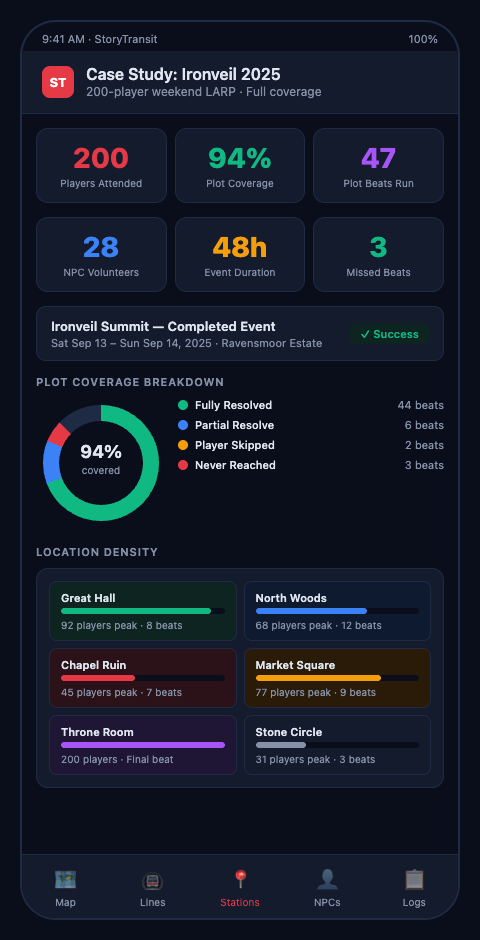
The organizing team divided the sixty-acre venue into six plot zones, each anchored by a physical plot station with a designated NPC. Each zone corresponded to one or two transit lines. The radio dispatcher at the central GOD tent—a structure modeled on the Profound Decisions crew hub used at Empire events, which manages 400+ crew serving 3,500+ players—received status updates from zone NPCs every thirty minutes.
The dispatch protocol was simple: every NPC in a zone sent a thirty-second radio update at each half-hour mark. The update answered three questions: have any story beats run since the last check-in, is the zone receiving player traffic, and do you need additional costumed volunteers? The dispatcher logged all three answers on the master dashboard.
When a line went dark—no beat completions and declining player traffic for sixty consecutive minutes—the dispatcher flagged it and alerted the nearest available costumed volunteer pool. The pool NPC received a two-minute brief from the line conductor and deployed to the dormant zone. When a story beat was completed, the zone NPC radioed confirmation and the dispatcher updated the board.
This approach meant the team never discovered gaps through player complaints or post-event surveys. They discovered them in real time, during a window when something could be done. By Sunday morning, the team had a live picture of which beats had run, which were pending, and which needed to be collapsed into adjacent plot lines due to low player engagement in certain zones.
The result: of forty planned story beats, thirty-six were successfully encountered by at least one player group. The remaining four were "dormant stops" that were intentionally held for a future event rather than forced into an already-crowded runtime. That's a 90% coverage rate—significantly above the post-event reconciliation averages documented in LARP research literature.
For context, the ConQuest of Mythodea runs 6,200 players plus 2,000 NPCs across 100+ hectares with continuous 24-hour gameplay for five days. Their operational model—compartmentalized zone management with dedicated role assignments and a centralized coordination hub—validates the same principle at extreme scale.
What Made This Case Study Different
Three specific decisions separated this event's coverage outcomes from previous large-scale LARP attempts by the same team.
The NPC pool structure. Instead of assigning every costumed volunteer to a fixed zone for the full event, the team designated twenty-five percent of volunteers as "pool NPCs"—unassigned to any line and available for dispatcher deployment. Pool NPCs rotated through multiple zones across the weekend, filling coverage gaps as they emerged. This buffer proved critical twice on Saturday when two line conductors simultaneously flagged dormant stops in different zones.
The station card system. Every plot station had a physical "station card"—a laminated index card with the beat description, NPC delivery notes, and a log sheet. When costumed volunteers rotated in and out of zones, the card transferred with the zone, not with the person. Incoming NPCs could read the card in thirty seconds and continue exactly where the previous NPC left off. This solved a recurring problem from earlier events, where NPC handoffs caused story beats to reset or contradict themselves.
The convergence beat schedule. The team pre-designed two story beats per day—one in the morning session and one in the evening session—that required plot elements from multiple parallel plotlines to intersect. These convergence beats naturally concentrated player groups at specific locations at specific times, creating predictable high-engagement windows that anchored the dispatch schedule. Rather than deploying costumed volunteers reactively, the team could pre-position pool NPCs around convergence beats and guarantee coverage at the moments of highest narrative density.
Advanced Tactics for Mass-Player Story Management
Tiered story beats. Not every beat needs to reach every player. Classify beats as Tier 1 (must reach at least one major faction group), Tier 2 (should reach two or more player clusters), or Tier 3 (optional enrichment). This prevents the team from treating forty beats as forty equally urgent obligations and allows proportional resource allocation.
Shift-based NPC handoffs. When costumed volunteers rotate out of a zone, the outgoing NPC debriefs the incoming one using the station card system. The card lists the beat status, last player group encountered, and any continuity notes. This prevents coverage gaps when volunteers change and maintains story continuity across the full weekend runtime.
Parallel line convergence points. Design one or two story beats per day that intentionally draw multiple plotlines together. These convergence beats create natural high-traffic moments at planned plot stations, generating player-driven coverage rather than relying entirely on runner deployment.
The stranded arc protocol. When a key character's player becomes unavailable mid-event, immediately flag any story beats that depended on them. The transit system approach makes this visible: a dormant stop flagged by the dispatcher can be transferred to a costumed volunteer playing a bridge NPC within minutes, preventing an entire plotline from stalling.
Staffing models and spatial coordination underpin everything in the dispatcher-driven approach, and multi-plot logistics documents those systems in depth. Teams building toward this scale often stall at a specific transition point, which the chamber to convention post covers directly — event systems need to be rebuilt rather than simply extended past a certain threshold. Measuring story coverage outcomes translates across formats too, and the retention case study from the actual play space applies similar instrumentation logic to a very different delivery medium.
The LARP event management market is valued at $1.42B in 2024 and growing at 9.3% CAGR, which reflects increasing organizer investment in tools designed to solve exactly this problem. Full plot coverage at 200 players is achievable—but only if the system behind the event is built for distribution, not just creation.
StoryTransit is purpose-built for LARP event organizers running weekend-long events where full plot coverage is non-negotiable. If you're organizing a high-attendance event and need a better way to track parallel plotlines in real time across a sixty-acre venue, the waitlist is open. Join the Waitlist for LARP Organizers and be first in line when early access opens for your event size.