Scaling From Solo Party to Multi-Table Mega-Campaign
When One Party Is No Longer Enough
A homebrew campaign designed for four players at one table can sustain itself on strong session notes and a reliable DM memory. The moment a second table enters the same world, that approach fails. Two parties can resolve the same faction conflict in opposite directions before the DM has time to update the shared canon. One group torches Brenhorn Village in Session 14. The other group arrives there in Session 15 expecting a vibrant trade hub. The session-report discipline that multiple parties in a shared world requires becomes non-negotiable the moment solo party scaling becomes a two-table D&D expansion.
Multiple Campaigns, One World frames the problem clearly: running parallel parties in one world requires tracking location, consequence, and timeline separation for each group simultaneously. The solo-party DM was tracking one timeline. The multi-table DM is now tracking N.
Tabletop Games Kickstarter Report 2024 shows TTRPG Kickstarter launches hit 1,892 in 2024, a sign of how large and ambitious the community's project appetite has grown. Multi-table homebrew federations are a natural expression of that ambition.
What most DMs discover when they attempt the expansion is that the problems compound faster than the solutions. With one table, a continuity error affects one group. With three tables, a continuity error can propagate through three groups simultaneously before anyone notices. A faction that one party destabilized in their Session 8 may be the target of a second party's mission in their Session 9 — if the world state has not been updated between sessions, both groups operate on false premises.
The solo-party DM who expands successfully is the one who builds the coordination infrastructure before the second table starts — not after the first contradiction surfaces. The gap between those two moments is where most multi-table mega-campaign homebrew federations fail.
Transit Architecture for Multiple Routes
The transit system metaphor scales naturally to multi-table play — it was designed for complexity. Think of each table as a separate train line running through the same city. The stations they pass through are shared world locations. The plot lines they operate on may overlap at major junction points — a war, a political crisis, a world-altering event — but each route has its own schedule, its own passengers, and its own local stops.
The key insight is that complexity in a multi-table campaign is not additive — it is multiplicative. Two tables share one world, but the interactions between their respective consequences create a combinatorial space of potential contradictions that grows with each session. Managing that space requires a transit map that shows all routes simultaneously, not separate maps for each table that the DM mentally reconciles before each session.
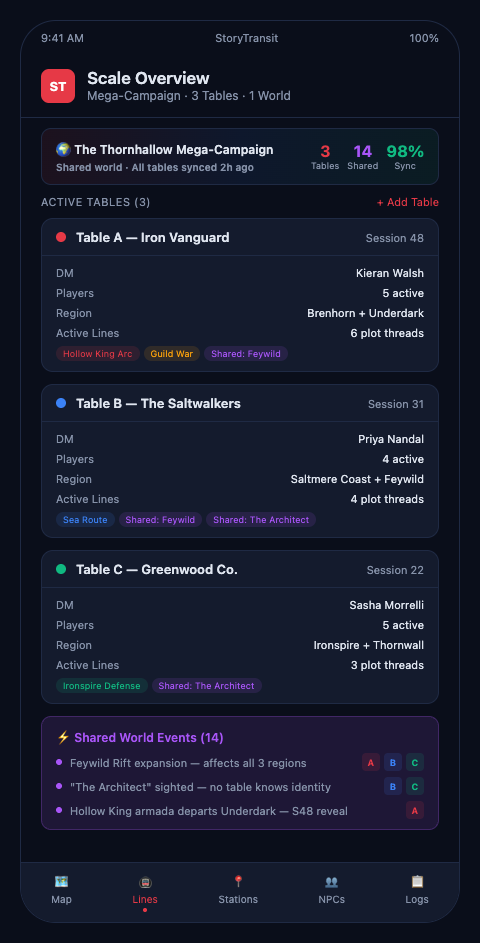
StoryTransit maps this directly: subplot lines remain shared across tables, but each party's position on each line is tracked separately. A dormant stop for one group may be an active station for another. When both groups reach the same junction, the DM can see the convergence coming before it happens.
The original West Marches design, documented by Ben Robbins, solved the same structural problem for 14 players. The West Marches founding principles mandate session-report sharing across all participants so that shared world continuity holds. Every group that ventures out returns with a report that updates the shared map. That mechanic — mandatory state sharing — is the transit equivalent of updating which stations have been visited and what changed there.
What is a West Marches Campaign? makes the documentation requirement explicit: no session without a report. That discipline is what separates successful multi-table worlds from those where groups unknowingly invalidate each other's actions.
Four structural requirements for multi-table play:
Consequence logging: Every session must produce a one-paragraph consequence entry describing what changed in the shared world. This is not optional — it is the mechanism that keeps tables from contradicting each other.
Shared faction states: Faction relationships, allegiances, and resource levels are stored centrally. No table operates on a private faction model.
Timeline gating: Events that affect the whole world — a king's death, a city's fall, a war's end — are marked as gated milestones. No table can trigger them unilaterally.
DM coordination protocol: In a multi-GM setup, there must be a designated coordinator who reviews consequence logs and flags conflicts before the next session round.
Managing the Homebrew Federation
The term "homebrew federation" describes what a multi-table campaign actually becomes: multiple autonomous groups operating inside a shared constitutional framework. The constitution is the world's core lore, its irreversible events, and its consequence-tracking protocol.
Behind the Screens – Multi-Table Events describes how organized play events use hierarchical GM structures and shared milestone tracking to keep tables in sync during live events. Long-running homebrew federations need a persistent version of that hierarchy, not just an event-day one.
The most common failure mode in multi-table scaling is the DM who tries to maintain separate continuity for each group without a shared record. By Session 20 across three tables, they are managing 60 sessions of consequences in their head. That is not a memory problem — it is a structural problem.
GM: Unify Worlds Across Multiple Games identifies clear communication protocols and shared consequence logs as the non-negotiable foundation. Without them, the world splits into incompatible versions.
In transit terms, the federation is a regional network. Each table operates its own local line, but all lines run through shared junction stations — the major world events, the powerful factions, the pivotal locations that all parties will eventually interact with. The shared junction stations are where consequence logging is non-negotiable. A party that passes through a junction station changes its state. Every subsequent party approaches a changed station.
Modern campaign management tools have started to address the multi-table use case. The Ultimate Guide to TTRPG Campaign Managers notes that platforms like Kanka and World Anvil offer multi-user collaboration essential for multi-GM campaigns. The infrastructure exists — the question is whether the DM adopts it before the second table creates its first contradiction, or after.
Advanced Scaling Tactics
Asynchronous consequence windows: After each session, the DM has a 24-hour window to post the consequence log before the next session at any table can begin. This creates a rhythm that prevents timeline collisions. It also builds a searchable archive of every world-state change across all tables — a record that becomes invaluable for DMs trying to reconstruct the world's history months later.
Faction-level subplot tracking: Rather than tracking every party's individual subplot lines, track subplots at the faction level. Parties interact with faction states; the faction state is what updates the shared world. A faction that one party has allied with while another party has antagonized has a complex state — but that complexity is manageable when it lives in a faction record rather than two separate party records.
Convergence event design: Plan one major convergence event per real-world month where all tables interact with the same world moment simultaneously. These events create shared narrative history that all players remember regardless of which table they belong to. They also function as synchronization points — everyone's timeline catches up to the same reference moment, and the DM can reset consequence-tracking from a known world state.
DM rotation protocol: In multi-GM setups, assign each DM responsibility for maintaining the world records for their specific table, with a designated coordinator who reviews all consequence logs and flags conflicts. No DM should be responsible for the entire multi-table continuity alone — that is the structural equivalent of scaling a single-party system by adding more parties without adding any infrastructure.
The foundation for this expansion strategy depends on having already solved the single-table continuity problem. The west marches threads post examines how West Marches-style campaigns manage dozens of active plot lines across open-group play — the same thread management challenge exists in a more controlled multi-table format. Dungeon master growth from one table to multiple requires the same world-state documentation discipline in either format.
For DMs scaling beyond the tabletop format entirely, chamber to convention explores how LARP organizers handle the same world-state coordination problem at physical event scale.
Start the Architecture Before You Scale
Multi-table mega-campaigns do not fail because DMs are bad storytellers. They fail because the architecture that worked at one table was never upgraded before the second table arrived. StoryTransit provides the transit-map infrastructure — shared subplot lines, consequence nodes, faction state tracking — that multi-table homebrew federations need from session one.
The DM who builds the world-state tracking system before the second table starts is not doing extra work for future convenience. They are protecting the investment that the first table has already made. Every session the original party played, every NPC they met, every subplot they seeded — all of that is now at risk if the world state it created is not protected by a shared record before new tables enter. The solo-party homebrew federation is the system that holds that investment intact across the entire network of tables that will eventually explore the same world.
Homebrew D&D DMs planning to expand their world beyond a single party can join the waitlist now and get access to the multi-table coordination tools before their second table creates its first contradiction. Join the Waitlist for Homebrew D&D DMs and build the federation on a foundation that holds.