Recap Episodes Done Right: A Producer's Starter Guide
Why Most Recap Episodes Don't Work
The most common recap episode mistake is making it a retrospective for existing fans instead of a navigation tool for mid-series arrivals. The producer selects memorable moments—the big fights, the emotional scenes, the genuinely funny improv—and strings them together with brief narration. The result is entertaining for listeners who already know the show and useless for anyone trying to get oriented before jumping into the current arc.
A recap episode that functions as a listener catch-up tool needs a different frame. Its primary job is not to entertain with highlights. Its job is to make the current story state legible to someone who has never heard the show—and to do that without running three hours or spoiling arc resolutions that haven't landed yet. This producer guide addresses that distinction head-on: what an actual play recap needs to accomplish structurally, and how to script one that works as a story summary rather than a fan highlight reel.
Recap sequences bring viewers up to date with plot via 20–40 second montages; most prevalent in dramatic serialized TV. The television format runs short because the medium demands it—but the underlying principle, that recap is an orientation tool rather than an entertainment product, applies directly to actual play audio. Your recap episode should be navigable by someone who's never heard of Lord Thadderon, Kaelith, or the Sunless Citadel. They should finish it knowing who the major players are, what they want, and where the story stands right now.
77% of US weekly podcast listeners binge-listen; 60% finish an entire series within the first week of release. A listener who discovers your show 60 episodes in and decides to binge will likely hit your most recent recap episode first. What they find there determines whether they go forward or go back to episode one.
The Transit Map Framework for Recap Structure
The transit metaphor is the clearest structural guide for recap episode production. Your recap episode is a system map—it doesn't need to show every stop on every line. It needs to show which lines are currently running, where they started, where they're going, and what the major junction episodes were.
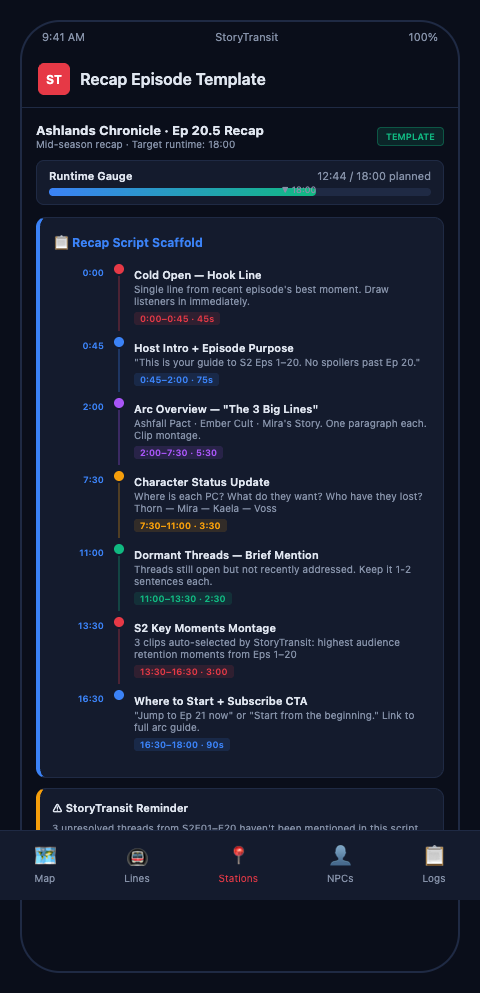
Section 1: The Current System Map (5–8 minutes). Open with the current state of the story. Not the history—the present. Which plot threads are active? Who are the main characters and where do they stand right now? What are the open questions the current arc is building toward? A listener who hears this section should be able to follow episode 61 without any additional context.
Section 2: The Line Origins (8–12 minutes). Walk through each major active thread and give it a brief origin story. Where did the Lord Thadderon conspiracy start? What is the cursed compass and when did it first appear? Keep each origin to two to three minutes maximum. The goal is context, not completeness.
Section 3: The Junction Episodes (3–5 minutes). Name the three to five episodes that carried the most narrative weight—the junction stations where multiple threads crossed. Recommend these as optional context for listeners who want more background. Don't recap them in full; just flag them as worth hearing.
Research on narrative memory in serialized TV confirms that serialized narratives require memory architectures—episodic, semantic, and working—to track arcs across episodes. Your recap episode is the extended version of that cognitive scaffolding, structured to do in 25–30 minutes what a "previously on" segment does in 40 seconds.
Show notes onboarding gives the written complement to this audio structure—the episode description system that supports the recap episode and carries orientation load between recap releases. Mid-season recap covers the specific scripting challenge of recapping without spoiling arc resolutions that are still building.
Practical Production Notes for Recap Episodes
When to release. Two natural trigger points: at the season midpoint, and immediately before a major arc climax. The midpoint recap serves mid-series arrivals who've been in the back catalog. The pre-climax recap serves any listener who's been inconsistent about keeping up. Research shows recapping significantly enhances recall of the gist of prior content—your most invested listeners benefit from the memory reinforcement as much as new arrivals do.
Scripted versus live. Recap episodes almost always work better scripted. The episode's job is orientation—not the organic discovery experience of a live session. A scripted recap moves through the story map efficiently, covers the mandatory orientation beats, and doesn't run long because no one went on a tangent. Twenty-five minutes scripted beats sixty minutes improvised for catch-up purposes. The cast's natural improv energy is what listeners come to actual play for in regular episodes—but in a recap episode, that energy works against efficient orientation. Save it for the story; script the summary.
"Previously on" cold opens versus full recap episodes. These serve fundamentally different needs and both belong in a mature production. The "previously on" segment—30 to 90 seconds at the top of each episode—serves listeners who missed one or two episodes and need a quick sync. The full recap episode serves mid-series arrivals and listeners catching up after an extended gap. Both belong in a mature actual play production workflow. The cold open is the express train; the recap episode is the transit guide.
Not Another D&D Podcast has released 811 episodes across multiple multi-year campaigns, requiring ongoing listener catch-up solutions. NADDPOD's longevity demonstrates that listeners will invest in long-running actual play shows—provided the producer builds the orientation infrastructure to make that investment accessible.
Session recap logs covers the GM-side session summary format that feeds directly into producer-side recap episode scripting. The documentation that GMs use for session continuity and the documentation producers need for recap production are built from the same source material.
The average listener subscribes to seven shows but regularly finishes fewer than a third of episodes. A good recap episode addresses that completion gap directly—it's the catch-up tool that brings a subscriber current without requiring a forty-hour back catalog marathon. StoryTransit gives producers the story map that makes scripting recap episodes fast, accurate, and structurally reliable.
Recap Episode Promotion and Discovery
A recap episode only works for listener catch-up if the right listeners find it. Most producers release a recap and trust the feed to surface it to people who need it. That's not enough. Mid-series listeners who subscribed on episode 47 often don't scroll backward through the feed looking for a recap—they just start listening from where they are and fill in gaps as they go.
Proactive placement changes this. Pin the most recent recap episode at the top of your show page if your hosting platform supports it. Reference it explicitly in the show notes of every episode released after the recap: "Just joined us? Start with our Season 2 catch-up episode linked in the show notes." Make the recap episode title explicitly discoverable—"[Show Name] Season 2 Catch-Up: Everything You Need to Know to Start at Episode 47" performs better in in-app search than a generic "Previously On" title.
Cross-promotion works here too. The recap episode is the content most likely to get shared by existing fans to friends they're trying to recruit. A fan who wants to bring someone into the show after episode 60 doesn't tell them to start from episode one. They share the recap episode. Making that episode as strong as possible serves both the mid-series onboarding function and the word-of-mouth recruitment function simultaneously.
Setting the scene, creating tension, and finding resolution maps directly to effective recap episode structure. A recap episode that applies three-act structure to the season arc—where we started, where the tension peaked and why, where the open questions currently stand—is more listenable than a chronological summary. New listeners get an emotional arc to follow. Returning listeners hear a shaped narrative that makes the back catalog feel coherent in retrospect.
The structural work behind a good recap episode—knowing the active threads, the character positions, the open questions—is exactly the same work that goes into a current-state show notes anchor. When a producer has a functioning story map, scripting a recap episode is an afternoon project. When they don't, it's a week of archaeology. StoryTransit maintains the map that makes recap scripting fast.
For shows releasing on an annual or biannual season cadence, the recap episode is the bridge between seasons. It serves the audience that followed the whole first season but needs a memory refresh before the second season starts. It serves the listener who discovered the show during the hiatus and wants to get oriented before the new season drops. Both audiences benefit from the same structured, transit-map-guided recap format. The recap episode you release between seasons is also one of the highest-performing discovery assets your show will have—listeners who find your show during a hiatus have time to binge, and a clear, well-structured recap is the most efficient possible guide for where to start and what to expect.
Actual play podcast producers who want their recap episodes to function as genuine catch-up tools—not just fan service for existing subscribers—need StoryTransit's arc-mapping infrastructure behind them. Join the Waitlist for Actual Play Producers and build the orientation system your mid-series listeners are looking for.