How Actual Play Producers Write Show Notes That Onboard Mid-Series Listeners
The Show Notes Problem for Mid-Series Listeners
Someone subscribes to your show on episode 52. They read the episode description for episode 53 and see: "The party continues their journey through the Sunless Citadel." That sentence means nothing to them. They don't know who the party is, what the Sunless Citadel is, or why the journey matters. They hit play anyway, get confused during the cold open, and drop off fifteen minutes in.
Your show notes failed them—not the story, not the audio quality, not the cast. The episode summary was written for listeners who were already current, and it offered nothing to anyone joining mid-series.
Listeners who engage with a show listen to 42% more of it; followers listen 50% more than non-followers. The gap between an engaged follower and a lost mid-series subscriber often closes or opens in the episode description. Show notes that give a new listener enough context to stay oriented for the first ten minutes of an episode are show notes that convert late-joining audiences into subscribers.
This isn't about writing longer descriptions. Most platforms truncate after 150–250 characters anyway. It's about writing structurally—layering the episode summary so it serves both current listeners and mid-series arrivals in the same 200-word block.
The Three-Layer Show Notes Format
Producers who successfully onboard mid-series listeners through show notes use a consistent three-layer structure. Each layer serves a different audience need.
Layer 1: The current-state anchor (40–60 words). This is the "story so far" paragraph—a present-tense description of where the main narrative threads stand as of this episode. Not history. Not backstory. Current position. "Lord Thadderon's conspiracy has fractured the party. Kaelith is operating alone following the confrontation in episode 49. The cursed compass is now active for the first time since episode 63." A mid-series listener reads this and has immediate orientation.
Layer 2: The episode summary (60–80 words). This is the standard description: what happens in this specific episode. Written for the listener who already knows the show, this layer tells current subscribers what to expect.
Layer 3: The thread flags (30–50 words). A brief list of which active threads appear in this episode and their status. "Lord Thadderon arc: new revelation about the Sunless Citadel connection. Kaelith arc: first scene with new companions. Dormant thread reactivation: cursed compass." Returning listeners who missed an episode use these flags to assess whether they need to catch up before listening.
Show notes with relevant keywords help people find episodes via search on Google and podcast directories. The thread flag structure also serves discoverability—episode descriptions that name active characters, locations, and plot threads surface more accurately in search.
New listener arcs covers the broader season arc onboarding challenge—show notes are one tool in that system, working alongside episode guides and character cards. Mid-season recap goes into the scripted recap format that complements these written show notes for listeners who prefer audio orientation.
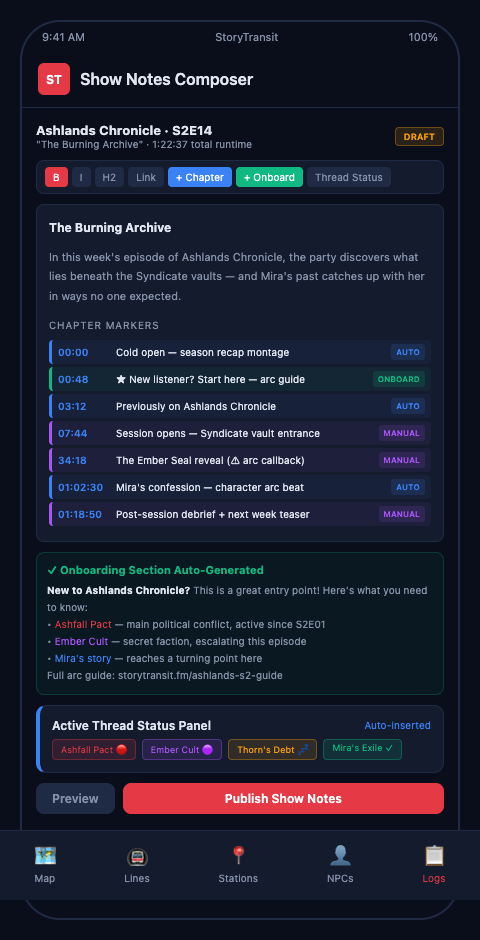
Maintaining the Current-State Anchor at Scale
The current-state anchor is the highest-value element of the three-layer format. It's also the one most producers stop maintaining after three months. The anchor requires knowing the current narrative state of your show with enough precision to write a 50-word summary—which means it depends on a functioning thread tracker.
StoryTransit makes the current-state anchor sustainable by pulling from the living story map. Instead of reconstructing the narrative state from memory each week, the producer opens the map, checks current thread statuses, and writes the anchor from documented positions. The 50-word summary takes five minutes when the map is current. It takes 40 minutes when it isn't.
Podcast apps rose from 16% to 26% as the primary discovery method; listeners search directly in the app for new shows. A late-joining listener who discovers your show through in-app search is going to land on a recent episode, not episode one. What they find in that episode's description determines whether they stay. Consistent current-state anchors mean every entry point in your feed is a viable starting point.
Post recaps engagement in play-by-post forums faces the same structural challenge: the recap needs to serve both the current participant and the newcomer simultaneously. The layered format that works in PbP recaps applies directly to the actual play podcast episode recap.
Narrative podcasts require structured editorial summaries to help listeners enter mid-story without confusion. The three-layer format is that structured summary—built into every episode description from episode one, updated from a living story map, and written at a level of specificity that gives the mid-series listener a real foothold.
One additional tactic that works well for shows past episode 40: a pinned "start here" episode description that lives at the top of your feed or on your show page. This is a standalone entry-point document—not an audio episode, just a text piece—that contains the full current-state summary, a short character glossary, and links to three recommended back-catalog episodes for context. Mid-series listeners who arrive via recommendations or social shares often look for exactly this kind of resource before committing to an episode.
Entertainment and information motives drive podcast engagement; emotional motives most directly affect usage level. The mid-series listener who finds your show through a friend's recommendation is emotionally primed. A clear, current show notes structure converts that emotional readiness into a completed episode listen.
Show Notes for the Back Catalog: Updating What's Already Published
New listener onboarding isn't only a forward-looking problem. Your episode feed contains 87 episodes, and mid-series listeners who follow recommendations or search links often land on episodes from months ago. If those older show notes were written as current-subscriber content—no anchor paragraph, no thread flags—they create the same onboarding barrier as the newest episode.
Retroactive show notes updating is tedious at scale, but a targeted approach makes it manageable. Identify the ten to fifteen episodes in your back catalog that receive the most external traffic—these are the most likely entry points for new listeners. Update those episodes' descriptions with a current-state anchor that reflects where the story stood at the time of that episode, not where it stands now. A listener landing on episode 47 should find show notes that orient them to the episode-47 story state, not the current episode-82 state.
This distinction matters more than it might seem. A mid-series listener who lands on episode 47 via a search or referral is not looking for a summary of where the show stands today. They're looking for enough context to understand what they're about to hear. The episode-47 anchor should describe the story state before that episode's events—which is exactly what the thread tracker from that period would have captured, if it existed.
Serialized shows hook passionate fans who binge; episodic formats serve casual listeners—show notes bridge both. The three-layer format works for binge listeners who start from the back catalog and for casual listeners who subscribe mid-series and follow weekly from a recent episode. The structure is flexible enough to serve both modes.
For shows without a thread tracker that would make retroactive anchors easy to write, a simplified approach works: identify the five "junction episodes"—the episodes where multiple major threads crossed—and give those five episodes the full three-layer treatment. Junction episodes are the ones mid-series listeners most benefit from having oriented show notes, because they carry the most narrative weight per episode and often get recommended as standalone entry points by existing fans.
Listeners who engage with show notes and follow-through materials listen to 42% more of a show—the engagement lift from good show notes isn't marginal. For actual play shows where every additional episode a mid-series listener hears increases the probability they become a long-term subscriber, that engagement differential compounds into meaningful retention impact over time.
The retroactive update work also reveals which episodes in the back catalog need the most support. If a particular episode was a major arc junction—the episode where Lord Thadderon's conspiracy first intersected with Kaelith's personal thread—it deserves more than a minimal description. Junction episodes are the ones worth prioritizing in any retroactive show notes improvement project, because they receive the most referral traffic and carry the highest narrative load per episode for any listener using them as an entry point. Junction episodes become high-traffic referral targets as the show grows. Existing fans recommend them to new listeners. Community discussions link them. Each one becomes an entry point that a well-written, three-layer description can convert into a new long-term subscriber. Every junction episode with weak show notes is a missed conversion opportunity.
Signals from listeners about what helps them navigate a saturated podcast landscape show that curation and editorial context matter. The three-layer format is precisely that editorial context—provided consistently, at every episode, for every listener regardless of when they joined the feed.
Actual play podcast producers who want every episode in their feed to onboard mid-series listeners reliably need StoryTransit's show notes infrastructure. Join the Waitlist for Actual Play Producers and get early access to the tools that make current-state episode summaries sustainable at any feed length.