How to Help New Listeners Follow a Season-Long Actual Play Arc
The 87-Episode Problem
Your show has 87 episodes in the feed. You've built something real: a long-running season arc with six major storylines, two retired PCs, a cursed compass introduced in episode 63, and a cast that has grown into characters your audience genuinely loves. Then someone subscribes on episode 47. They hear Kaelith reference something Lord Thadderon said "back at the Sunless Citadel," and they have no idea what that means.
That listener has two choices: go back to episode one and commit to a forty-hour catch-up marathon, or keep going and hope context fills in. Most choose a third option—they unsubscribe. Serialized shows see a heavy concentration of listeners in early episodes; the first episode remains the primary gateway to the series, which means every new subscriber who lands mid-season is working against the gravitational pull of your back catalog.
The actual play podcast format compounds this. Unlike scripted fiction, your story wasn't planned from the ending backward. It emerged live, at the table, across dozens of sessions. The season arc exists, but it exists in a hundred scattered show notes, a producer's memory, and 87 audio files. There's no structured document that tells a mid-series listener what they need to know to feel oriented.
This is a documentation problem with a producer-side solution. AP producers engage in interconnected processes including community work that supports audience retention—and building onboarding scaffolding is one of the highest-leverage things you can do for long-term growth.
Mapping the Season Arc as a Transit System
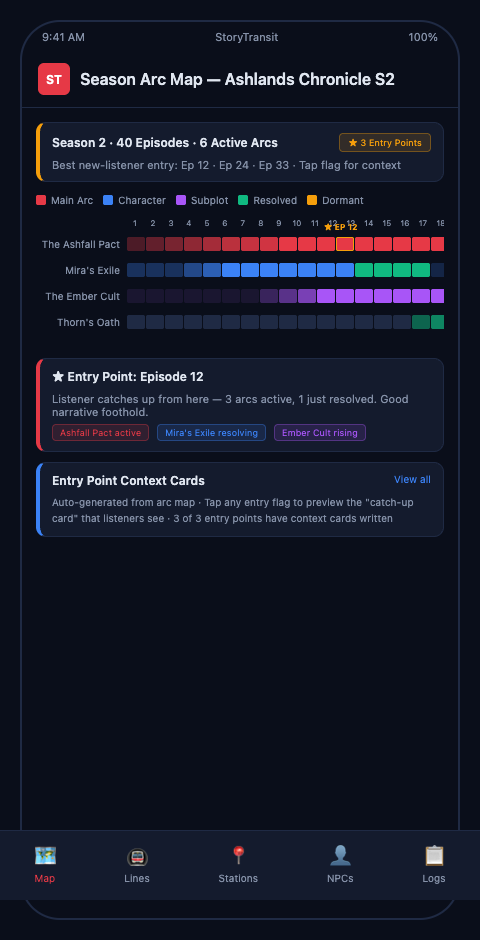
The clearest framework for making a complex season arc accessible is to treat it like a city transit map. Your plot threads become transit lines. Your story beats become stations. Character arcs become named routes with clear origin and destination points. And the subplots that went dormant—the cursed compass, the pact Kaelith made in episode 12—become dormant stops waiting to be reactivated.
When you visualize the season this way, new listener onboarding becomes a question of orientation, not recitation. You don't need to explain every stop on every line. You need to show new listeners which lines are currently active, where the express trains are running, and which stops they're going to hit in the next five episodes.
Start by identifying your three to five primary transit lines for the current story phase. In a show 87 episodes deep, these are probably the threads that have been building since the season's midpoint—the ones your regulars reference in Discord every week. Each line needs a one-sentence description: where it started, what's currently at stake, who's involved.
Next, mark your junction stations—the episodes where two or more lines crossed. The Sunless Citadel arc, wherever Lord Thadderon first appeared, wherever Kaelith's backstory collided with the main plot. These junctions are the episodes worth linking in your episode guide because they carry the most narrative weight for context.
Dividing your feed into seasons and surfacing the latest season by default helps new listener navigation. StoryTransit extends this by giving producers a persistent map layer—one document where all active lines, dormant stops, and junction episodes live together, ready to surface in show notes or a dedicated episode guide page.
The transit metaphor also clarifies what you do not need to provide. A new listener doesn't need to know every stop on the Red Line from episode 1 through 87. They need to know where the Red Line is going and where it's been in the last ten episodes. That's an achievable summary, not an overwhelming archive.
Practical Onboarding Tools Producers Can Deploy Now
A transit map is structural thinking. Here's how it translates into assets your mid-series listeners can actually use.
The entry-point episode guide. Not a full episode list—a curated guide of 8–12 episodes that together form the most efficient path into the current story phase. Think of these as express train routes: a listener who hears these specific episodes arrives at your current feed point with enough context to follow the live threads without feeling lost. Your recap episodes guide covers how to structure these bridge episodes so they work for new listeners without spoiling arc resolutions for veterans.
The persistent "story so far" show note. This is a single paragraph—never more than 150 words—that lives in the show notes of every episode going forward. It describes the current state of the transit map: which lines are active, where the major characters are standing, what the open questions are. A listener who joins on episode 87 reads this paragraph and can follow episode 88 without any back-catalog work. Your show notes onboarding post goes deeper on the format and word-count discipline this section requires.
The character card system. For each active PC and major NPC, maintain a 50-word card: who they are, what they want, what's standing in their way as of the current episode. These cards live in your show notes or episode guide and get updated whenever a major arc beat lands. New listeners use them as a quick reference; long-term listeners love them as a continuity check.
76% of listeners are interested in long-form podcasts with episodes 60 minutes or longer, which means your audience has demonstrated tolerance for investment. The problem isn't that the content is long—it's that entry points are unclear. Structural tools remove that barrier.
Cross-niche thinking helps here too. Mid-campaign onboarding in play-by-post games faces the same orientation challenge—same solution logic applies. A new player joining a running PbP campaign mid-thread needs the same transit map clarity as a new podcast listener joining at episode 47.
The Compounding Return on Onboarding Investment
Onboarding infrastructure pays dividends the longer your show runs. The entry-point episode guide you build today still works when you have 140 episodes in the feed. The "story so far" paragraph you write for episode 88 becomes the template for episode 120. The character cards you maintain now are the raw material for your season-end recap.
Critical Role averages 60,000–75,000 live viewers per episode with total per-episode audiences reaching 1.2–1.5 million across platforms. The show's ability to continuously onboard new listeners into a multi-hundred-episode back catalog is not accidental—it's the product of consistent structural documentation across every episode. StoryTransit gives actual play producers the infrastructure to build that system without a full-time story coordinator.
Every episode you release without a "story so far" anchor is an episode that could have converted a mid-series subscriber into a long-term listener. The transit map approach makes that conversion systematic rather than hopeful.
When to Build These Systems: Before vs. After the Problem
Most producers start thinking about onboarding infrastructure after a subscriber complaint or a noticeable drop in their listener numbers. Building retroactively is harder than building prospectively, but it's still worth doing. The highest-leverage retroactive move is the entry-point episode guide—once you've built it, every future listener has a path in regardless of when they find your show.
For shows in their first 20 episodes, the investment is even simpler. The season arc hasn't fully developed yet, which means the transit map has fewer lines to document. The "story so far" paragraph is short because the story is short. The character cards are easy to write because the arcs are early-stage. Building these tools at episode 10 costs a fraction of what it would cost to build them at episode 80.
The actual play genre emerged with Critical Role in 2015 and is now credited with bringing tens of thousands of new players to the hobby. The genre's growth means the competition for mid-series listeners has never been higher. Producers who offer the clearest onboarding path will capture a disproportionate share of the listeners who are actively looking for a show to commit to.
The "story so far" infrastructure also serves your cast and production team. A producer who keeps a current transit map doesn't just help listeners—they help the editor who wasn't in the room when episode 34 was recorded, the social media manager who needs to write accurate episode previews, and the GM who wants to reference what was established in episode 22 before prepping episode 78.
The entry-point episode guide also serves a function that most producers don't anticipate: it becomes the natural source material for promotional content. A show that can articulate which eight episodes give a new listener the essential arc context can use that guide in social media outreach, in community recommendations, and in creator-to-creator recommendations at conventions or collaborative projects. The guide isn't just an onboarding tool—it's a shareable pitch for the show's story.
Serialized podcasts demand a commitment to a cohesive narrative unfolding across multiple episodes. That cohesion doesn't maintain itself. It's the product of consistent documentation work by the production team—and StoryTransit is built to make that work sustainable for actual play shows running on live, unscripted content.
StoryTransit is purpose-built for actual play podcast producers managing long-running season arcs. Join the Waitlist for Actual Play Producers and get early access to the thread-mapping tools that turn your 87-episode archive into a navigable system. The tools are built around how AP shows actually grow—live, unscripted, and one episode at a time.