Mid-Season Recap Scripting Without Spoiling Future Episodes
Why Mid-Season Recap Scripting Is Harder Than It Looks
The instinct when writing a recap is to summarize everything that happened. That instinct, left unchecked, produces a spoiler document dressed up as a catch-up episode. Every line that explains where a character ended up reveals something about the arc's trajectory. Every summary of resolved tension confirms which threads closed and which didn't — and an informed listener can infer from what you don't mention what's coming next.
Spoilers measurably reduce TV episode enjoyment, and spoiler type and placement significantly affect audience enjoyment. For a serialized actual play podcast, the mid-season point is particularly sensitive: you're far enough in that there are genuine stakes and momentum, but far enough from the end that the second half's resolutions are still intact. A carelessly written recap can effectively spoil its own show.
The practical difficulty is that the writer of the recap — often the producer — knows too much. They've been in every session, they know where the arcs are heading, and the temptation to write toward the payoff rather than away from it is constant. Spoiler-free scripting requires active restraint, not just good intentions.
There's also a secondary problem: selective recall. A producer who has lived with the story through every session will naturally emphasize the threads that feel most significant to them — often the ones approaching resolution. From a listener's perspective, giving extra weight in the recap to threads that are about to resolve is effectively a spoiler for which arcs are "winning" the season. Balanced recap writing means giving airtime proportional to arc importance in the first half, not arc importance in the GM's plans for the second. Spoiler avoidance in the mid-season arc recap is a discipline problem as much as a writing problem — the season midpoint is where the producer's advance knowledge creates the most risk of telegraphing what the audience hasn't heard yet.
The Recap Map: What to Include and What to Hold
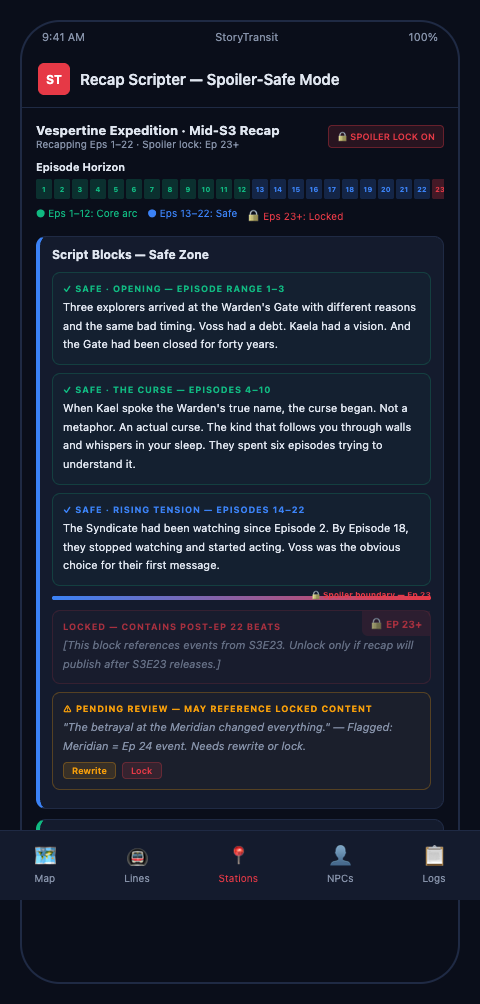
StoryTransit's approach to recap scripting treats the mid-season episode as a transit system map for listeners who may have missed some stops. The goal is to show them the lines that are running, the stations they've passed through, and the general direction of travel — without revealing which terminus each line is headed to.
The recap map has three zones.
Zone 1: Established history (safe to include). Anything that resolved before the midpoint is fair game. Arcs that closed, plot questions that were answered, character moments that have no future bearing. These form the backdrop — they give mid-series listeners context without creating forward-facing spoilers. The Sunless Citadel expedition that wrapped in episode eight. The misunderstanding between the party and the merchant guild that got resolved. These are anchoring facts that orient the listener without pointing toward the future.
Zone 2: Active threads (include the setup, not the trajectory). Live arcs need to appear in the recap because they're the reason listeners should care about the second half. But the script should establish what the thread is and why it matters, not where it's heading. The cursed compass is a mystery worth caring about. That it will turn out to be connected to Lord Thadderon's family line is not something the recap should hint at. Describe the thread's present state, not its resolution state.
Zone 3: Dormant threads (flag without resolution context). Arcs that have gone quiet deserve a mention — they signal to attentive listeners that something is coming. But the phrasing needs to treat them as open questions, not setup for a reveal. "The compass hasn't come up since episode six, which feels deliberate" is safe. "The compass is going to matter soon" is not. Dormant threads flagged in the recap also serve a production function: they remind the GM what's still live and may accelerate reactivation planning for the second half.
Mid-season recap episodes can re-engage lapsed listeners without revealing future arc resolutions. Apple recommends recap and trailer episodes to help new listeners catch up in serialized podcast feeds. Both recommendations assume the recap is spoiler-safe — which requires intentional scripting, not just good memory.
Scripting Techniques for Spoiler-Free Recaps
The zone structure defines what to include. The following techniques govern how to write it.
Anchor to emotion, not outcome. Instead of describing what happened, describe how characters felt and what was at stake. Emotional stakes survive into the second half without spoiling it. A scene recap that says "Kaelith faced the hardest choice she'd made in the campaign" creates anticipation without revealing what she chose or whether it mattered. The emotional resonance carries forward; the plot detail is held.
Use questions as forward momentum. The end of a mid-season recap should leave listeners with open questions, not summaries. "What does the compass actually do?" is a better closing note than "The compass mystery remains unsolved." Questions create pull; summaries create closure, even premature closure. The goal is to send the listener back into the episode feed wanting to find out, not feeling like they already have a map of where things are going.
Avoid relative language for unresolved arcs. Phrases like "so far" and "up until now" signal that a resolution is coming. For live threads, write in a way that treats the current state as the permanent state — even if you know it isn't. This keeps the script from accidentally signaling future beats. "Lord Thadderon is the party's primary adversary" is neutral. "Lord Thadderon has been the party's primary adversary up until this point" signals a change.
Time-box the episode summary depth. Effective podcast episode summaries recap past events without telegraphing unresolved threads or future payoffs. For a mid-season recap, a useful rule is: go deep enough on resolved arcs that the listener understands the world, but summarize live arcs in a single sentence that names the thread without characterizing its direction. The disproportion is intentional — resolved arcs can sustain detail because they don't create spoiler risk.
The spoiler audit pass. Before the recap airs, run a dedicated spoiler audit: read every sentence about a live thread and ask "does this confirm, hint at, or logically imply how this arc resolves?" If yes, revise. This is a distinct pass from the normal proofread — its purpose is finding forward-facing information that slipped in under the radar, not grammar or clarity.
The mid-season recap connects to two broader producer skills. Season three onboarding covers how to handle later-entry listeners who arrive not at the midpoint but at a full season break — the arc presentation challenges overlap significantly. For producers earlier in their recap practice, the recap episodes guide covers the fundamentals of recap structure that the mid-season spoiler problem builds on. The challenge of writing around unresolved arcs also appears in serialized written formats — slow-burn arcs from the play-by-post world covers how to maintain tension in long arcs without telegraphing resolution.
The Recap as a Subscriber Retention Tool
A well-executed mid-season recap does more than catch up new listeners — it re-engages subscribers who've fallen behind, gives lapsed listeners a reentry point, and signals to the audience that the show's production quality extends to how it manages its own story.
Structural hooks and content checkpoints placed mid-season reduce listener dropout. A spoiler-free recap is one of the most efficient checkpoints available because it serves multiple audience segments simultaneously: the binger who wants a refresher, the casual listener who missed a few episodes, and the new subscriber who found the show at episode 14. All three get value from the same episode without any of them being spoiled for what's ahead.
The recap also functions as a show notes anchor in the episode feed — a mid-catalog episode that new subscribers can use as a starting point before committing to the full back catalog. A recap episode placed strategically in the feed converts browsers into committed listeners more reliably than any cold-entry episode because it explicitly demonstrates the show's narrative depth without requiring thirty episodes of context.
There's a production discipline benefit too. Writing the mid-season recap forces the producer to assess the season's arc landscape in a structured way: what has been established, what is still active, what has been promised. This assessment often surfaces issues — an arc that was introduced and then functionally forgotten, a promise that was implied but never stated clearly enough to satisfy the audience, a dormant thread that needs reactivation before the season ends. The recap is both an audience-facing product and an internal audit. Shows that write it thoughtfully end up with a cleaner second half.
The script itself benefits from StoryTransit's zone structure. A producer who can pull the current arc status dashboard — active threads, stalled threads, dormant threads — has the structural raw material for the recap script already organized. Zone 1 (established history) maps to the archive; Zone 2 (active threads) maps to the active arc list; Zone 3 (dormant threads) maps to the dormant arc list. The recap practically writes itself from the dashboard — except for the spoiler-safe language, which is where the scripting technique described above does its work.
Actual play podcast producers on the waitlist get access to the mid-season recap template and the spoiler audit checklist. Join the Waitlist for Actual Play Producers and give your second half the re-entry ramp it deserves.